The Hidden Persuaders
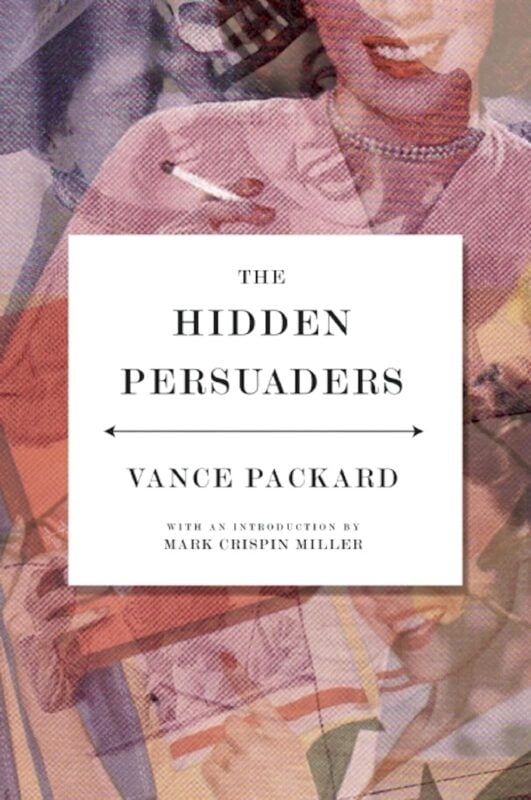
The Hidden Persuaders by Vance Packard reveals the use of psychological techniques in modern advertising to manipulate consumer behavior beneath conscious awareness. Through the lens of postwar consumer culture, Packard investigates how marketing industries deploy insights from psychoanalysis and behavioral science to engineer public desires and choices.
The Depth Approach and Its Strategic Deployment
Advertisers engage psychologists to excavate unconscious fears, desires, and anxieties. They do not merely inform consumers; they reframe products as answers to hidden emotional needs. Packard calls this the “depth approach,” where persuasion operates below the threshold of awareness. These strategies use motivation research to shape perceptions and predict responses without relying on declared preferences or conscious reasoning.
Corporations integrate symbolic cues into product design and messaging to trigger subconscious associations. A soap promises purity, a car signals power, a brand becomes an identity. These associations emerge from extensive psychological profiling that guides advertising decisions. Marketers discover, for example, that men buy cigars to affirm dominance, women seek beauty products as shields against insecurity, and children respond to rhythm and sound rather than claims of health.
Manipulating Consumers Through Emotional Engineering
Packard shows how advertisers segment audiences by emotional disposition. High-anxiety consumers receive comfort appeals, while status seekers encounter symbols of exclusivity. Agencies test responses in controlled environments, analyzing subconscious reactions to colors, sounds, shapes, and slogans. Results influence every element of a campaign—from packaging design to celebrity endorsements to store layout.
This method of psychological targeting accelerates consumption. Products cease to solve practical problems and instead fulfill emotional yearnings. A toothpaste may clean teeth, but its advertising appeals to sexual attractiveness. A car ad presents power, liberation, or social belonging. Consumers, conditioned by repeated symbolic appeals, make purchases that mirror identity aspirations rather than functional need.
Political Messaging and the Theater of Consent
The same techniques shift into political domains. Candidates become brands, crafted and sold with the same psychological tools used in commerce. Image supersedes policy. Packard highlights how postwar politicians rely on public relations experts trained in commercial persuasion. Campaigns aim not to inform but to soothe fears, reinforce tribal loyalties, and signal strength.
Televised debates, focus groups, and emotional trigger words replace substantive argument. Voters, targeted as demographic composites, receive tailored messages designed to affirm existing biases. Manipulation takes the form of positive reinforcement and selective storytelling. Political discourse becomes marketing theatre, scripted to simulate consent while engineering outcomes.
Psychological Profiling in Corporate and Social Institutions
Corporations expand psychological manipulation beyond customers. Packard details how internal management practices incorporate psychiatric techniques to mold employee behavior. Staff undergo personality tests to assess conformity, ambition, or passivity. Employers select, promote, or redirect personnel based on profiles optimized for loyalty and performance.
Education systems, churches, and social organizations adopt these tools. Clergy attend workshops on motivational psychology to craft sermons that stimulate guilt, hope, or awe. Schools design curricula around the emotional responsiveness of students. Social engineering becomes a management science, practiced not only by advertisers but also by community leaders, urban planners, and cultural institutions.
The Industrialization of Influence
Advertising evolves into a coordinated system of influence, linking mass media, corporate research, and psychological expertise. Agencies invest heavily in consumer laboratories, where hidden cameras, biometric sensors, and controlled environments track involuntary responses. Psychologists script test scenarios, observing micro-reactions to variations in tone, lighting, or phrasing.
Data flows from test subjects into predictive models. Analysts identify which images inspire trust, which colors signal freshness, and which rhythms trigger nostalgia. This feedback loop produces campaigns calibrated for psychological efficiency. Influence becomes quantifiable, repeatable, and scalable. As a result, persuasion ceases to be a craft and becomes an industry.
Hidden Appeals and the Erasure of Rational Choice
Consumers imagine themselves as rational actors, making decisions based on comparison, cost, and need. Packard dismantles this illusion. He reveals that many decisions are shaped by unconscious forces triggered through hidden appeals. A color scheme alters perception of quality. A slogan evokes a childhood memory. A celebrity smile generates identification.
This manipulation does not rely on deception. It circumvents reasoning altogether. Advertisements do not ask questions; they imply solutions. Products become emotional props, purchased to alleviate status anxiety, mask inadequacy, or display virtue. As emotional dependency replaces deliberation, the space for reasoned choice shrinks.
Vulnerability and the Ethics of Persuasion
Packard questions the ethical basis of these methods. Manipulation exploits emotional vulnerabilities—loneliness, fear, insecurity—not to heal but to monetize. Children become targets through animation, jingle repetition, and peer influence. The elderly are offered false promises of vitality. Women are told they can erase age or shame with beauty creams. Men are promised dominance through car ownership.
These tactics do not inform. They trespass. Packard argues that such psychological intrusions threaten the autonomy of the individual. The right to mental privacy—the capacity to form preferences free from external shaping—erodes. As commercial goals drive emotional engineering, human dignity becomes secondary to market efficiency.
Corporate Self-Justification and Industry Denial
Industry leaders dismiss Packard’s claims as sensational or unfounded. They insist advertising merely reflects consumer demand. Trade journals ridicule Packard, calling his book propaganda disguised as inquiry. Executives publish counter-analyses asserting that persuasion remains ineffective without quality products or voluntary choice.
Yet these denials reveal the book’s impact. The intensity of backlash shows that Packard struck at foundational practices. By exposing the concealed structure of influence, he challenged the legitimacy of mass marketing. His critics feared not factual inaccuracy but perceptual shift. If consumers began to question the integrity of their choices, the economic consequences would ripple.
Cultural Reception and Lasting Influence
The Hidden Persuaders triggered public debate across media, education, and politics. It inspired skepticism toward advertising, motivated regulatory proposals, and encouraged academic exploration of media effects. Filmmakers began depicting ad executives as morally ambiguous or manipulative. Cultural critiques drew upon Packard’s insights to analyze consumerism, conformity, and mass culture.
Subsequent generations of media scholars and activists adopted his framework. Terms like “media literacy,” “consumer awareness,” and “psychographic targeting” emerged from the intellectual soil he cultivated. Though marketing strategies evolved, the central concern he raised—how to preserve human agency under systemic persuasion—remains urgent.
A Blueprint of Consumer Vulnerability
Packard offers a map of how persuasion operates when directed toward the unconscious. He identifies the actors, methods, and goals of an industry designed to shape desire. His argument compels readers to examine how choices form, why they persist, and when they collapse under pressure. What happens when the means of persuasion render resistance invisible?
The book poses a challenge to the foundational assumption of liberal democracies: that individuals govern themselves through informed consent. If consent results from hidden manipulation, if choices follow scripts written by those who profit from them, then the project of freedom faces structural sabotage. Packard’s work remains a vital guide for recognizing the mechanisms of influence and reclaiming the space for self-direction.