Runaway: Gregory Bateson, the Double Bind, and the Rise of Ecological Consciousness
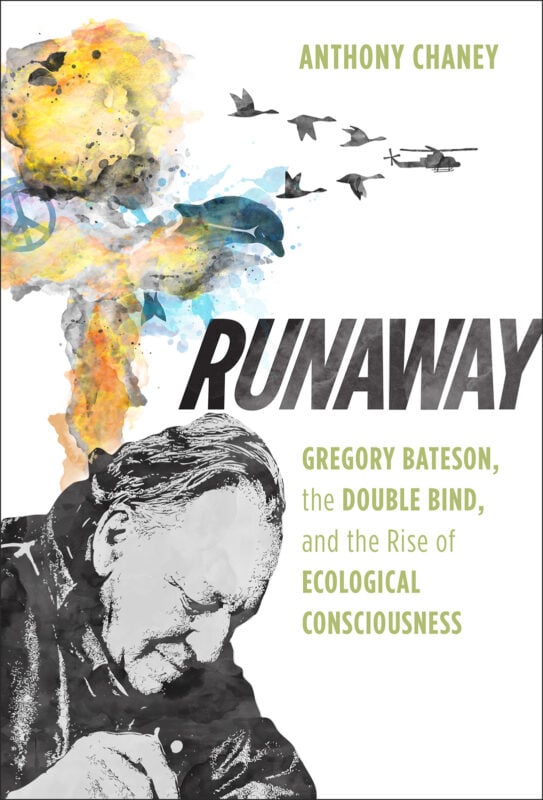
Runaway: Gregory Bateson, the Double Bind, and the Rise of Ecological Consciousness by Anthony Chaney anchors Bateson’s ideas at the core of ecological and epistemological transformation during the twentieth century. Chaney structures the narrative around the convergence of Bateson’s theories and the cultural ruptures of the 1960s, especially the crisis of modernity and the limits of instrumental reason.
London, 1967: A Moment of Fracture
At the Congress on the Dialectics of Liberation, Gregory Bateson introduced the concept of ecological runaway to an audience brimming with revolutionaries and visionaries. His description of the greenhouse effect reframed environmental crisis as a systemic feedback failure. The concept of runaway—a condition where reinforcing loops spiral beyond equilibrium—forced a reevaluation of how human systems relate to their environments.
Allen Ginsberg responded with existential clarity. He saw in Bateson’s analysis a new form of apocalypse, slower than nuclear war, distributed through time and space. What kind of consciousness responds to a future shaped by systemic overshoot? Bateson proposed a form of thought capable of seeing the world in loops, dependencies, and patterns. This reconfiguration began to unsettle the scaffolding of control-based knowledge.
The Double Bind: Communication as Constraint
Bateson developed the double bind theory while studying communication patterns in families affected by schizophrenia. He identified a structure in which contradictory messages trap the recipient, paralyzing choice and distorting identity. “Obey me by disobeying me” imposes a logic that dissolves clarity. Bateson saw this logic reflected in political structures, institutional norms, and ecological interventions.
The double bind exists where systems compel contradictory imperatives. Growth demands consumption. Survival demands conservation. These imperatives interlock without exit. The structure generates paralysis, confusion, and reactive escalation. Bateson treated the double bind not as dysfunction but as diagnostic. It reveals where systems have turned back on themselves.
Cybernetics and the Language of Feedback
In the Macy Conferences on Cybernetics, Bateson absorbed the grammar of feedback systems. He applied cybernetic insight across fields, tracing how information circulates in self-correcting loops. A system regulates itself through negative feedback. A system destabilizes through positive feedback. Industrial civilization accelerates its own entropy through feedback loops that lack counterbalancing restraints.
This insight changes the role of science. Prediction shifts from linear causation to recursive patterning. Control gives way to observation. The scientist becomes a participant within the system, not its master. Bateson refused separation between subject and field. He traced mind through the interactions that maintain coherence across biological and social systems.
Ecological Epistemology: Mind in the System
Ecological consciousness reorders perception around interrelationship. Bateson rejected substance-based metaphysics. He defined reality through the dance of differences that make a difference. He located intelligence in the flow of messages across boundaries—between neurons, between organisms, between species and their environments.
This epistemology eliminates the illusion of externality. No observer stands outside the system. No intervention occurs without feedback. Actions ricochet through the ecology of mind, altering the field of action itself. Chaney presents this as a decisive rupture. Bateson’s thought generates an epistemological frame where dependence supersedes autonomy and pattern recognition replaces dominance.
Schismogenesis and the Dynamics of Division
Bateson’s fieldwork among the Iatmul of New Guinea produced the concept of schismogenesis. Social systems, like ecological systems, fragment under pressure. Competition and submission escalate reciprocally. Interactions create divergence. In tribal societies, rituals like naven function to diffuse tension and restore systemic coherence.
Schismogenesis reveals that relational patterns create cultural form. Conflict and cohesion emerge from feedback dynamics, not essential traits. Bateson translated this principle into the analysis of modern institutions. He saw in bureaucracies, militaries, and markets the same loop structures, scaled to the complexity of global civilization.
Behaviorism, Control, and the Limits of Design
While observing dolphins in Hawaii, Bateson clashed with behaviorist models that framed learning as stimulus-response conditioning. He challenged B.F. Skinner’s theory at its core. Operant conditioning designs behavior through reinforcement. Bateson asked a deeper question: what world does this design presume?
He answered with a critique of control-based science. Control presumes predictability. Predictability presumes linearity. Linear assumptions falter in complex systems. Bateson sought science adequate to recursive causality, where effects circle back into causes and patterns emerge from interaction, not command.
Modernity and Its Epistemological Exhaustion
Chaney locates Bateson’s thought at the inflection point of modernity’s collapse. The Western mind split subject from object, meaning from mechanism. Scientific rationalism advanced by partitioning value from fact. Bateson diagnosed this partition as maladaptive. He proposed an epistemology where values arise from systemic fitness, not transcendental decree.
The ecological crisis exposes the failure of dualistic thinking. The modern dream of mastery—over nature, over the body, over the future—unravels in the face of feedback loops too vast to govern. Bateson framed this failure as a problem of epistemology, not morality. The patterns of perception themselves generate instability.
Pattern, Relationship, and the New Real
Bateson replaced explanation with description. He searched for patterns that connected, not causal arrows that isolated. The unit of survival is not the organism or the society. It is the organism-in-its-environment. He saw survival as a property of relationships. What kind of learning preserves those relationships? He called it deutero-learning—learning about learning. Systems adapt by adjusting the rules of adaptation.
This mode of inquiry redefines intelligence. Intelligence emerges through sensitivity to feedback, through responsiveness to the signals of disintegration. Bateson called for a humility grounded in complexity, a reverence for systems that exceed comprehension.
The Apocalyptic Encounter and the Ethical Turn
Ginsberg’s encounter with Bateson’s ecological frame reshaped his moral horizon. He faced the reality that human activity, aggregated and automated, had become geophysical force. The apocalypse arrived through circuits of consumption and systems of extraction. Ginsberg asked what remains when meaning dissolves in planetary feedback.
Chaney captures the ethical gravity of this confrontation. Ecological thought does not prescribe action. It reconfigures the actor. The ethical task becomes perceptual: to see the patterns, to enter into relationship with their rhythms, to inhabit the space where action responds to form.
Bateson’s Relevance and the Path Forward
Bateson’s ideas seeded entire disciplines—family therapy, systems theory, environmental humanities. He trained no school, founded no doctrine. His work resists codification. Chaney positions Bateson as a hinge figure, whose thought turns inquiry toward complexity, relationality, and ecological depth.
Runaway concludes on the edge of catastrophe, where feedback accelerates and control disintegrates. Bateson’s voice enters this space with calm precision. He maps the error. He invites a new logic. The question he poses remains open: what must change in our perception for life to continue in the systems we have set in motion?