Prisoner of Infinity: Social Engineering, UFOs, and the Psychology of Fragmentation
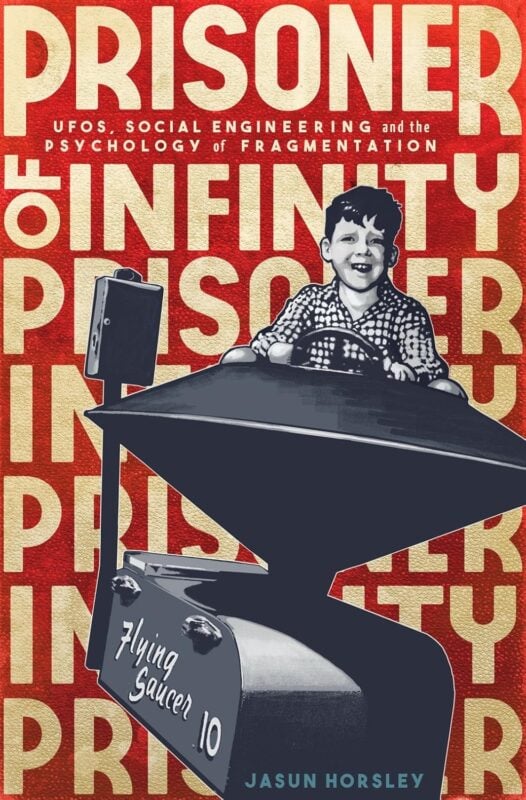
Prisoner of Infinity: Social Engineering, UFOs, and the Psychology of Fragmentation by Jasun Horsley investigates the collision of UFO phenomena, social engineering, trauma, and the manufacturing of belief. Horsley constructs an inquiry into how narratives form, why individuals accept them, and the stakes for both society and the self. The book offers a synthesis of psychology, biography, history, and cultural critique, grounded in the extraordinary life and work of Whitley Strieber, whose alien abduction narratives catalyzed both public fascination and personal transformation.
Unraveling Strieber’s Journey
Whitley Strieber, born in 1945 in San Antonio, entered the public imagination through horror fiction such as The Wolfen and The Hunger before pivoting to nonfiction with Communion. This 1987 account of his alleged alien abduction experiences triggered a cultural storm, selling over a million copies and giving rise to a legion of followers and skeptics. Strieber’s journey traverses Catholic education, a career in advertising, and immersion in mystical and esoteric study. The trajectory of his work offers more than mere spectacle; it becomes a case study in the convergence of trauma, the supernatural, and narrative construction.
Mapping the Psychology of Belief
Horsley frames Strieber’s experiences within a psychological architecture that links trauma, dissociation, and visionary encounters. The author positions childhood trauma—not merely as background noise, but as the structural engine driving both the need for extraordinary experience and the form that experience takes. When psychic wounds arise from separation, loss, or abuse, the mind does not only defend; it generates narratives that simultaneously protect and reveal. The impulse to seek meaning in abduction, mystical union, or otherworldly intervention emerges from these fissures. Horsley demonstrates that the abduction experience does not simply reflect an outer event. It enacts an inner crisis, articulated in mythic form.
The Cultural Logic of UFOs
The book claims that UFOs operate as cultural fictions—crucial fictions—whose function extends beyond literal interpretation. Through the lens of Carl Jung, Jacques Vallee, and other thinkers, Horsley observes that the iconography of the UFO mirrors both collective hopes and psychic distress. The mid-20th century explosion of flying saucers, abduction tales, and cosmic anxieties coincides with technological and social transformation. The UFO’s persistence owes to its plasticity; it adapts to the needs and fears of each era. Horsley identifies the convergence of science fiction, Cold War paranoia, and the breakdown of religious authority as fertile ground for the UFO’s ascendancy.
Social Engineering and the Changing Images of Man
At the intersection of personal psychology and collective control, Horsley explores the impact of intentional social engineering. He details the Stanford Research Institute’s 1973 report, Changing Images of Man, as a blueprint for managing cultural evolution. The report argues that traditional religious and ethical systems can no longer satisfy the demands of a technologically advanced, capitalist society. By seeding new spiritual paradigms—drawing on Freemasonry, New Age movements, and altered states of consciousness—the architects of culture harness and redirect desire, loyalty, and work ethic toward sustaining the established order. Horsley interprets the UFO narrative as one manifestation of this broader program. Through abstraction and myth, the machinery of belief enables population management, psychological manipulation, and the perpetuation of elite power.
Trauma, Dissociation, and Mystical Experience
Horsley links the capacity for visionary experience directly to trauma-induced dissociation. He draws on psychoanalytic theory, notably the work of Donald Kalsched and Norman O. Brown, to show how overwhelming childhood experiences create “archetypal traumatogenic agencies”—autonomous psychic forces that both defend and imprison. These forces may assume the guise of angels, aliens, or higher intelligences, but their roots remain in psychic fragmentation. Mystical union, in this schema, emerges as both a compensation for and reenactment of the original wound. Horsley argues that the person who seeks transcendence often seeks first to escape the intolerable. When the psyche cannot integrate its pain, it generates a “self-care system” that simultaneously protects from and perpetuates suffering, often through visionary narratives or mystical experiences.
Eroticism, Eros, and the Splitting of the Psyche
The book exposes a persistent cleavage in Western spirituality: the severing of eros from spirit. Horsley details how religious and social authorities encourage the sublimation, repression, or redirection of erotic energy, casting bodily desire as antithetical to spiritual realization. This separation cultivates both psychic vulnerability and social malleability. Denied healthy outlets, libido seeks substitute expressions in ritual, ideology, or deviant behavior. Horsley contends that de-eroticized spirituality leaves the subject susceptible to external manipulation, inner division, and compulsive myth-making. When eros cannot find embodiment, it returns as a haunting, splitting the psyche and compelling the search for union in otherworldly encounter.
Transhumanism, Technology, and the Escape from the Body
Prisoner of Infinity draws connections between ancient spiritual longing and contemporary technological ambition. The narrative of alien contact and abduction resonates with the dreams of transhumanists—those who seek to transcend the biological body, upload consciousness, and achieve immortality through machines. Horsley shows that this ambition recapitulates the earliest psychic wound: the loss of unity, the longing for the mother, the desire to escape finitude. The technological singularity and the fantasy of ascension both offer release from the limitations of embodiment. These projects, when pursued without integration of the body and psyche, merely perpetuate the cycle of escape and loss.
The Politics of Narrative
Narratives shape reality not only by describing but by prescribing. Horsley asserts that the stories societies tell—about aliens, abductions, saviors, and enemies—generate frameworks for action, governance, and control. When authorities propagate mythologies that obscure the origins of distress, they reinforce dependence and distract from genuine inquiry. The proliferation of abduction accounts, conspiracy theories, and mystical revelations coincides with efforts to manage dissent, pacify the populace, and redirect existential anxiety away from systemic critique. In this sense, the UFO functions as a “strange attractor,” pulling seekers ever deeper into the labyrinth of narrative, away from material or political transformation.
Whitley Strieber’s Role as Case Study
Through detailed biographical analysis, Horsley uses Strieber as a prism for understanding the interface between individual psychology and collective narrative. Strieber’s self-disclosures—accounts of abuse, family dynamics, artistic struggle, and transcendent encounters—demonstrate how the personal and the cultural intertwine. His shifting relationship to belief, authority, and his own memories illuminates the challenges of discerning the real from the imagined. Horsley’s investigation raises pressing questions: What do we gain from believing in extraordinary narratives? How do such stories serve to integrate—or disintegrate—the self? What incentives operate behind the propagation of certain mythologies?
Intersecting with Conspiracy, Ritual, and Power
The book explores the connections between abduction phenomena and documented programs of psychological manipulation, such as MKULTRA. Through archival research and theoretical synthesis, Horsley situates the UFO narrative within a history of mind control, ritual abuse, and covert social experimentation. He shows that the stories people adopt often intersect with the intentions and operations of institutions wielding significant influence. When visionary experiences dovetail with political agendas, the subject may become both witness and participant in a grander scheme.
The Embodied Psyche and the Path to Integration
Throughout, Horsley returns to the body as the locus of both injury and healing. Genuine integration, he argues, depends on confronting trauma directly, reclaiming embodied eros, and discerning the ways in which both individual and collective narratives arise from the interaction of psyche and soma. Seeking wholeness requires self-examination, the willingness to doubt inherited stories, and the courage to inhabit discomfort without recourse to dissociative escape. The encounter with the unknown—whether alien, mystical, or traumatic—becomes an invitation to recognize the constructedness of narrative and the centrality of embodiment in any real solution.
Reframing the Mystery
Prisoner of Infinity resists simple answers. Horsley’s synthesis establishes that the enigma of the UFO endures because it fulfills multiple psychic, social, and political functions. The mystery persists because it originates at the confluence of real trauma, psychological defense, social engineering, and the perennial quest for transcendence. When people pursue the unknown, they pursue themselves, their wounds, and their longing for unity. The UFO, as symbol and experience, operates within the grammar of the human condition, encoding the struggle for meaning, autonomy, and integration.
The Work of Self-Reflection
By embedding his own autobiography within the larger narrative, Horsley models a methodology of inquiry that privileges self-reflection. He challenges readers to recognize the reflexivity inherent in all investigation: The observer shapes what is observed. The desire to solve mysteries external to the self reflects, at its core, the desire to resolve inner division. Genuine understanding emerges when people acknowledge their complicity in belief, their vulnerability to narrative, and their power to choose which stories to inhabit.
Implications for the Future
The book closes with an invitation to move beyond inherited narratives and scripted roles. Horsley calls for a new engagement with both the personal and the collective unconscious—a conscious participation in myth-making, grounded in honesty, humility, and embodied presence. The capacity to question, revise, and release stories that no longer serve fosters resilience and autonomy. In the era of accelerating technological change, proliferating media, and profound existential uncertainty, the imperative to discern the origins, functions, and consequences of narrative becomes ever more urgent.
Search Engine Summary
Prisoner of Infinity by Jasun Horsley examines how UFO abduction experiences, trauma, social engineering, and cultural narratives shape belief and identity. The book uses Whitley Strieber’s life as a case study to reveal how childhood trauma, psychological defense, and myth-making converge. Horsley analyzes the role of social engineering projects like Changing Images of Man, exposing links between spiritual movements, transhumanist ambitions, and population control. The book draws on Jungian and psychoanalytic theory to connect trauma, dissociation, and mystical experience, critiquing the Western split between body and spirit. Horsley integrates autobiography with research, advocating self-reflection as the path to integration. Prisoner of Infinity delivers a definitive, in-depth exploration of the psychological, political, and spiritual dimensions behind UFO narratives and the wider mystery of human belief.