9/11 Explained to the FBI: The Arnon Milchan Hypothesis
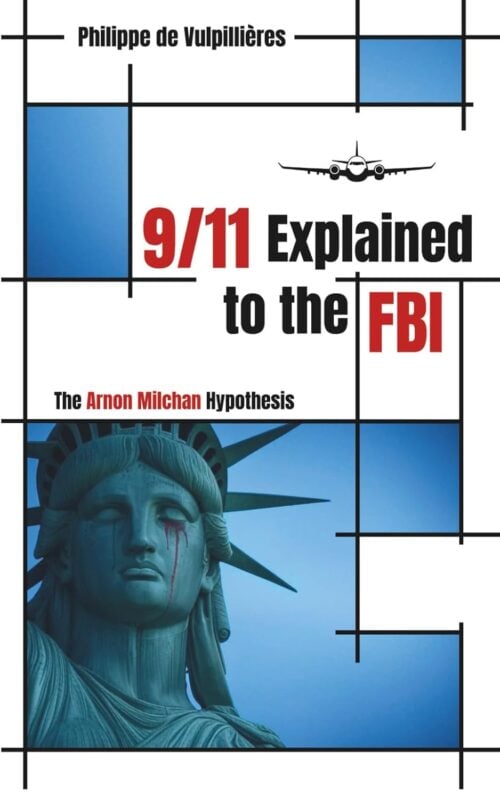
9/11 Explained to the FBI: The Arnon Milchan Hypothesis by Philippe de Vulpillières argues that Israeli intelligence operative, arms dealer, billionaire, and Hollywood producer Arnon Milchan conceived and directed the September 11, 2001 attacks as a false-flag operation that advanced Israeli strategic goals, empowered American neoconservatives, and opened a global war against designated terrorist states. Vulpillières constructs his case through the collapse of World Trade Center Building 7, Israeli intelligence activity inside the United States, the Project for the New American Century, Milchan’s clandestine work for Israel’s Lekem intelligence bureau, and the alleged Aesopian coding of the 2001 film Swordfish.
The Citadel of Forbidden Questions
Vulpillières begins with WTC 7, the 47-story building that collapsed during the afternoon of September 11 after suffering fires and damage from debris. He cites Architects & Engineers for 9/11 Truth and Richard Gage, whose organization attributed the building’s symmetrical descent to controlled demolition. That interpretation defines the book’s starting premise: professionals gained access to the World Trade Center, prepared the buildings, concealed explosives, and coordinated their destruction.
The author also challenges the official account of American Airlines Flight 77 through statements attributed to veteran pilot Russ Wittenberg. He treats the Pentagon’s damaged façade, the aircraft’s reported descent, and its final maneuver as evidence against the accepted flight narrative. General Leonid Ivashov supplies the book’s operational framework by arguing that an attack of this complexity required state intelligence resources, professional planners, extensive financing, and Arab operatives who could serve as visible scapegoats.
Vulpillières adopts Webster G. Tarpley’s three-part model of patsies, moles, and professionals. Patsies receive the blame. Moles inside government agencies obstruct warnings, redirect investigations, and secure the chosen narrative. Professionals execute the operation, manage its technical demands, and remove vulnerable participants. This structure allows the author to place the alleged Arab hijackers, compromised American officials, and Israeli operatives within distinct layers of one coordinated enterprise.
Anthrax, PNAC, and the War Agenda
The October 2001 anthrax attacks form an extension of the September operation in Vulpillières’s account. Letters containing the phrases “Death to America,” “Death to Israel,” and “Allah is great” strengthened the public association between the attacks and Islamic terrorism. The investigation eventually centered on Fort Detrick scientist Bruce Ivins, who died in 2008 before trial. Vulpillières links the anthrax panic to Colin Powell’s February 2003 presentation at the United Nations, where Powell invoked biological weapons to support the case against Saddam Hussein’s Iraq.
The book then turns to the Project for the New American Century. Wesley Clark’s description of a post-9/11 “policy coup” introduces figures such as Dick Cheney, Donald Rumsfeld, Paul Wolfowitz, William Kristol, Douglas Feith, and Richard Perle. PNAC’s September 20, 2001 letter urged military action beyond Afghanistan, including regime change in Iraq and pressure against Iran, Syria, Hezbollah, and the Palestinian Authority.
Richard Perle occupies a central position because he advised Benjamin Netanyahu, helped write A Clean Break: A New Strategy for Securing the Realm, chaired the Defense Policy Board, maintained relationships with defense contractors, and promoted claims connecting Mohamed Atta to Iraqi officials. Vulpillières presents Perle’s activities as evidence that political actors stood ready to convert the attacks into an expansive Middle Eastern war program aligned with Israeli strategic interests.
Israeli Intelligence Inside America
The author assembles several episodes that, in his interpretation, establish Israeli foreknowledge and operational proximity. Employees of the Israeli messaging company Odigo reportedly received warnings before the attacks. ZIM Israel Navigation moved its offices from the World Trade Center shortly before September 11. Five Israeli men connected to Urban Moving Systems attracted police attention after witnesses reported that they photographed and celebrated the destruction from New Jersey.
Vulpillières also recounts the Israeli “art student” affair. More than one hundred Israeli nationals approached personnel connected to the FBI, Drug Enforcement Administration, military installations, and other federal agencies during 2000 and 2001. Some had served in Israeli military intelligence or technical units. Their travels brought them into Florida communities associated with Mohamed Atta, Marwan al-Shehhi, Waleed al-Shehri, Abdulaziz al-Omari, and other alleged hijackers. Companies named in this section include Amdocs, Nice Systems, and Retalix.
The concentration of approaches toward DEA personnel leads Vulpillières into Afghanistan’s opium economy. He cites the Taliban’s 2000 ban on poppy cultivation and the resulting collapse in production, followed by the industry’s revival after the American invasion. The unexplained DEA interest later reappears inside his analysis of Swordfish, whose plot revolves around billions accumulated through a fictional DEA money-laundering operation.
Swordfish as Aesopian Language
The book’s distinctive argument begins with the concept of Aesopian language: a work conveys one meaning to the general audience and a concealed meaning to informed participants. Vulpillières applies this method to Swordfish, released in the United States on June 8, 2001. Dominic Sena directed the film from Skip Woods’s screenplay; Joel Silver and Jonathan D. Krane produced it; John Travolta, Hugh Jackman, Halle Berry, Don Cheadle, and Sam Shepard starred.
Travolta plays Gabriel Shear, a wealthy former Mossad operative who leads a covert organization and seeks $9.5 billion from dormant DEA accounts. Shear justifies extreme violence as a means of protecting America and financing war against terrorist states. During his exchanges with hacker Stanley Jobson, played by Hugh Jackman, he proposes sacrificing hundreds or a thousand innocent Americans to preserve the national way of life.
Vulpillières names the film’s scheme “Operation Your Friends Kill You.” He identifies its major components: American civilians die on American soil; mass media magnify an urban bloodbath; a secret organization engineers the violence; an insider within government supports the plan; a staged death protects the organizer; and the resulting funds finance attacks against Arab-Muslim targets. The film ends with the assassination of Allal bin Hazzad, an elusive terrorist leader whom the author identifies as a cinematic representation of Osama bin Laden.
The imagery also carries weight in this reading. A helicopter lifts a bus filled with hostages into the upper stories of a skyscraper. An explosion occurs outside a building labeled WORLDBANC. Gabriel repeatedly manipulates appearances and declares, “What the eye sees and the ear hears, the mind believes.” Vulpillières connects that maxim to televised images of the towers, reported telephone calls from aircraft, collapse explanations, and later recordings attributed to bin Laden.
Gabriel Shear and Arnon Milchan
Vulpillières builds a detailed correspondence between Gabriel Shear and Arnon Milchan. Both possess immense wealth, operate within Hollywood, maintain intelligence backgrounds, deal with arms, connect with nuclear procurement, use Monaco banking channels, conduct business in nightclubs, and serve secret organizations established during the 1950s.
Milchan produced more than one hundred films, including Once Upon a Time in America, Brazil, Pretty Woman, L.A. Confidential, Heat, Fight Club, and The Medusa Touch. His intelligence work placed him under Lekem chief Benjamin Blumberg, whose bureau acquired materials and technology for Israel’s nuclear program. The book describes Milchan’s role in obtaining ammonium perchlorate, carbon-carbon materials, inertial-guidance equipment, precision radar, and krytrons. Richard Kelly Smyth faced prosecution for exporting krytrons through companies connected to Milchan.
Milchan’s political relationships extend the proposed network. Vulpillières names Shimon Peres as Milchan’s mentor and Benjamin Netanyahu as his close friend. He also traces relationships with Ariel Sharon, Moshe Dayan, Rupert Murdoch, Terry Semel, Gerald Levin, Michael Eisner, Robert De Niro, Michael Douglas, Sydney Pollack, and Joel Silver. Sumner Redstone’s description of Milchan as “Mr. Israel” supplies the chapter title that defines him as a broker linking Israeli intelligence, political leadership, Hollywood studios, media corporations, and global finance.
Hollywood Clues and Chronological Convergence
Several productions deepen the author’s hypothesis. Milchan helped produce The Medusa Touch, adapted from Peter Van Greenaway’s novel whose cover showed an airliner striking a skyscraper. He served as an executive producer of The Lone Gunmen, whose March 4, 2001 pilot portrayed government conspirators remotely steering a passenger jet toward the World Trade Center to create support for a profitable war. Milchan also produced Don’t Say a Word, released on September 28, 2001; the title echoes the Polish root of his surname, which the book translates as remaining silent or carrying a secret.
Fight Club receives similar attention. The 1999 film ends with twin skyscrapers collapsing during Project Mayhem, an operation designed to erase banking records. Vulpillières uses these productions to establish what he calls chronological convergence: recurring images, themes, personnel, and corporate relationships cluster around Milchan before September 11.
The author dates the operation’s conceptual origin to the mid-1980s, when the Jonathan Pollard and Richard Kelly Smyth scandals exposed Lekem and led Israel to dissolve the bureau. Swordfish places the original DEA operation fifteen years before its 2001 story. Vulpillières treats that interval as a possible reference to a plan that developed after Lekem’s downfall.
Motives, Money, and Media Control
The book identifies four motives. The principal geopolitical goal involved reshaping the Middle East through American military power. A financial operation may have exploited accounts or records within WTC 7 and the damaged Pentagon accounting offices. Peripheral beneficiaries included defense contractors, World Trade Center leaseholder Larry Silverstein, and traders who purchased unusual airline put options before the attacks. The final motive, which Vulpillières calls “Kubrickian regicide,” emerges from his spiritual and psychoanalytic interpretation of Eyes Wide Shut.
Christopher Bollyn’s work helps connect Milchan to media executives who shaped coverage after September 11. Vulpillières emphasizes Milchan’s access to Rupert Murdoch, Gerald Levin, and Michael Eisner, along with his long relationship with Warner Bros. and his 1997 partnership with Murdoch’s News Corporation. Through these connections, the author presents Milchan as a figure capable of coordinating intelligence personnel, political allies, cinematic messaging, and media silence.
The Spirit of Outlaws
Part Three expands the investigation into a moral theology of 9/11. Vulpillières links Swordfish with Stanley Kubrick’s Eyes Wide Shut through a recurring structure: a wounded man enters the realm of an immensely wealthy criminal sovereign; an innocent woman dies after crossing a protected boundary; and the righteous witness ultimately accepts silence. Gabriel Shear and Red Cloak represent hidden rulers whose wealth places them beyond ordinary justice.
The author situates this structure within his concept of the “Spirit of the Brothel,” a union of Mammon, lust, narcissism, secrecy, and moral disintegration. Jeffrey Epstein, Adnan Khashoggi, Robert Maxwell, Leslie Wexner, and Ehud Barak appear within this wider network of arms dealing, offshore money, sexual exploitation, and Israeli state power. Vulpillières interprets 9/11 as a crime produced by a culture that converts human beings into expendable figures inside spectacles designed by wealthy men.
The Pulpit of the Runaways
The final section turns toward the Catholic Church. Vulpillières accuses the modern hierarchy of abandoning spiritual discernment, biblical authority, family order, masculine responsibility, and direct confrontation with evil. He connects narcissistic pathology, addiction, sexual trauma, psychopathy, and demonic influence, then calls for a renewed Christian response grounded in discipline, truth, justice, courage, and contempt for money.
The conclusion returns to the central accusation. Vulpillières presents the public image of impoverished Islamic militants as a calculated disguise for a wealthy, technologically capable, politically connected intelligence apparatus. His narrative places Arnon Milchan at the center of that apparatus: a veteran of Lekem, nuclear procurer, Hollywood power broker, confidant of Israeli leaders, associate of global media executives, and proposed architect of an operation that joined mass violence, cinematic symbolism, political transformation, financial gain, and strategic war.