Financial Vipers of Venice: Alchemical Money, Magical Physics, and Banking in the Middle Ages and Renaissance
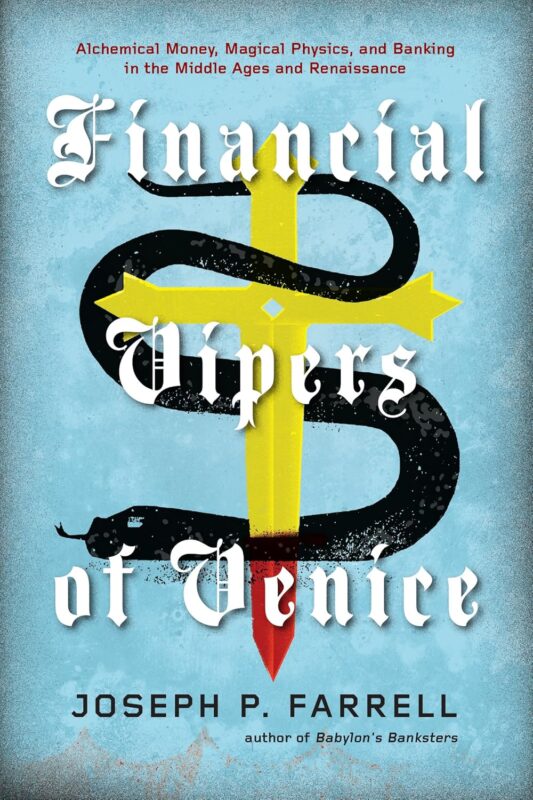
Joseph P. Farrell’s Financial Vipers of Venice explores the hidden currents of alchemical philosophy, Hermetic metaphysics, and occult finance that structured power in the late Middle Ages and Renaissance. The book positions Giordano Bruno’s execution as a pivotal moment in a historical struggle between emergent scientific-magical worldviews and entrenched religious and financial oligarchies. Venice serves not as a mere city-state, but as an operational matrix for the transformation of metaphysical ideas into financial instruments. The author situates metaphysical doctrines, especially those derived from Hermeticism, as directly formative of early economic systems—credit, bullion, corporate personhood—and shows how they were weaponized by merchant elites to forge and maintain global dominance.
The Metaphor as System
The structure of Farrell’s argument follows a topological metaphor of the medium. He identifies this metaphor not as allegory but as a physical, ontological logic through which power manifests itself—financially, politically, and metaphysically. This metaphor, he claims, derives from ancient texts like the Corpus Hermeticum and Vedic cosmology. It conceives of reality as mutable substance, a medium constantly transmuting form while maintaining an indestructible substrate. This view enabled Renaissance magi to propose that manipulation of the medium—whether through language, symbol, or credit—effectively constituted magic.
Giordano Bruno’s adoption of this model made him dangerous. He presented man as both microcosm and operator of this medium, positioning human consciousness as the link between metaphysical potential and material actuality. Such a claim undermined the priestly hierarchy of the Church and the aristocratic claims of financial elites. Bruno’s view that man is the philosopher’s stone threatened those who monopolized sacred and monetary authority.
Bruno, Venice, and the Doctrine of the Medium
Farrell opens by recounting the calculated betrayal and execution of Bruno in 1600. The Inquisition, empowered by both Vatican orthodoxy and Venetian oligarchs, burned Bruno for heresies that included belief in an infinite universe and the magical nature of Christ. But the philosophical depth of his heresies lies in their foundation on Hermetic physics. Bruno taught that magic, memory, and metaphysics converge in the manipulation of the underlying medium of reality. In this model, financial systems and religious systems operate through the same logic: abstraction layered over substance, form imposed on flow, and control exercised through symbols.
The Venetian oligarchy understood this. Farrell presents Venice not only as a maritime republic but as the first true corporate empire—a state governed through controlled information, strategic obfuscation, and monopolized finance. Venice weaponized the metaphor. It created “super-companies” like the Bardi and Peruzzi families that collapsed under suspicious timing and with tactical outcomes that benefited Venetian financiers. These collapses transferred economic power into fewer hands and consolidated control over European bullion flows.
Hermetic Economy and the Evolution of Money
Farrell traces the roots of modern financial instruments to the fusion of Hermetic ideas and medieval legal reforms. He challenges the conventional narrative that money evolved from barter, instead arguing—through citations of David Graeber and others—that virtual money and credit preceded coinage. In this view, money originated as symbolic representation within metaphysical systems of value. Farrell proposes that alchemy’s metaphors—transmutation, circulation, essence—became financial tools. Bills of exchange, corporate charters, annuities, and derivatives are extensions of the magical belief that value can be created from abstraction.
Through the Hermetic metaphor, alchemists did not only attempt to change lead into gold but explored how the mutable medium could produce forms—chemical, social, or monetary—by intentional act. This is the core of what Farrell calls “mathematical magic”: using systemic logic to engineer outcomes in the real world. Venice institutionalized this by aligning alchemical thinking with political policy. It understood that whoever controls the metaphor of money controls the material destinies of nations.
Corporate Personhood as Theological Weapon
Farrell identifies a central shift in the development of finance: the legal fiction of the corporation. He links this to theological debates in medieval Italy, where thinkers struggled with the metaphysics of personhood. Out of this struggle emerged the persona ficta—the corporation as a person in law, bearing rights, debts, and continuity across generations. This fiction allowed families and oligarchs to operate with impunity, separating liability from agency. The corporation, animated by the same metaphysical assumptions as the magician’s homunculus, became the ideal vessel for financial manipulation.
He describes how super-companies leveraged this concept to dominate trade. When they failed, their collapse was structured to preserve elite wealth while externalizing loss to debtor states and rival cities. The failure of the Peruzzi and Bardi in the 1340s, for instance, did not end Florentine banking. It shifted the financial center further toward oligarchical control and created new opportunities for systemic redesign. Venice, by surviving and benefiting from these crises, demonstrated its mastery over the metaphor.
The Geometry of the Scam
The core mechanism of control lies in Farrell’s exposition of financial pyramids: hierarchical structures that extract value upward while presenting horizontal illusions of equity. Venice engineered such systems through bullion manipulation, false scarcity, and control of minting rights. It exported grain with built-in deficits, forcing client states into dependence. It manipulated the East-West gold and silver flows, ensuring its merchants gained from every imbalance. The Council of Ten, Venice’s inner circle, operated as a state-level intelligence agency, using espionage, misinformation, and terror to enforce policy.
Farrell frames these operations not as accidents of history but as direct expressions of the Hermetic model. Venice used secrecy, coded communication, and symbolic architecture to conceal its operations while embedding its logic in the structure of European finance. Its influence extended to the Americas through the Genoese and Spanish networks tied to Columbus. The Piri Reis map, with its anomalous features, appears in this narrative as a relic of hidden cartographic traditions shaped by these same forces.
Renaissance Magic as Operational Finance
By the time the Reformation fractured Christendom, Venice had already tested the limits of the Hermetic metaphor. Bruno, who attempted to recode religion through a metaphysical system of infinite living worlds, clashed with every power structure he encountered. His doctrine implied that control must shift from external institutions to the internal realization of human sovereignty. That threat extended beyond theology into the architecture of finance. The powers that killed Bruno were defending not merely dogma but capital.
Bruno’s art of memory—a symbolic system that encoded complex metaphysical structures into spatial and visual forms—was more than mnemonics. It was a means of embedding command structures into cognition. Farrell suggests that such systems were used by initiatory groups to preserve and transmit strategies of control. In this light, memory palaces become algorithmic platforms, generating operational blueprints for metaphysical governance. The intersection of imagination and finance occurs at the level of symbol, where intention can animate form.
Collateralization and the Northward Shift
Farrell concludes by charting the transfer of Venetian methods to Amsterdam and London. The persona ficta, the bullion manipulation, and the pyramid structure of finance all moved northward after Venice’s formal political decline. The establishment of the Bank of England in 1694 reflects this transference: a private institution exercising sovereign power under the guise of national interest. Venice’s intellectual architecture was reborn in the East India Companies, in modern central banking, and in derivatives markets.
The metaphors endure. Finance continues to operate on the logic of medium manipulation. Credit, like magic, creates effects from symbols. Corporations act as legal golems, animated by arcane procedures and hidden covenants. Power remains concealed behind abstraction, protected by institutional structures that mirror the secrecy of alchemical orders. Farrell’s synthesis reveals that modern finance is the functional continuation of Hermetic metaphysics—transmuted, not extinguished.
Who now holds the metaphor? The financial elite, sovereign central banks, corporate entities, or networks that transcend borders? Farrell invites the reader to reconsider history not as a sequence of material events but as the enactment of metaphysical structures. In this frame, monetary crises, wars, and empires arise as surface effects of deeper symbolic configurations. By understanding the medium—its properties, patterns, and protocols—we uncover the operational grammar of power.