Titan: The Life of John D. Rockefeller, Sr.
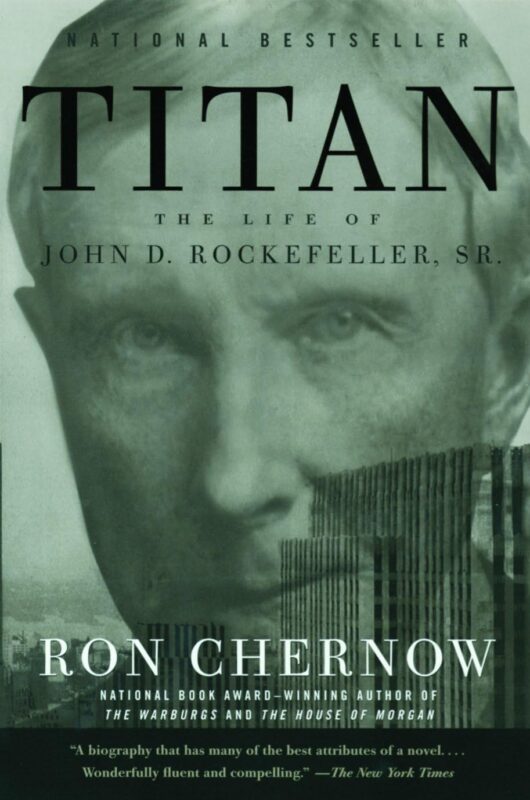
Titan: The Life of John D. Rockefeller, Sr. by Ron Chernow reconstitutes the story of the United States’ most consequential business figure, tracing Rockefeller’s journey from the rural hardship of upstate New York to the summit of global finance and philanthropy. Ron Chernow marshals exhaustive research and narrative rigor to deliver a biography that unlocks both the private man and his seismic public impact.
The Formative Years and Family Inheritance
John Davison Rockefeller’s story begins on the stony ground of Richford, New York, where hardship and religious devotion interwove. His mother, Eliza, anchored the family with discipline and faith, shaping Rockefeller’s habits of thrift and persistence. His father, William Avery Rockefeller, alternated between absenteeism and flamboyant presence, introducing instability and the cunning of a practiced swindler. Young John learned caution, composure, and a drive for control, as his household oscillated between parental care and the chaos brought by his father’s double life. The intersection of strict maternal order and paternal unpredictability forged Rockefeller’s lifelong approach to risk, secrecy, and self-discipline.
Apprenticeship in Commerce
Rockefeller’s first ventures emerged from necessity. He started as a bookkeeper, mastering double-entry accounting and discovering satisfaction in balance and order. In Cleveland, Ohio, a city poised on the edge of the petroleum revolution, Rockefeller invested his modest savings in partnership with Maurice Clark. He methodically tracked expenses, negotiated relentlessly, and demanded precision. The oil boom introduced volatility; Rockefeller responded with systematic calculation, always searching for leverage in a market overrun with chaos and speculation.
Founding Standard Oil and Mastering Scale
When Rockefeller acquired his first oil refinery, he grasped the potential for consolidation in an industry fragmented by waste and inefficiency. He sought efficiency, quality, and reliable supply chains. With Henry Flagler’s strategic partnership, Rockefeller engineered vertical integration, drawing together refining, transportation, distribution, and marketing. Standard Oil became a unified enterprise that absorbed competitors through negotiation, acquisition, and, when necessary, pressure. Rockefeller cultivated relationships with railroad executives, securing preferential shipping rates and re-investing cost savings to undercut rivals. Through this intricate web of arrangements, Standard Oil achieved a scale that dictated market terms. The business grew not through isolated maneuvers, but by the relentless pursuit of systematized control.
Corporate Strategy and Expansion
Standard Oil’s internal structure mirrored Rockefeller’s quest for order. He delegated authority, established reporting systems, and insisted on secrecy. Decisions flowed from a small, trusted circle. Rockefeller’s direct engagement—personally reviewing contracts, dispatching lieutenants to negotiate, and absorbing industry data—kept the company nimble. Standard Oil expanded beyond Cleveland into Pittsburgh, Philadelphia, New York, and then globally. Rockefeller orchestrated this growth through layered partnerships and subsidiaries, each feeding information and resources back to the central organization.
Contestation and Public Backlash
Rockefeller’s dominance provoked fierce opposition. Independent refiners, local politicians, and eventually the federal government scrutinized Standard Oil’s methods. Muckraking journalists, led by Ida Tarbell, investigated the company’s deals, exposing the intricacies of railroad rebates, secret pacts, and the relentless pressure exerted on competitors. The press constructed Rockefeller as the archetype of the monopolist, a figure of suspicion and awe. Standard Oil’s power summoned antitrust investigations. Congressional hearings and legal proceedings sought to penetrate the company’s shroud of secrecy, demanding explanations for tactics that redefined competition in American industry.
The Antitrust Case and Transformation
The Supreme Court’s 1911 decision to dismantle Standard Oil did not end Rockefeller’s influence; it multiplied his wealth and extended his legacy. As Standard Oil splintered into dozens of new entities—Exxon, Mobil, Chevron, and others—Rockefeller’s stockholdings appreciated in value. He had already begun to recede from daily operations, entrusting management to a new generation and concentrating his energy on stewardship of his fortune.
Philanthropy as System
Rockefeller’s approach to giving mirrored his business principles. He created structures—the Rockefeller Foundation, the General Education Board, the Rockefeller Institute for Medical Research—that institutionalized philanthropy on a scale previously unknown in the United States. He financed the eradication of diseases, the expansion of higher education, and the professionalization of scientific research. Instead of distributing sporadic gifts, Rockefeller built endowments and designed programs for sustained impact. He championed efficiency in charity, supporting causes that advanced public health, agricultural innovation, and knowledge dissemination.
Family and Succession
Rockefeller’s relationship with his children, especially John D. Rockefeller, Jr., reveals a pattern of deliberate succession. The elder Rockefeller imposed high expectations, tested judgment, and instilled both caution and ambition. John Jr. absorbed these lessons, ultimately assuming control of the family’s philanthropic ventures. The younger Rockefeller expanded the legacy into new domains—urban planning, conservation, and global outreach—while seeking public engagement and transparency that his father had eschewed.
Private Life, Public Image
Rockefeller maintained strict personal discipline: early hours, daily walks, careful diet, and methodical routines. He resisted extravagance, preferred quiet family gatherings, and expressed devotion through letters and Bible study. The accumulation of immense wealth brought scrutiny and persistent misrepresentation. In old age, Rockefeller endured caricature and protest. He often responded with silence or carefully crafted public gestures, such as the famous handing out of dimes to strangers—a practice that mixed public relations with private amusement.
Rockefeller’s Motivations and Worldview
The biography scrutinizes Rockefeller’s inner world. Religious conviction shaped his actions; he interpreted financial success as divine favor and viewed philanthropy as stewardship. Rockefeller expressed gratitude for his opportunities, emphasizing duty and humility in private writings. His commitment to order, sobriety, and self-improvement became a template for his enterprises and his giving. He described business as a form of ministry, with prosperity as both test and responsibility.
Impact on American Capitalism
Rockefeller engineered a new template for business in the United States. He demonstrated the possibilities of scale, integration, and planning in a volatile economy. His strategies established the model for subsequent corporations, from resource extraction to manufacturing and distribution. Rockefeller’s approach catalyzed the formation of antitrust law, compelled innovations in regulation, and introduced the problem of corporate power into national politics. The convergence of ambition, method, and context produced effects that reverberated across industries.
Legacy in the Modern World
The Rockefeller name persists through foundations, universities, hospitals, and conservation projects. The wealth generated by Standard Oil seeded institutions that advance medical research, education, and cultural preservation. Rockefeller’s innovations in corporate structure and philanthropy remain foundational to contemporary models of enterprise and social investment. The biography offers a framework for understanding the convergence of personal discipline, institutional ambition, and national transformation.
Conclusion: Enduring Lessons from Titan
Titan: The Life of John D. Rockefeller, Sr. by Ron Chernow stands as a definitive study in the relationship between character and consequence. Rockefeller’s synthesis of discipline, ambition, secrecy, and stewardship yields a life that reshaped economic and social landscapes. Readers seeking to understand the mechanics of power, the origins of modern philanthropy, and the interplay between personal conviction and public action will find in this biography a narrative of rare depth and resonance. The story advances inexorably, propelled by the logic of cause and effect, and delivers an anatomy of achievement whose structure endures as a model for leaders, critics, and students of enterprise. The book’s analysis grounds itself in specificity, presenting Rockefeller’s methods, motivations, and outcomes as a confluence of forces whose imprint on history persists.


About the Book
https://youtu.be/nTFS49wMkq0