The Empire of ‘The City’ – The Secret History of British Financial Power
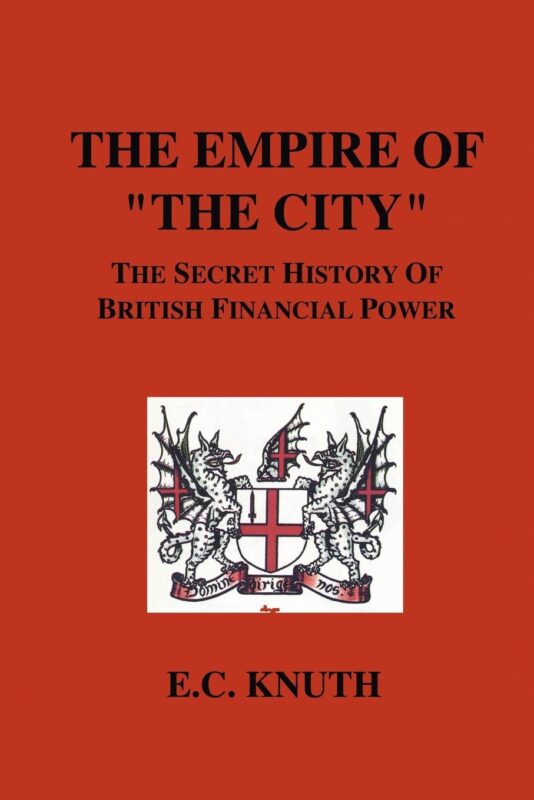
The Empire of the City by Edwin C. Knuth presents a documented structure of global power centered in the financial district of London. The book traces the development of a transnational regime led by international bankers, identifies its key institutions, and shows how its actions have shaped modern geopolitics through war, commerce, and covert manipulation.
The Sovereign Structure of the City
Knuth defines the City of London as a corporate-political hybrid with legal autonomy, entrenched financial power, and operational control over British imperial and international policy. Its status as a sovereign city within a city creates a jurisdictional firewall. It operates through privileges and prerogatives older than the British parliament. It asserts control through the Bank of England, legal trust structures, and a cartel of merchant banks whose activities extend into foreign ministries, trade organizations, and multinational corporations. This legal entity, with its own governance charter and protected secrecy, governs through strategy rather than public mandate.
Pilgrims and the Imperial Ideology
The ruling class of the City advances a precise ideological objective: global consolidation under elite Anglo-American governance. Knuth identifies the Pilgrims Society as the vehicle that organizes this class across national borders. Founded in 1902 and sustained through elite educational and financial networks, the society integrates American industrialists, British lords, European technocrats, and colonial administrators into a unified program. Its members hold senior posts in finance ministries, central banks, diplomatic delegations, and media trusts. Through coordinated political influence, they craft a narrative of peace while orchestrating conflict, frame democracy as consensus while enforcing economic control, and sponsor educational reform while shaping the boundaries of permissible debate.
World Wars as Financial Reordering
Knuth argues that global conflicts did not erupt from spontaneous aggression. They emerged as planned episodes within a long arc of financial reordering. The City’s interests required periodic destruction of rising industrial competitors. It mobilized alliances to encircle and destroy powers like Germany and Russia, whose territorial ambitions and resource independence threatened financial hegemony. World War I reconfigured European debt structures and transferred gold reserves into City-aligned institutions. World War II consolidated American entry into imperial finance, unified Western central banking protocols, and destroyed Axis industrial resistance. Each war recalibrated global trade routes, redrew state borders, and expanded the reach of private financial syndicates.
The American Pivot and Economic Submission
Knuth identifies the Spanish-American War as a critical turning point. The United States, having adopted British imperial tactics, transitioned from internal industrial growth to external market dependency. The annexation of the Philippines and the suppression of nationalist revolts in China and Latin America marked the alignment of American military and commercial interests with the goals of the London financial elite. American presidents, cabinet members, and policy advisors began consulting directly with Pilgrim Society members. Treaties favored British strategic priorities. American capital flowed through investment banks tied to the City. American universities revised curricula to reflect the ideological premises of internationalism and financial orthodoxy.
Control through Legal Construction
Knuth identifies legal engineering as the core mechanism of control. The City governs through layered charters, exclusive contracts, and banking instruments insulated from democratic revision. By embedding legal protections into international treaties and trade agreements, the City makes its policies irreversible by electoral means. Legal experts, trained in schools funded by the same syndicates, codify doctrines that prioritize investor security over national development. These doctrines govern everything from labor law to monetary policy, creating a supranational legal architecture aligned with financial capital.
The Eastern Question and Strategic Encirclement
Knuth explores the recurring use of the "Eastern Question" as a pretext for war. Russia's desire for warm-water ports represented a threat to British control of maritime trade. The City used Turkish client states, diplomatic isolation, and military interventions to block Russian access. These maneuvers generated wars in the Balkans, structured alliances like the Entente Cordiale, and destabilized the Ottoman Empire in ways that benefited British commercial shipping. In each case, conflict emerged not from ideological division but from access control over energy routes and trade chokepoints.
Suppression of National Movements in Asia
The City viewed nationalist movements as threats to contractual regimes that guaranteed financial rents. In China, Egypt, and India, Knuth identifies a pattern of calculated military action, economic retaliation, and political co-optation. When Chinese nationalists sought to expel British financial agents and their native proxies, the City responded through naval bombardments and economic isolation. British-controlled Hong Kong functioned as a staging ground for these operations. Japan received support as a counterweight to Chinese nationalism until its independence threatened the financial chain of command. The same structural logic shaped interventions in India and Egypt, where nationalist governments faced assassination, embargo, or infiltration.
Media, Academia, and the Manufacturing of Consent
Control over information underpins the City’s operations. Knuth documents how major publishers, university endowments, and scientific foundations received funding from banks aligned with the Pilgrim Society. These institutions shape public discourse, define policy realism, and marginalize critiques of financial empire. Public intellectuals who revealed the City’s structure—Charles Lindbergh Sr., David Starr Jordan, Senator Gerald Nye—faced smear campaigns, funding cuts, and legal persecution. Knuth argues that this censorship prevents collective action by obscuring the identity of those who shape policy outcomes.
Financial Instruments as Weapons of Influence
Knuth reveals how financial instruments enforce geopolitical compliance. Loan terms dictate domestic policies. Currency swaps influence trade decisions. Investment embargoes destabilize regimes. These tools function as weapons of influence more effective than standing armies. By embedding repayment obligations in sovereign law, the City ensures that political leaders, regardless of ideology, enforce economic structures that protect capital flow to London. Debt becomes the mechanism through which sovereignty is erased and policy is outsourced.
Institutional Reinforcement of Global Hierarchies
The City institutionalizes its strategy through think tanks, philanthropic endowments, and international legal bodies. The Carnegie Endowment, the Rockefeller Foundation, and the League of Nations function as tools of moral persuasion that mask coercion. These organizations propose frameworks that appear inclusive while enforcing exclusion through legal structure. Knuth emphasizes that these bodies do not moderate imperialism. They distribute its functions across public and private sectors, creating plausible deniability for outcomes orchestrated in boardrooms and cabinet meetings.
Cycles of Consolidation and Renewal
Knuth organizes history into cycles of consolidation. Wars destroy resistance. Peace treaties encode financial rules. Revolts trigger repression. Emerging powers attract alliances and then face betrayal. The City survives these cycles by anticipating change and embedding adaptive strategies into legal and economic institutions. It does not merely react. It initiates through design, adjusts through proxy, and restores order through debt.
Conclusion: The Architecture of Command
The book closes with a comprehensive claim. The modern world operates on a financial architecture designed for elite control, enforced through legal invisibility, and reproduced through ideological conformity. Knuth urges historical clarity, not through abstraction but through the naming of structures, agents, and mechanisms. The empire he describes functions through trust law, monetary monopoly, and elite consensus. It cannot be dismantled through rhetoric. It must be understood in form, traced in law, and challenged through institutional design.
Knuth documents a convergence: war, finance, law, and ideology form a single command structure. Its center resides in the City. Its power emerges not from visibility but from structural permanence. Its longevity depends on collective ignorance. Knowledge disrupts. That is the first act of resistance.