The Ghost-Seer
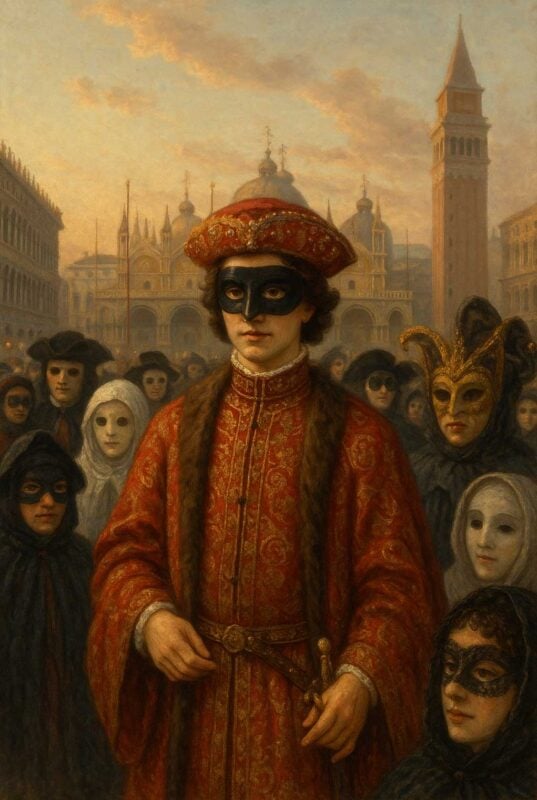
The Ghost-Seer; or the Apparitionist by Friedrich Schiller exposes a web of intrigue, mysticism, and psychological manipulation that unravels in the shadowed alleys and salons of Venice. The narrative follows a German prince whose path intersects with a series of cryptic figures and inexplicable events, culminating in a quest to understand the forces manipulating his fate.
A Prince Ensnared by the Supernatural
The story begins with a quiet, introspective nobleman visiting Venice during the carnival season. This prince, known for his melancholic disposition and philosophical leanings, soon finds himself under the influence of a mysterious Armenian. Their encounters ignite a sequence of uncanny revelations, beginning with a public prophecy of death that proves true within hours. The prince’s identity is exposed, catapulting him into unexpected political obligations, while the Armenian’s insight becomes increasingly precise and disturbing.
Encounters with the Unknown
Venice, a city of masks and illusion, sets the stage for a confrontation with the uncanny. A man in Armenian robes shadows the prince through the streets, knows intimate details of his life, and predicts deaths with terrifying accuracy. He saves the prince from an assassination plot, arranges meetings that defy rational explanation, and vanishes at will. The prince, intrigued and unsettled, begins to believe he is being observed by forces beyond comprehension.
What drives a man to follow signs only he can perceive? Why does the appearance of the Armenian unsettle even the most composed minds? The prince, an intellectual skeptic by habit, begins to shift. He craves knowledge not offered by books or reason but by direct confrontation with the invisible.
The Lure of Forbidden Knowledge
The prince’s journey deepens when a Sicilian magician offers a séance that promises to summon the dead. The prince agrees, motivated by a desire to reach a fallen comrade and uncover a vital secret left incomplete at the soldier’s death. A public display ensues: figures appear in smoke and shadow, voices emerge from beyond the grave, and physical manifestations of spirits seem to invade the material world.
The magician orchestrates the scene with mechanical precision. The ghost speaks, the lights flicker, thunder rolls through the room. Then an uninvited apparition arrives. Unlike the first, it silences the magician, withstands gunfire, and radiates unearthly authority. Panic ensues. The magician collapses. The spectators freeze. In the silence that follows, the true ghost delivers a message of judgment and destiny to the prince.
The Mask Beneath the Mask
After the séance, the magician is arrested. Under questioning, he confesses that every element of the performance—except the final apparition—was a carefully staged illusion. He used mirrors, electric shocks, smoke, and actors to produce the effects. But when he describes the second figure, his tone changes. This was no collaborator. He identifies the stranger as “the Incomprehensible,” a man seen across centuries and continents, immune to time, untouched by injury, bound by a mysterious command to disappear every midnight without fail.
Who or what is this figure? Is he an emissary of divine judgment, a remnant of ancient wisdom, or a supernatural force operating beneath the surface of political and religious power?
The Veil of Political Power
The prince, now a recognized sovereign due to the death of his cousin, finds himself trapped in a net of appearances. Venice’s senators embrace him, court figures send him wealth, and factions vie for his influence. Yet his fascination with the Armenian and the ghostly episode overshadows his new title. He sees politics as performance, authority as shadow play. The hidden mechanisms guiding events—coincidence, prophecy, manipulation—demand his attention more than any diplomatic audience.
At the center lies the Armenian, whose role expands from mere informant to orchestrator. He predicts outcomes, warns of betrayal, and compels obedience. When the prince seeks answers, the Armenian vanishes, only to reappear at crucial moments. The prince becomes convinced he is under surveillance by unseen powers, and that his soul is the true target of these interventions.
Faith, Reason, and the Limits of Human Power
Schiller interrogates the boundaries of enlightenment rationalism. The prince, once secure in empirical logic, now grapples with phenomena that defy his framework. The séance and the prophecy cannot be contained within conventional categories. They offer truths inaccessible to reason but deeply persuasive in experience. The ghost speaks with authority. The Armenian commands without violence. The magician’s lies give way to genuine terror in the face of the real.
What authority governs the unseen? Does reason falter where destiny begins? The prince moves toward spiritual awakening through terror and awe, not through deduction or doctrine.
Control and Surrender
Schiller explores control as illusion. The magician creates visions, but loses control when the true apparition arrives. The Venetian Inquisition appears omnipotent, yet defers to the Armenian without question. The prince holds a title, but finds himself a pawn in a broader game. Every figure believes he directs the plot, only to discover a greater force framing his role.
Submission replaces strategy. When the prince meets the ghost of his friend, he no longer seeks power—only understanding. His final appeal to the apparition does not ask for secrets or predictions but guidance: “How must I do that?” he asks, when told to think of himself. The answer: “Thou wilt learn at Rome.”
The path forward leads not into battle or negotiation but into spiritual instruction. The prince must surrender ambition and embrace transformation.
The Incomprehensible as Mirror
The character known only as the Armenian, or the Incomprehensible, embodies the synthesis of mysticism, espionage, and existential force. He performs no miracle on stage. He simply knows more than he should. He appears exactly where needed. He evokes fear in deceivers and deference from institutions. When he speaks, commands follow.
This character resists interpretation. Is he angel or spy, prophet or hoaxer? Schiller withholds explanation. Instead, he presents him as the necessary presence in a world where perception alone cannot secure truth. He is the missing grammar of understanding—a figure whose existence refutes reduction.
Consequences of Revelation
After the séance, the prince cannot return to ordinary life. He probes the magician, seeks the Armenian, questions his own memory. Even when the trickery is explained, its symbolic residue remains. The ghost’s final words—cryptic, directive, charged—refuse dissection. They demand obedience, not interpretation.
The prince leaves Venice changed. He carries a secret. He believes in forces that act without heraldry. His status as ruler matters less than his journey into meaning. Rome awaits, not as capital or power center, but as destination for conversion.
Legacy of the Apparition
The Ghost-Seer achieves its force by collapsing the categories that define certainty. Rationalism, mysticism, politics, and performance intermingle until distinctions fade. The narrative does not resolve into revelation. It compels continued seeking.
Schiller offers no key to decode the Incomprehensible. The ghost remains elusive. The magician confesses only what he understands. The prince moves forward in ignorance, armed only with reverence.
What begins as a tale of misdirection becomes a fable of awakening. The Ghost-Seer leads its reader through deception, danger, and display to the border where human knowledge ceases and obedience to mystery begins. In that space, Schiller leaves us, confronted not with answers but with the obligation to live as if the unseen exists.