TV Sets: Fantasy Blueprints of Classic TV Homes
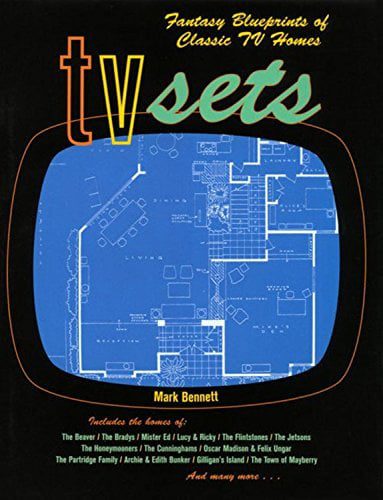
TV Sets: Fantasy Blueprints of Classic TV Homes by Mark Bennett translates visual nostalgia into architectural imagination. Drawing from decades of popular television, Bennett renders forty meticulously detailed blueprints of fictional homes that once shaped the domestic imagery of millions of viewers. These are not conceptual studies but precise, scalable floor plans rooted in emotional memory and cultural reference.
Reconstructing a Fictional America
Through the houses of Mike and Carol Brady, Ward and June Cleaver, and Darrin and Samantha Stevens, Bennett maps the internal logic of sitcom storytelling onto architectural space. The homes are not symbols. They are fully realized geographies of routine, aspiration, and narrative structure. Each room, stairwell, and garage tells a story—about character dynamics, temporal flow, and the mid-century American ethos.
Bennett’s commitment spans over two decades. Without video reference in the early years, he relied on live observation, sketches on napkins, and memory. From these fragments, he produced formal architectural drawings complete with borderlines and title blocks. His process mirrors the domestic construction of television itself: iterative, collaborative, and charged with subtext.
Domesticity as Visual Grammar
Sitcom architecture reveals priorities. Living rooms often anchor the visual field, offering symmetry for dialogue and social cohesion. Kitchens define routine, from June Cleaver’s immaculate work surfaces to Carol Brady’s functional cabinetry. Bedrooms reflect generational distinction—Beaver and Wally’s nautical motifs versus Greg Brady’s psychedelic crash pad.
Bathrooms, seldom shown, reappear in Bennett’s plans. Their presence asserts physical realism in sets designed for illusion. Basements, attics, porches, and driveways receive similar treatment. These spaces ground fantasy in tactile detail and allow the viewer to imagine beyond the frame.
Television as Suburban Blueprint
Suburbia dominates Bennett’s layouts. The grid of Mayfield and the symmetry of Hilldale enforce order. Trees line properties. Driveways serve sedans and station wagons. Porches welcome visitors and perform neighborhood harmony. Yet within this order, architectural quirks emerge: the sunken living room in the Petrie house, the cantilevered staircase of the Brady home, the divided plan of the Stevens’ magical colonial.
By redrawing these homes, Bennett archives not only spatial design but also a cultural worldview. His work transforms ephemeral sets into enduring records of how television scripted domestic space.
Urban Interiors and Comedic Tension
Apartments in The Odd Couple and I Love Lucy complicate the suburban narrative. Oscar Madison’s cluttered den and Felix Ungar’s compulsive reordering create friction within a finite space. Lucy and Ricky’s shifting units—from 4A to 3D, from New York to Connecticut—visualize changing family dynamics and career ambition.
Bennett respects these variations by capturing not only layout but modulation. Sliding doors, repurposed rooms, and shared hallways turn architecture into plot devices. The New York apartments condense tension, while suburban sprawl in Beverly Hills or Mayberry dissipates it.
Gothic, Futuristic, and Surreal Settings
Beyond realism, Bennett explores speculative architecture. The Addams Family mansion operates like a horror-themed laboratory, with racks, crypts, and foghorns. The Munsters’ house blends Victorian decay with comic absurdity. The Jetsons reverse gravity, suspending domesticity in orbit.
Even fantastical structures obey logic in Bennett’s renderings. He decodes their spatial rules—where stairs lead, how bedrooms align, which windows overlook which yards. The result is not mere homage but structural clarity.
Gilligan’s Island and the M_A_S*H compound receive similar treatment. Their open-air constructs replace walls with makeshift boundaries, emphasizing impermanence and adaptability. Yet the plans remain precise, acknowledging function amid flux.
Emotional Engineering in Blueprint Form
Each floor plan reflects affective design. Bennett does not idealize; he anchors emotion in architecture. The bar in Jim West’s train coach becomes a site of tactical plotting and gentlemanly repose. Mayberry’s wraparound porch signals stability, while the Ricardo’s Beverly Palms suite blends glamour with dislocation.
These homes externalize their occupants’ identities. Felix Ungar’s hallway leads to order. Fred Flintstone’s stone living room communicates primal comfort. Mary Richards’ compact studio arranges solitude with sophistication. The blueprint becomes biography.
Serial Continuity Through Spatial Repetition
Television requires spatial consistency. Viewers navigate shows partly through memorized architecture. Bennett restores this continuity across episodes and seasons. He reconciles discrepancies in set design, choosing representative features that sustain believability.
In doing so, he affirms the viewer’s internal map. The hallway behind the kitchen. The landing above the stairs. The backyard tree. These elements act as narrative anchors, enabling both episodic memory and longitudinal attachment.
Hand-Drawn as a Medium of Devotion
Bennett’s method underscores his commitment. He rejects digitization. His pen traces each molding, doorknob, and light fixture with personal fidelity. The imperfections of inked lines convey warmth, subjectivity, and time.
He imagines a utopian neighborhood where these fictional homes exist side by side. Such an idea exposes the intertextuality of television—how audiences travel between shows, how characters share archetypes, how domestic ideals echo across series.
Blueprints as Cultural Record
TV Sets functions as both artwork and archive. It records how architecture shaped the values, desires, and narratives of twentieth-century television. These blueprints testify to how homes, even fictional ones, organize meaning. They offer more than nostalgia. They provide structural insight into how Americans once viewed family, community, and domestic life.
By transforming memory into measurement, and entertainment into architecture, Mark Bennett invites readers to walk once more through doors that only existed on screen—now made solid through imagination and line.