The Last Circle: Danny Casolaro’s Investigation into the Octopus and the PROMIS Software Scandal
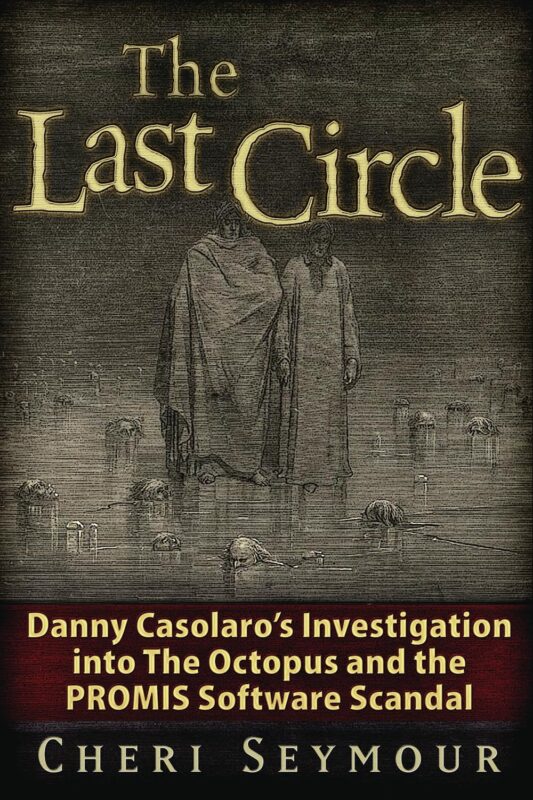
The Last Circle by Cheri Seymour reconstructs journalist Danny Casolaro’s unfinished investigation into a network of intelligence operatives, corporate executives, organized crime figures, and government officials bound by shared financial and covert interests. Casolaro called this web “The Octopus.” His 1991 death in a Martinsburg, Virginia hotel—his wrists cut multiple times, his notes missing, his body embalmed before his family was informed—became the axis around which Seymour’s inquiry turns. She traces the structures of power he pursued, following the data trails that linked the stolen PROMIS software, CIA cutouts, the Department of Justice, global drug cartels, and private intelligence corporations operating as commercial fronts.
The Octopus and Its Origins
Casolaro uncovered patterns of covert finance stretching back to the early Cold War. Seymour identifies a cadre of intelligence veterans who transitioned from military and CIA operations in the 1950s into private ventures that blended espionage with profit. Many of these men—Robert Booth Nichols, Michael Riconosciuto, and figures inside the National Security Council—appear as recurring operators in her narrative. They used shell corporations such as First Intercontinental Development Corporation (FIDCO) and Meridian International Logistics (MIL) to move weapons, narcotics, and capital across borders. FIDCO letters from 1983 show direct correspondence with White House official Michael McManus and Lebanese President Amin Gemayel about multimillion-dollar transactions. These documents establish the scale of coordination between government insiders and private intermediaries.
PROMIS and the Machinery of Surveillance
At the center of Casolaro’s investigation stood the PROMIS software, developed by Bill and Nancy Hamilton’s company Inslaw for the U.S. Department of Justice. The program managed legal case data, but its adaptability made it valuable for intelligence purposes. Seymour details how DOJ officials allegedly stole and modified PROMIS, embedding a “back door” that allowed remote access to any database using it. Israeli operatives, including Mossad technicians, reportedly expanded the modification to enable bidirectional espionage, giving foreign intelligence services entry into U.S. nuclear research networks such as Los Alamos. Canadian investigator Sean McDade of the RCMP confirmed in 2000 that Canada had obtained a pirated PROMIS version. His classified mission, Project Abbreviation, revealed how the software’s architecture permitted silent data extraction from national systems.
The Investigators and the Shutdown
McDade’s work connected him to California detective Sue Todd, who was pursuing a double homicide tied to PROMIS distributors. Together they uncovered banking transactions linking Canadian officials to Reagan-Bush administration intermediaries. When McDade returned to Ottawa, he established a war room to track financial flows between Strategic Software Planning in Massachusetts and Canadian procurement accounts. His investigation soon collided with U.S. agencies. Seymour records that FBI and DOJ personnel who earlier pursued the same trail—Thomas Gates, Richard Stavin, Marvin Rudnick—had been removed or silenced after tracing money laundering routes through the Cali Cartel and former DOJ official Mike Abbell. The same structural pattern repeated: inquiry met obstruction at the moment it threatened exposure.
From Intelligence to Organized Crime
The Octopus integrated intelligence logistics with organized crime economies. Seymour maps this convergence through Nichols and Riconosciuto, who collaborated with Wackenhut Corporation and the Cabazon Indian Reservation to develop weapons prototypes while simultaneously manufacturing methamphetamine. Wackenhut, a major private security firm, functioned as an intelligence contractor with government clearance. Its joint venture on tribal land offered legal insulation for covert projects. Letters from Wackenhut’s director of relations confirmed that Riconosciuto was valued for advanced weapons designs, including railgun concepts presented to U.S. Army propulsion specialists.
Riconosciuto’s later testimony connected these technical ventures to narcotics operations. He described how PROMIS could automate money laundering through CHIPS and SWIFT banking systems, moving funds invisibly through international transfers. His affidavit to Inslaw in March 1991—days before his arrest on drug charges—outlined the modification of PROMIS for clandestine financial control. Seymour presents his subsequent imprisonment as part of the recurring containment of witnesses who reached the core of the system.
Danny Casolaro’s Final Days
Casolaro had spent months interviewing Nichols, accumulating hundreds of phone calls and recorded conversations. His notes indicated that he had linked Abbell, Nichols, and Cali Cartel leaders Gilberto and Miguel Rodríguez to U.S. intelligence contacts. His last recorded meeting in Martinsburg involved confronting Nichols about these connections. Days later, he was found dead. Seymour reconstructs this timeline with precision: the missing accordion file, the rapid cleanup of the hotel room, the premature embalming, and the DOJ’s 1994 report that excluded any reference to the Abbell–Cali link.
The California Nexus
Seymour’s own reporting began in Mariposa County, California, where she investigated local corruption involving sheriff’s deputies, drug distribution in Yosemite National Park, and the Curry Company, a concessionaire owned by MCA Entertainment. She discovered that investigators tracing the disappearance of deputy Ron Van Meter in 1980—believed murdered after exposing narcotics trafficking—encountered political protection networks that reached into state and federal offices. The Queen’s motorcade crash of 1983, which killed three Secret Service agents, intersected the same web through Commander Roderick Sinclair, whose family ties reached back to General Douglas MacArthur’s intelligence apparatus. Seymour shows how local incidents in Mariposa served as entry points into the larger architecture Casolaro described.
Wackenhut, FIDCO, and Corporate Espionage
The book details Wackenhut’s alliances with defense and intelligence agencies. Through subsidiaries like Meridian Arms, its executives pursued contracts that merged private profit with national security operations. Nichols, serving simultaneously as a director of FIDCO and MIL, leveraged these structures for financial transfers involving the Arab Bank in Amman, Jordan, amounting to over three billion dollars. These transactions supported prisoner exchanges and weapons deals under NSC supervision. Seymour’s documentation, based on correspondence and interviews with former operatives, demonstrates how the corporate hierarchy mirrored intelligence command structures, enabling deniability and profit in equal measure.
The Role of the Media and the Judiciary
Journalists and prosecutors who approached the Octopus narrative faced systematic suppression. Paul Rodriguez and Kelly O’Meara’s four-part Insight magazine series in 2001—“Nothing is Secret,” “The Plot Thickens in PROMIS Affair,” “PROMIS Trail Leads to Justice,” and “PROMIS Spins Web of Intrigue”—validated core aspects of Seymour’s findings. Yet DOJ internal reviews dismissed these claims without transparent inquiry. Seymour lists multiple investigators—FBI agent Thomas Gates, Organized Crime Strike Force prosecutor Richard Stavin, and Customs officer Scott Lawrence—whose investigations were halted once they intersected with intelligence operations. Lawrence’s Indo-China Project, a U.S. Customs internal probe into cross-border drug routes, was shut down after he sought grand jury subpoenas for CIA officials.
Financial Architecture of the Octopus
The Octopus operated through financial instruments designed for opacity. Seymour explains how drug profits functioned as an informal currency within covert trade networks. “Drugs are gold,” one source told her, describing how narcotics trafficking underwrote intelligence budgets outside congressional oversight. Banking systems such as CHIPS and SWIFT provided the infrastructure for these transactions. PROMIS, once modified, could monitor and direct fund movements, making it both surveillance tool and laundering mechanism. Nichols’s documented work moving money from the Philippines for government officials through Swiss accounts illustrated the operational use of these methods.
The Collapse of Accountability
Seymour tracks how investigations consistently collapsed at the junction between intelligence and criminal justice. Files vanished, evidence was sealed, and witnesses faced prosecution or intimidation. Casolaro’s notes identified this pattern as the Octopus’s defining trait: a self-protecting organism feeding on secrecy. The DOJ’s sealing of all MCA wiretaps, the disbanding of Los Angeles’s Organized Crime Strike Force, and the absence of prosecutions despite extensive FBI recordings confirm the closure of official channels. Seymour’s interviews with former prosecutors reveal how national security designations blocked cases involving corporate executives and entertainment industry leaders linked to organized crime.
The Continuing Reach
By the 2000s, elements of the Octopus had migrated into digital surveillance. Seymour notes that the NSA’s ECHELON system and Canada’s CSIS network exchanged intercepted data, effectively replicating the PROMIS model at scale. McDade’s experience of being monitored by ECHELON during his investigation illustrated the feedback loop between discovery and control: those who investigate the network become its subjects.
The Structural Pattern
The Last Circle builds a chronological structure that exposes repetition as design. Each attempt to investigate—Casolaro in Virginia, McDade in Ottawa, Gates in Los Angeles, Seymour in Mariposa—ends at the same institutional barricade. The recurrence of the same corporations, officials, and intermediaries across decades forms an empirical pattern rather than a conjectural one. Seymour’s documentation converts anecdote into structure, revealing how intelligence privatization during the Cold War matured into a permanent infrastructure of clandestine finance.
The Human Cost
The narrative returns often to Casolaro’s death, not as mystery but as consequence. Seymour positions him among others who challenged the Octopus: deputy Ron Van Meter, investigators Ray Jenkins and Sue Todd, whistleblower Michael Riconosciuto. Their stories converge on the same outcome—discreditation, isolation, or death. The book’s dedication to “the fallen warriors who did battle with the Octopus” frames the investigation as a moral undertaking within a corrupted system.
The Octopus as Systemic Design
Seymour concludes that the Octopus functions through integration, not conspiracy. Intelligence agencies, corporate entities, and criminal syndicates share logistics, finance, and personnel. The same men who manage covert operations manage private contracts; the same banks process narcotics proceeds and defense funds. PROMIS serves as both symbol and mechanism of this integration—a technology created for justice repurposed for surveillance and control. The book’s title, The Last Circle, evokes Dante’s vision of treachery as the deepest level of betrayal. Seymour applies that image to institutions that devour their own investigators.
The Enduring Record
By assembling interviews, documents, and official correspondence, Seymour extends Casolaro’s unfinished work into a historical record of systemic corruption. The Last Circle documents how investigative journalism, law enforcement, and political oversight collapsed before an adaptive network that feeds on secrecy, technology, and capital. The book stands as a detailed anatomy of modern clandestine power, where the boundaries between national security and organized crime dissolve within the circuits of global finance. It exposes how information systems designed for transparency became the instruments of concealment, and how the pursuit of truth became a life-threatening act within the very institutions sworn to uphold it.