Finance Capitalism and Its Discontents
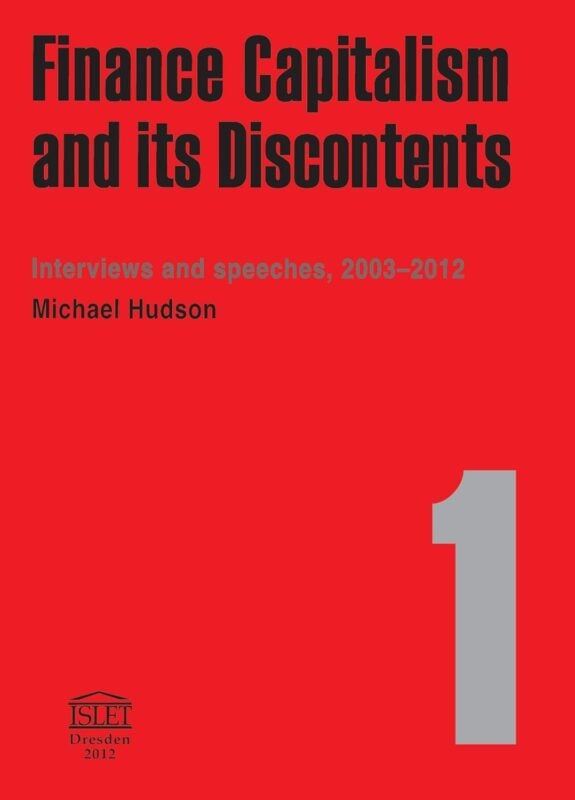
Finance Capitalism and Its Discontents by Michael Hudson explores the economic transformation that occurred when financial engineering supplanted industrial productivity as the engine of modern economies. Hudson grounds his analysis in historical developments and demonstrates how debt, deregulation, and privatization have reshaped wealth distribution, political power, and institutional behavior.
The Rise of Financial Extraction
Financial capitalism centers its strategy on extraction. Banks do not fund productive enterprise. They lend against existing assets, inflate prices through credit expansion, and profit from asset turnover. This system does not build factories or generate employment growth. It escalates private wealth accumulation through rent seeking, interest payments, and leveraged acquisitions. The financial system targets real estate, monopolies, and public infrastructure—not to expand services or production, but to harvest their income streams. Debt transforms into a revenue claim, pulling future earnings into present financial obligations.
Compound interest magnifies this process. As debts accumulate, servicing costs devour income. Workers and businesses allocate an increasing share of earnings to creditors. The cycle intensifies when new debt covers old obligations. As Hudson shows, this financial dynamic results in stagnation, not innovation. Economic growth slows as rising debt burdens suppress consumption, investment, and wages.
Austerity and Economic Contraction
Debt repayment redirects economic priorities. Governments, under pressure from creditors and financial institutions, restructure budgets to ensure bondholder returns. They cut social services, reduce public investment, and privatize assets to generate liquidity. This policy direction strips demand from the economy. Fewer public goods, higher unemployment, and falling wages diminish household purchasing power.
Austerity shrinks markets. Producers face declining demand while consumers contend with rising costs and stagnant incomes. Budget surpluses achieved through spending cuts deepen recessions. The promise of fiscal health collapses under the reality of economic paralysis. Tax revenues fall, deficits re-emerge, and public debt resumes its climb.
The Technocratic Seizure
Financial institutions deploy a political strategy to protect their interests. They position technocrats in place of elected leaders, bypassing democratic accountability. These technocrats impose policy regimes designed to stabilize creditor claims. They shift tax burdens from property and capital onto wages and consumption. They enforce structural reforms that dismantle labor protections and suppress wage growth.
Hudson reveals how this seizure of governance creates a regime of debt peonage. Workers pay not only for their daily needs but for the legacy claims of past financial deals. Public infrastructure—roads, water, energy—is sold to private investors who extract rent while underinvesting in maintenance. Educational systems transform into loan-based markets. Social security morphs into individually funded investment schemes vulnerable to market volatility and fraud.
Privatization and Class Power
The transformation of public goods into private assets does not aim to improve services or efficiency. It reconfigures class power. Ownership shifts to concentrated financial actors who derive income through tollbooths and licenses. Formerly public functions now generate dividends, interest, and management fees. Voters lose influence over the distribution and quality of essential services.
This shift undermines democratic planning. Markets do not allocate resources by need or developmental potential. They reward asset holders. Policy reflects asset values, not collective priorities. Hudson describes how governments suppress wages and social spending to attract capital, feeding cycles of underinvestment, social fragmentation, and economic instability.
From Industrial Growth to Rentier Dominance
Industrial capitalism used profits for reinvestment. Productivity gains financed expansion, wage growth, and public infrastructure. Finance capitalism diverts those gains to creditors. Instead of building capacity, firms engage in mergers, stock buybacks, and leveraged takeovers. Income flows to debt service, not research, training, or equipment.
Asset inflation replaces productive output as the measure of success. Rising housing prices, stock valuations, and financial derivatives become signs of prosperity. This apparent wealth creation rests on expanding debt. When asset values fall, the underlying fragility becomes visible. Defaults rise, lending freezes, and public bailouts restore liquidity to financial institutions while leaving households and governments burdened with unpayable obligations.
Global Finance and Sovereignty
Hudson documents how international institutions enforce these dynamics on a global scale. The IMF and World Bank condition loans on austerity, deregulation, and privatization. Debtor nations surrender policy control. Their economies become vehicles for foreign investment returns. Essential services face underfunding. Strategic assets transfer to multinational corporations.
National sovereignty erodes. Fiscal decisions respond to credit ratings. Monetary policy aligns with external demands. Governments no longer act as stewards of domestic development. They operate as debt collectors for foreign investors. This subordination fragments political consensus and fuels emigration, disinvestment, and social unrest.
Social Consequences of Financialization
Financial capitalism restructures daily life. Households depend on credit to sustain consumption. Mortgage, education, and medical debt shape career and family decisions. Retirement security hinges on volatile investment portfolios. Job insecurity becomes structural, not cyclical. Employers suppress wages to maintain margins. Workers endure debt-driven discipline. Missing a payment triggers penalties that cascade across financial obligations.
This social architecture undermines solidarity. It isolates individuals as risk-bearing units. Credit scores replace citizenship as the measure of trustworthiness. Institutions—schools, hospitals, transportation systems—respond to profit imperatives, not public needs. Economic policy rewards rent extraction, not shared prosperity.
Historical Roots and Reversals
Hudson draws on classical economics to identify alternative models. The Physiocrats, Adam Smith, David Ricardo, and John Stuart Mill all distinguished productive capital from unearned income. They advocated taxing land rent, monopolies, and financial claims. They viewed these revenues as socially created and suitable for funding public goods. Hudson urges a return to this vision.
He identifies the post-WWII period as a turning point. Public investment, progressive taxation, and wage growth underpinned decades of economic expansion. The dismantling of these policies from the 1980s onward correlates with rising inequality, financial instability, and democratic erosion. Hudson presents this reversal not as an accident but as a project—coordinated, deliberate, and global in scope.
Debt Forgiveness as Economic Restoration
Unpayable debts destroy economies. They freeze investment, suppress demand, and transfer income to unproductive sectors. Hudson advocates a modern debt jubilee. He draws on historical precedents where debt cancellation reset economic relations and restored growth. From ancient Mesopotamian clean slates to post-war Germany, societies have recognized that maintaining illegitimate debts imposes greater costs than forgiving them.
Debt forgiveness must accompany structural reform. Hudson calls for restoring public banking, taxing economic rents, and dismantling financial monopolies. Policy must direct credit toward production, not speculation. Democratic institutions must reclaim authority over monetary and fiscal policy. Economic planning must prioritize employment, infrastructure, and ecological sustainability.
Strategic Implications
The analysis in Finance Capitalism and Its Discontents frames economic crisis as the consequence of financial class dominance. Hudson exposes the mechanisms that channel wealth upward, suppress wages, and dismantle public institutions. He identifies financial claims as the central obstacle to shared prosperity. He proposes a concrete, historically grounded alternative.
Policymakers face a choice. They can enforce creditor claims and manage decline. Or they can restructure the system to support labor, investment, and democratic governance. Hudson provides the intellectual architecture for choosing renewal over collapse. His critique clarifies the stakes and defines the path forward.