Babylon’s Banksters: The Alchemy of Deep Physics, High Finance and Ancient Religion Paperback
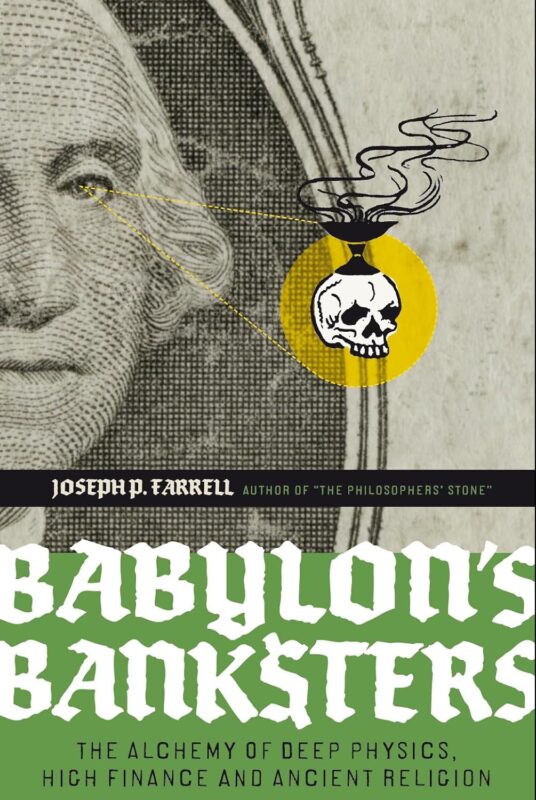
Babylon's Banksters by Joseph P. Farrell presents a compelling thesis: financial elites have long manipulated both money and energy through hidden knowledge inherited from a lost high civilization. Farrell draws from physics, ancient religion, banking history, and esoteric traditions to show that modern financial crises stem from deliberate suppressions and recoveries of this concealed science. He situates the roots of global finance not in recent centuries but in the remnants of an interplanetary conflict whose aftermath shaped the structure of ancient empires and today’s central banking systems.
Ancient Templates for Power
Mesopotamia and Egypt held more than mythological narratives and monumental architecture. Farrell identifies their temples as operational centers for both astronomical observation and economic control. He proposes that these civilizations inherited symbolic systems designed to encode lost sciences, including a unified model of physics and finance. These temples functioned as early banks. Priests measured celestial events to guide agricultural and fiscal cycles. Architecture mirrored cosmic alignments, embedding scalar and torsion-based physics within ritual structures. Sacred geometry and alchemical motifs encoded not aesthetic preferences but survival strategies following a cosmic cataclysm.
A Global Monopoly Emerges
The priesthoods of Sumer and Egypt aligned with merchant elites to rebuild fragments of the lost technology. They consolidated control by institutionalizing money as symbolic authority rather than direct representation of labor or value. This shift created a split: an esoteric elite preserved the underlying physics of money creation, while exoteric governance administered debt instruments disconnected from production. Over centuries, this bifurcation hardened into financial castes whose power derived from the manipulation of scarcity. This monopoly extended through empires and into the chartered banking institutions of the modern world.
Alchemy as Economic Engine
Farrell recasts alchemy not as a proto-chemistry but as an encoded language for energy transformation. He interprets the creation of fiat money as the financial equivalent of transmutation. Central banks create money from nothing and charge interest on it—an act that mimics the alchemical goal of deriving value from the void. This sleight of hand defines what Farrell calls the “closed system” of finance, in which debt exceeds the money supply by design. Scarcity becomes policy, not result. Such a system cannot sustain itself without periodic implosions, which allow elites to consolidate assets under the guise of crisis.
Cycles as Control Mechanism
Financial markets follow cyclical behaviors more predictable than traditional economics admits. Farrell incorporates the work of Edward Dewey and the Foundation for the Study of Cycles, arguing that long-wave economic events align with astronomical and geophysical rhythms. These patterns reveal a deeper physics ignored by mainstream financial models. The suppression of this data is strategic. By concealing the cyclicality of economic behavior, elites retain the power to trigger or withhold credit and liquidity according to private calendars rather than public need.
The Rise of Econophysics
The collapse of the derivatives market in 2008 exposed the fragility of models built on statistical shortcuts. Farrell traces this collapse to the work of Dr. David X. Li, whose Gaussian copula formula enabled vast bundling of risk into synthetic credit instruments. The formula ignored historical data in favor of market price behavior. This methodological choice created an illusion of safety that accelerated the growth of credit default swaps beyond any reasonable hedge. Farrell connects Li’s work to Chinese financial strategy, suggesting that the formula’s deployment and timing may have served geopolitical ends.
China's Strategic Detachment
Farrell highlights China’s use of sovereign money as a direct rejection of Western banking norms. The People’s Bank of China issues credit without tying it to debt owed to private banks. This structure creates an open system of finance that allows expansion in sync with economic growth rather than in response to interest obligations. China’s rise signals more than a shift in global manufacturing—it represents the re-emergence of a financial model last used effectively by Nazi Germany before its destruction. The threat lies in the model, not the state.
Nazi Germany's Breakaway Model
Nazi Germany implemented a debt-free currency system based on state-issued labor certificates. This radical financial independence, paired with aggressive pursuit of exotic energy technologies, placed the regime in direct conflict with global finance. Farrell suggests that Nazi research into torsion physics and vacuum energy marked a systematic effort to recover the lost physics of the ancient world. Through the SS’s technology offices, Germany pursued a parallel scientific pathway, unpublicized and deeply classified. Its defeat did not end these efforts; rather, it dispersed the knowledge into allied and covert hands.
The Bilderberg Convergence
Farrell identifies the 1954 Bilderberg meeting as the beginning of a new détente between remnants of the Nazi international network and the Anglo-American financial elite. This alliance formed around shared interest in monopolizing the physics-finance connection. Both factions recognized the need to suppress public access to over-unity energy systems and to maintain control of the credit supply through closed monetary regimes. Their cooperation stabilized the postwar order while enabling covert continuation of high-energy physics research under corporate and military auspices.
Scalar Temples and DNA Templates
The book expands into scalar physics and Earth grid theories. Farrell references the work of Konstantin Meyl and others to argue that ancient sacred sites resonate with planetary frequencies. These sites form a global energy web that ancient builders manipulated to harness geomagnetic power. He explores connections between architectural patterns and human DNA, suggesting that elites understand and exploit these templates to regulate consciousness and behavior. This strategy extends into selective breeding among banking dynasties and the symbolic narratives that surround bloodlines like the Rothschilds.
A Blueprint of Suppression
The suppression of both technologies and theories that could liberate energy and finance from centralized control defines modern history. Farrell outlines three primary mechanisms: ridicule of alternative science, legal blockades on technological development, and assassination or marginalization of disruptive thinkers. He documents patterns of invention suppression, particularly in energy and propulsion systems that hint at non-linear field manipulation. These patterns suggest coordinated activity rather than institutional inertia. The goal is not progress but preservation of advantage.
Strategic Obfuscation of Origins
Farrell posits that myths, alchemical texts, and ancient cosmologies preserve remnants of pre-cataclysmic knowledge. These remnants, encoded in symbolism and ritual, provide frameworks for recovering the lost science. Elite groups maintain access through coded transmission rather than direct disclosure. Control depends on maintaining the illusion that these texts are allegories rather than technical manuals. By controlling interpretation, elites block access while mining the material for themselves. This secrecy does not reflect benevolence. It reflects strategy.
Convergence of Finance and Physics
The central claim emerges with increasing clarity: the world financial system is an engineered artifact designed to mirror specific physical assumptions. A system based on scarcity, accumulation, and entropy reflects a belief in closed systems, both economic and energetic. The elites who maintain this structure fear its dissolution. An open system of finance would mirror an open system of physics, one in which energy is abundant, debt is unnecessary, and monopoly loses its lever. The battle is not over ideology. It is over access.
The Banksters' Decline
The model Farrell presents converges toward a visible horizon. The closed system cannot endure its own contradictions. The increasing visibility of suppressed technologies, the emergence of debt-free currency systems, and the breakdown of economic modeling all signal transition. The system fails under its own constraints. The rise of alternative financial architectures and the rediscovery of ancient physics intensify pressure on the elite paradigm. Their power depends on secrecy. Transparency dissolves it.
Physics as Liberation
Energy flows determine power. Whoever controls the source and narrative of those flows controls society. Farrell asserts that the recovery of ancient physics represents not a return to mysticism but a reactivation of lost capacities. These capacities include coherent field manipulation, over-unity energy generation, and geometric harmonization of architecture with planetary frequencies. They also include the capacity to align financial instruments with cycles of abundance rather than scarcity.
An Ancient Struggle Reignites
The cosmic war Farrell describes continues not in outer space but in boardrooms, laboratories, and digital exchanges. Its weapons are algorithms, treaties, trade routes, and disclosure campaigns. Its battlefields span regulatory frameworks and intellectual property laws. Its victors will determine whether energy and credit remain centralized tools of coercion or become distributed platforms of sovereignty. The stakes are total.
The Alchemy of Agency
Farrell concludes that the choice lies in who creates the money and what that money represents. When private banks create money as interest-bearing debt, the system enslaves. When states issue money as receipts for value, the system liberates. The same holds for energy. When physics remains captive to fossil extraction and consumption, power accumulates in monopolies. When physics embraces the medium as energy source, autonomy expands. Alchemy begins with a question of agency: who controls the process of transformation? The answer defines history.