The War on Populism: Consent Factory Essays, Vol. II (2018-2019)
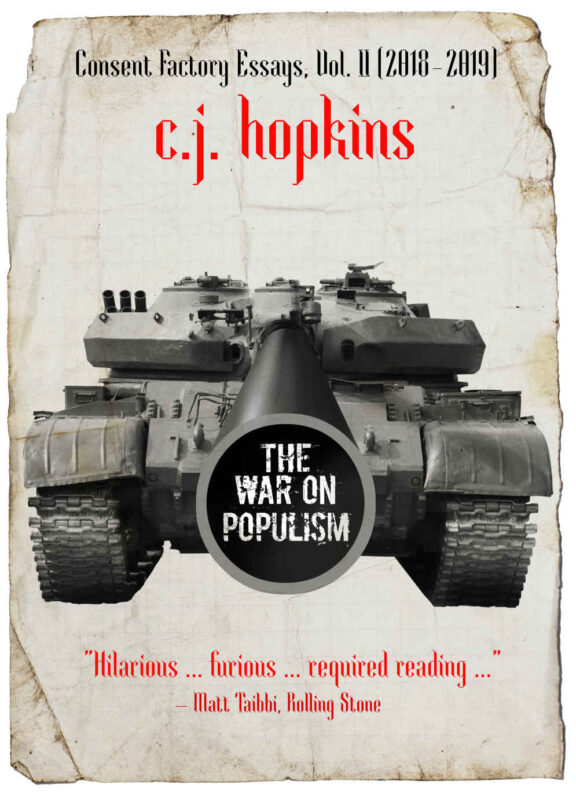
The War on Populism: Consent Factory Essays Vol. II (2018-2019) by C. J. Hopkins interrogates the architecture of global capitalism, dissects the media’s role in shaping consensus, and traces the transformation of dissent into pathology in the years following the 2016 Trump election. Hopkins mobilizes sharp satire and relentless logic to chart how “GloboCap”—his shorthand for the interconnected global capitalist order—identifies threats, manufactures narratives, and subsumes resistance into market ideology. Through this lens, the essays expose the system’s capacity for ideological adaptation, its deployment of information warfare, and its relentless drive to commodify value, identity, and dissent.
Origins of the War on Populism
The campaign Hopkins calls the “War on Populism” crystallizes on the night of November 8, 2016, as a spontaneous consensus forms among elites, intelligence agencies, and media operators. No secret memos or official declarations initiate this paradigm shift. Key actors understand their roles and launch a coordinated narrative pivot. The war on terror dissolves, replaced almost overnight by a new existential struggle against “populism”—embodied in the figure of Donald Trump and echoed by parallel movements in the United Kingdom, Germany, France, and beyond. The machinery of intelligence and media swiftly begins manufacturing stories of Russian collusion, disinformation, and fascist resurgence, flooding public discourse with a new enemy and a new rationale for conformity.
The Role of Ideology in Shaping Reality
Hopkins defines global capitalism not simply as an economic system, but as an ideology—one that operates by delimiting the boundaries of conceivable reality. He draws on Marx and Engels’ understanding of ideology as the production of consciousness, asserting that global capitalism constitutes the conceptual terrain upon which collective reality is constructed. Within this framework, ideology does not obscure reality but rather becomes indistinguishable from it, setting the parameters of what can be thought, said, or even imagined. The system achieves ideological dominance by eradicating alternative value structures, absorbing the remnants of old orders, and recoding social and cultural life in the language of the marketplace.
The Mechanics of Narrative Change
The transition from the war on terror to the war on populism unfolds through seamless media and institutional cooperation. The threat of terrorism evaporates as the enemy morphs into a conspiracy of Russian-backed neo-fascists, emerging precisely at the moment when Trump wins the presidency. Intelligence agencies fabricate dossiers and leak stories; the media amplifies these tales and forges mass hysteria. The campaign seduces liberals, coerces the left, and isolates dissenters through guilt, fear, and emotional manipulation. By the end of Trump’s first year, the populist insurgency becomes synonymous with Russian infiltration, fascist takeover, and existential threat to democracy itself.
GloboCap and the Transformation of Values
The essays delineate GloboCap’s mission: to erase despotic values—those established by kings, priests, artists, families, or communities—and replace them with a single, fungible value: exchange value. Global capitalism, as Hopkins describes, operates as a value-decoding and recoding machine, transforming societies into markets and rendering identity, belief, and even opposition as commodities. The end of the Cold War marks an acceleration, as GloboCap destabilizes and restructures former Eastern Bloc states and Middle Eastern societies, incorporating them into a borderless market. The logic of absorption extends inward as well, targeting holdout pockets in Western democracies that cling to traditional, religious, or national values.
Manufacturing Conformity: The Media’s Enforcement Arm
Mainstream and corporate media serve as GloboCap’s principal enforcers, orchestrating reality through the relentless repetition of official narratives. Journalists parrot intelligence agency leaks, marginalize alternative viewpoints, and demonize those who challenge the prevailing order. Terms like “populist,” “globalist,” or “neoliberal” acquire pejorative connotations, transformed into coded language for racism, anti-Semitism, or extremism. Media coverage operates less as debate than as disciplinary action, constructing “crises” to reinforce conformity and delegitimize resistance. The process is cumulative—accusations stick, and repeated exposure creates unassailable axioms, immune to refutation or critical scrutiny.
Weaponizing Identity and Division
Hopkins identifies identity politics as both a genuine force for justice and a tactical asset for GloboCap. Campaigns for social justice become interwoven with efforts to enforce ideological uniformity. The system weaponizes difference—racial, gender, sexual, religious—to prevent the coalescence of populist resistance. Rival factions among left and right are set against one another, distracted by cultural skirmishes while the machinery of commodification proceeds unimpeded. As ideological boundaries blur, even anti-capitalist or anti-globalist movements are neutralized, stigmatized, or absorbed back into market logic. The essayist observes the relentless drive to “purify” society of despotic values, establishing a hyper-conformist consumer landscape modeled on the language and ethics of multinational corporations.
The Expansion of Surveillance and Censorship
Hopkins traces the expansion of digital surveillance and corporate censorship as central features of the war on populism. Platforms like Twitter and Facebook collaborate with intelligence and law enforcement, tracking dissent, deploying “counter-speech” teams, and erasing content deemed subversive or divisive. Google algorithmically deranks or misrepresents non-corporate news sources, while advisory emails and warning labels target users who engage with flagged content. These mechanisms operate under the banners of “combating extremism” and “protecting democracy,” while consolidating control over the terms of debate and the shape of collective reality.
Pathologizing Dissent
A central theme in Hopkins’ analysis is the pathologization of dissent. Resistance to GloboCap becomes medicalized, transformed from disagreement into evidence of psychological disorder or deviance. Critics face branding as conspiracy theorists, extremists, or even mentally ill—a maneuver that removes dissent from the sphere of debate and places it within the domain of treatment, exclusion, or elimination. The system tolerates only officially sanctioned forms of dissent, while anything else is rendered abnormal or dangerous. This paradigm extends to the labeling of entire movements as threats to national or global security, providing ideological cover for their marginalization or neutralization.
The Manufacture of Mass Hysteria
Hopkins dissects the manufacture of mass hysteria as a tool for reality control. From Russiagate to the Brexit crisis, the essays chart the repetitive use of emotionally charged narratives to engineer conformity and shape public response. Accusations of foreign interference, fascist infiltration, and systemic racism serve to direct outrage, coerce behavior, and rally support for the enforcement of ideological orthodoxy. Hopkins presents these crises not as spontaneous eruptions, but as orchestrated campaigns that harness fear, guilt, and social pressure to strengthen GloboCap’s hegemony.
The Death Throes of Nationalism
The rise of populist and neo-nationalist movements emerges in the essays as a symptom of global capitalism’s completion, not its reversal. Hopkins frames populism as the last, spasmodic effort of national sovereignty to reassert itself in the face of an unstoppable process of global market integration. These movements flare brightly, capture the attention of media and elites, but ultimately serve as markers of the end of an era. Nationalist and fundamentalist resistance proves difficult to absorb, but Hopkins asserts that GloboCap’s time horizon and systemic reach will eventually overwhelm these holdouts, converting even resistance into fodder for the market.
Democracy as Ideological Mask
Hopkins treats “democracy” as a linguistic mask for capitalist ideology. As global capitalism exhausts despotic values, it markets itself as democracy to secure legitimacy and conceal the mechanisms of commodification. The language of democracy obscures the reality of market domination, even as real political power shifts to unaccountable corporate and supranational entities. The manufactured crises—wars, elections, social upheaval—divert attention from the consolidation of this power, providing a spectacle in which democracy appears vibrant and embattled, even as its substance is redefined in market terms.
No Escape from the Ideological Desert
Hopkins argues that the scope of global capitalism has rendered ideology both ubiquitous and invisible. The system’s reach produces an environment in which alternatives become unthinkable; all opposition is reinterpreted as deviation from the norm, not as legitimate adversary. The commodification of values and identities erases inherent meaning, creating a “desert of the real” in which everything becomes interchangeable, fungible, and ultimately disposable. The system’s operators—billionaires, CEOs, even political leaders—occupy positions within the machine but cannot exert genuine control over its logic or trajectory. Global capitalism runs itself, driving humanity toward a future defined by nihilism and commodification.
The Inexorable Logic of Systemic Power
Across the essays, Hopkins sustains the claim that global capitalism’s logic operates independently of individual will or conspiracy. The system assimilates resistance, recodes ideology, and co-opts even those who profit from its operation. Structural power emerges from the system’s self-perpetuating logic, not from the intentions of its actors. This insight directs attention away from scapegoats and villains and toward the dynamics of commodification, surveillance, and consensus formation that define the era.
The Closing of the Ideological Circle
As the essays draw to a close, Hopkins refuses to offer false hope or facile solutions. He recognizes the scale of GloboCap’s achievement—a global order that defines the boundaries of reality, polices the terms of debate, and subsumes all resistance into the logic of the market. The current period’s ideological polarization, media-driven hysteria, and accelerating conformity reflect the system’s power, not its weakness. Dissent persists but finds itself surrounded, outmaneuvered, or pathologized. The future, Hopkins warns, will see continued polarization, intensified surveillance, and more sophisticated campaigns to direct and control the terms of public life.
A Record of Madness and Manipulation
Hopkins intends these essays as an unofficial historical record, documenting both the madness of recent years and the machinery responsible for it. He compels readers to observe the convergence of narrative control, ideological enforcement, and social engineering as elements of a single, global campaign for the domination of consciousness. The account insists on specificity—naming actors, mapping strategies, and clarifying the logic at work beneath the spectacle. Hopkins invites readers to see through the manufactured crises, to recognize the forces shaping “reality,” and to prepare for a future in which the contest for hearts and minds continues, reshaped by each new phase of systemic evolution.