The Making of a Human Bomb: An Ethnography of Palestinian Resistance (The Cultures and Practice of Violence)
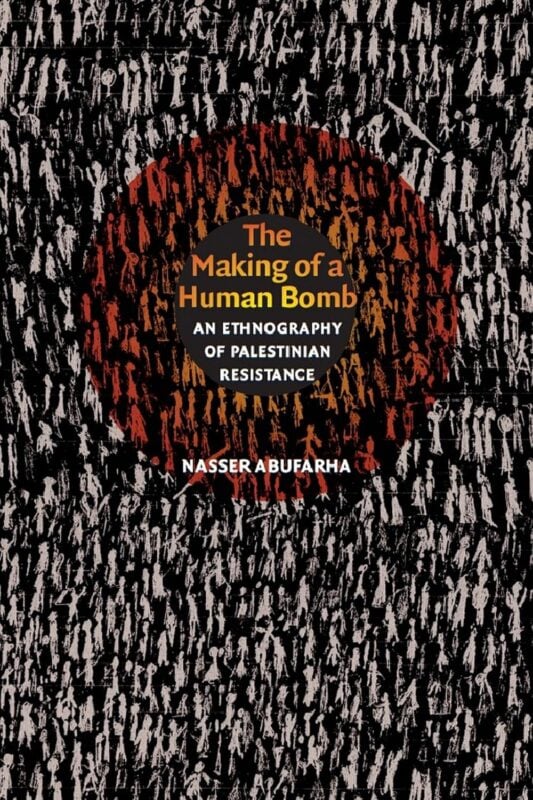
The Making of a Human Bomb by Nasser Abufarha investigates how Palestinian martyrdom operations emerge from embedded cultural, historical, and political contexts. Drawing from fieldwork in Jenin during the Al-Aqsa Intifada, Abufarha dissects the poetics, aesthetics, and strategy of what Western discourse calls suicide bombings but Palestinians name ’amaliyyat istishhadiyya—martyrdom operations. He constructs a framework that binds acts of self-sacrifice to cultural production, asserting that martyrdom represents a form of life through death, rooted in social cosmology and the lived experience of fragmentation under Israeli occupation.
Palestinian Ontology and the Grammar of Sacrifice
Abufarha centers his ethnographic work on Palestinian life as shaped by the Israeli state’s occupation. Fragmentation, confinement, and restricted movement generate an ontological state that defines how Palestinians relate to space, history, and each other. Martyrdom, in this framework, does not signify disappearance but emergence. The act of self-detonation transforms the performer into a symbol that bridges dislocated communities and reclaims disrupted geographies. It is an assertion of presence where political and physical displacement suppresses identity.
Martyrdom conveys this through performative violence. The martyr disrupts Israeli normalcy and reconstitutes Palestinian visibility. Inverting death as disappearance, the act produces a moral and cultural subject who gains posthumous agency. The martyr becomes both agent and offering, the human bomb functioning as a ritual that regenerates collective memory and territorial imagination. The martyr fuses with the land, producing a sacrificial exchange that sanctifies place and history.
Historical Continuities of Self-Sacrifice
The emergence of martyrdom operations during the 1990s builds on earlier models of Palestinian resistance. The fida’i—the fighter who sacrifices himself for the homeland—defined the 1960s and 1970s resistance ethos. These fighters did not return. Their operations were cross-border, culminating in death. This template remained until Hamas initiated the first istishhadiyya attacks in 1994. With Hamas and Islamic Jihad’s adoption of the practice, and later participation from secular groups like Fatah and the Popular Front for the Liberation of Palestine (PFLP), martyrdom became a political tool and a cultural form.
The transition from fida’i to istishhadi signals not only a change in strategy but a shift in symbolic logic. Istishhad foregrounds intentionality, elevating the subject from passive death to deliberate self-sacrifice. This language emerged not from Islamic theology but from political necessity. The term istishhadi did not exist in classical Arabic usage. Hamas introduced it to bind nationalist resistance to an Islamic metaphysics of reward and duty. The istishhadi is one who seeks martyrdom, transcending victimhood by orchestrating their own disappearance into communal regeneration.
The Role of Cultural Production in the Human Bomb
Abufarha tracks how martyrdom enters everyday life not only through acts of violence but through sustained cultural work. Posters, songs, videos, and parades convert individual death into collective identity. The image of the martyr circulates widely, producing affective solidarity and spatial continuity. Palestinian media, school murals, and family testimonials reconstruct the martyr as a subject who lives beyond death through cultural invocation.
Martyrdom, then, becomes a medium of storytelling. Each act enters a lineage that recodes the geography of occupation into a cartography of resistance. Land is not merely contested—it is fused with the martyr’s body. Through sacrifice, the martyr irrigates the land with meaning. The metaphor of blood as water, flesh as soil, and explosion as reconstitution allows Palestinian collectives to imagine an unfragmented space despite territorial divisions. This semiotic practice sustains political agency under siege.
Ethnography of Violence as Social Expression
The book positions martyrdom as a culturally mediated performance, guided by strategic goals and shaped by communal expectations. Drawing on interviews with militants, families, and political operatives, Abufarha reveals the human bomb as a social subject constructed through dialogue, preparation, and symbolic alignment. The act is deliberated, not impulsive. Militants offer themselves; organizations accept and orchestrate.
This exchange is bound by ritual and aesthetics. Statements, recordings, and martyr videos are produced with intentional symbolism, referencing place, history, and future redemption. The martyr carries not only explosives but representational weight. Their performance refracts personal grievances through collective struggle, and the detonation becomes a scene that reasserts control in an environment saturated with surveillance and dispossession.
From Personal Agency to Political Strategy
Abufarha’s analysis refuses psychological reductionism. He dismisses interpretations that frame martyrdom as irrational or pathological. Instead, he presents martyrdom as a strategic and communicative act—a political maneuver that gains coherence within a field of constrained options. Martyrdom is not an escape; it is an address. The target is both physical and symbolic.
Groups like Hamas, Fatah, and PFLP deploy martyrdom with calculated goals. These acts are timed, located, and framed within political escalations. Martyrdom responds to assassinations, incursions, or diplomatic failures. The second Intifada marked a turn inward. Palestinians ceased appealing to global institutions and redirected their struggle toward direct confrontation. Martyrdom became a way to communicate defiance when negotiations had collapsed and international legitimacy proved inaccessible.
Ritual Performance and the Rebirth of Land
Sacrifice in this context creates a moral economy. The martyr offers the body as a means of restoring sanctity to land and asserting political will. Drawing on theories of sacrifice from Durkheim, Hubert, and Mauss, Abufarha argues that martyrdom reorders cosmological relations. The body becomes a medium of exchange, transferring sacred value to space, producing landscapes of belonging.
This ritual exchange links the microcosm—the body—to the macrocosm—the nation. Explosions are not destructions; they are creative acts, reassembling fragmented identities through sacrificial logic. The martyr activates a blood covenant, turning the rupture of flesh into the continuity of peoplehood. Through this lens, martyrdom is not merely violent resistance but cosmogenic practice.
Narratives of Historicity and Collective Memory
Abufarha places this symbolic system within broader Palestinian historicity. His childhood memories, shaped under Israeli occupation, lacked formal education in Palestinian history. Instead, history persisted through oral narratives, songs, and indigenous cartographies. Children scrawled “Palestine” on walls and trees even as textbooks erased the word. This cultural tenacity became a framework through which martyrdom gained coherence. The erasure of Palestine produced the drive to inscribe it through action.
Martyrdom stories tap into a century of dispossession, dating back to Ottoman land transformations and British Mandate displacements. Through song, mural, and anecdote, Palestinians construct a continuous narrative that binds past traumas to present resistance. Martyrs occupy this continuity, becoming markers of historical causality rather than aberrations.
Operational Data and Fieldwork Integration
The book incorporates data from 213 operations between 2001 and 2004, including 80 considered istishhadiyya. Abufarha’s fieldwork includes interviews with families, political operatives, and cultural producers. He charts variables such as geography, age, gender, and educational background of martyrs. This empirical mapping grounds the symbolic analysis in material reality. The martyr emerges as both subject and dataset, as both icon and informant.
By embedding his study in Jenin—his hometown and a center of resistance—Abufarha claims ethnographic authority while navigating methodological challenges. He acknowledges his dual role as insider and analyst, maintaining critical clarity while drawing from personal history. This positioning enables access to sensitive networks and deep cultural fluency.
Martyrdom as Challenge to Global Hierarchies
Abufarha expands the analytical frame beyond Palestine. He links martyrdom to global formations, arguing that the act challenges the international order’s moral and political hierarchies. The West’s criminalization of suicide bombing, paired with its legitimation of state violence, produces a discourse that delegitimizes Palestinian resistance while obscuring its structural causes. Martyrdom interrupts this narrative by asserting non-recognized sovereignty and collapsing the asymmetry between occupier and occupied.
Martyrdom thus forces visibility. It disrupts geopolitical amnesia and inserts Palestinian presence into global consciousness. The aesthetic of rupture becomes a grammar of demand. The book challenges readers to confront the violence embedded in invisibility and the coercive frameworks that define who counts as a political subject.
Conclusion: Toward a Cultural Logic of Resistance
The Making of a Human Bomb demands a shift in how violence is understood. It insists on reading martyrdom through its cultural logic, situating the act within layered histories of loss, performance, and assertion. Abufarha constructs a theory of resistance grounded in cultural production, social imagination, and the transformative capacity of sacrifice.
His work dismantles the reductive binaries that dominate security discourse. Martyrdom is neither madness nor nihilism. It is a structured, aesthetic, and strategic act that reorganizes political space. The human bomb is not a spectacle of death but a medium of reconstitution—of identity, territory, and agency. Through the body, Palestinians write their demand for recognition into the geography of conflict.

About the Book