Beyond Chutzpah: On the Misuse of Anti-Semitism and the Abuse of History
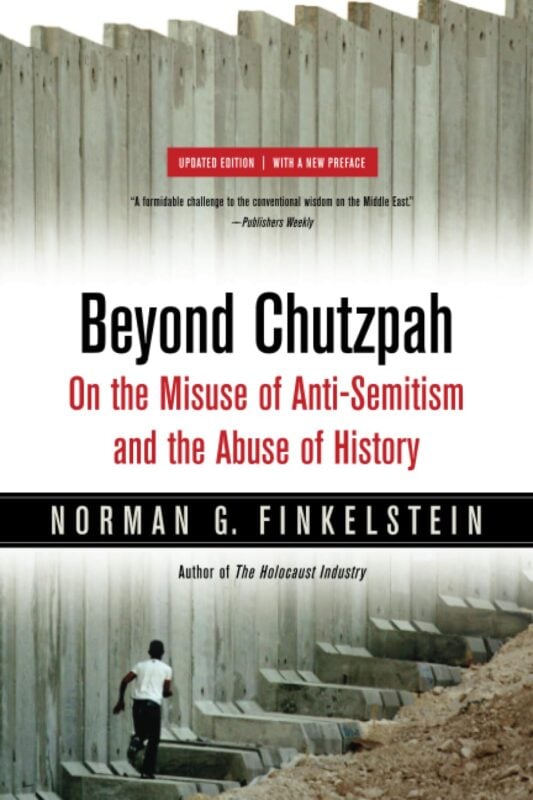
Beyond Chutzpah by Norman G. Finkelstein confronts the political manipulation of anti-Semitism and exposes systematic distortions in how history, law, and human rights are used to shield Israeli state actions from scrutiny.
The Collapse of Historical Debate
Norman Finkelstein anchors his analysis in the assertion that foundational questions about the Israel-Palestine conflict no longer sustain real controversy. Israeli archives and independent scholarship, particularly by Israeli historians such as Benny Morris and Shlomo Ben-Ami, document the ethnic cleansing of Palestinians in 1948. The former foreign minister of Israel concedes that expulsion was consistent with Zionist strategic objectives. This historical record narrows the frame of debate and leaves little ambiguity about the character and consequences of Israel’s founding war.
Once scholars accept that displacement was systemic, the rationale for discussing competing narratives diminishes. Historical contention shifts into political theater. Finkelstein argues that institutions continue to manufacture doubt through selective citation, deliberate omission, and reliance on discredited apologists. These distortions serve to obscure a historical pattern whose factual core is publicly documented and no longer disputed by serious researchers.
Unchallenged Human Rights Documentation
Human rights reports on the Occupied Palestinian Territory have achieved rare unanimity across organizational boundaries. Amnesty International, Human Rights Watch, B’Tselem, and Physicians for Human Rights all reach consistent conclusions regarding Israeli violations. They find patterns of collective punishment, extrajudicial executions, destruction of civilian infrastructure, and illegal settlement expansion. These findings do not vary by political orientation or international affiliation.
Finkelstein surveys these reports to demonstrate a convergence rarely found in conflict zones. He isolates the singularity of human rights consensus as an evidentiary foundation. From this position, he identifies how state actors, including Israel and its supporters, deflect scrutiny not by refuting facts but by casting doubt on the legitimacy of the investigators. This maneuver, he contends, shifts focus from facts to motives, an evasion tactic that undercuts public understanding.
The Function of the High Court
Israel’s High Court of Justice features prominently in Finkelstein’s analysis as a juridical mechanism that retroactively legalizes violations of international law. He traces how rulings on the separation wall, expropriation of land, and targeted killings cohere with state policy. The court lends legal cover to military strategies while preserving the illusion of democratic accountability.
In its landmark ruling on the separation barrier, the International Court of Justice declared the wall illegal and reaffirmed that Israel possesses no sovereign claim to the West Bank, East Jerusalem, or Gaza. By contrast, Israel’s domestic courts treated the same issues as security disputes and insulated them from the broader legal consensus. Finkelstein uses this judicial bifurcation to illustrate how national law is weaponized against international norms.
Controlling the Narrative Through Language
Language operates as a central battlefield. Finkelstein dissects terminological strategies that present Israeli violence as defensive and Palestinian resistance as terrorism. He shows how military operations involving heavy artillery and aerial bombardment are framed in U.S. and Israeli media as targeted strikes. Meanwhile, acts of Palestinian resistance, including stone-throwing or symbolic protests, receive labels that imply irrational aggression.
This asymmetry extends to casualty framing. Israeli casualties are individualized and mourned publicly; Palestinian deaths are aggregated and abstracted. The media architecture reinforces these distinctions through repetition and source selection. Statements by state officials receive primacy; contradictory evidence from human rights organizations appears as afterthought or not at all.
The Spectacle of the New Anti-Semitism
One of Finkelstein’s central claims is that the category of “new anti-Semitism” serves to silence critique of Israeli policy. He distinguishes between actual anti-Jewish prejudice and a rhetorical construct designed to immunize Israel from political accountability. According to this logic, condemnation of occupation, settlement policy, or civilian targeting becomes ipso facto evidence of latent anti-Semitism.
Finkelstein exposes this discourse as a tactical redeployment of Holocaust memory. He argues that post-1967 American Jewish elites, who had previously avoided overt Zionism for fear of dual loyalty accusations, began using Holocaust trauma as a moral shield. The Holocaust Industry, as he calls it, elevates Jewish suffering to a unique moral plane, weaponized to delegitimize Palestinian claims.
In this narrative, Palestinian actors are recast as heirs to Nazi ideology. From the Mufti of Jerusalem to contemporary leaders like Ahmadinejad or Hamas officials, a line is drawn linking Arab nationalism with genocidal intent. Finkelstein presents this genealogy as fictive, constructed through selective quotation, historical misrepresentation, and strategic silence.
Legal Consensus and Political Obstruction
The legal consensus supporting a two-state solution based on 1967 borders remains unchallenged in international law. General Assembly resolutions, World Court rulings, and human rights organizations affirm that Israel’s settlement enterprise, annexation of East Jerusalem, and military presence in the West Bank violate core principles of humanitarian law.
Finkelstein demonstrates that Israeli negotiators have consistently demanded terms that exceed their legal entitlements while Palestinians have agreed to concessions far below theirs. At Camp David, for example, Palestinians accepted partial settlement retention and limited return of refugees. Israel demanded major annexations, permanent military control, and renunciation of refugee rights. Yet media narratives cast Palestinian negotiators as rejectionist and Israeli leaders as generous.
The Role of the Media in Reinforcing Impunity
Major media outlets, especially in the United States, play a pivotal role in constructing public ignorance. Finkelstein documents how reports by credible investigators such as Human Rights Watch are buried beneath Israeli government statements. Discrepancies between eyewitness accounts, forensic evidence, and military denials are seldom reconciled. Instead, institutional trust is granted to the state over independent observers.
This imbalance produces a manufactured controversy. Incidents of clear culpability—such as the shelling of civilians on a Gaza beach—are reported as disputed matters. Meanwhile, systematic trends of abuse and structural violence are obscured by episodic coverage. Finkelstein asserts that this dynamic preserves Israel’s impunity and undermines informed civic discourse.
Manufacturing Intellectual Legitimacy
Finkelstein dedicates significant space to exposing fraudulent scholarship used to justify Israeli policy. He singles out figures such as Alan Dershowitz, whose book The Case for Israel he examines line by line. Finkelstein accuses Dershowitz of plagiarism, fabrication, and reliance on discredited sources. He shows how selective citation and tendentious logic create the appearance of rigorous defense while evading countervailing evidence.
These intellectual maneuvers operate within a broader network of institutional support. Prestigious universities, think tanks, and media platforms provide legitimacy to what Finkelstein identifies as propaganda. He positions his own intervention as an act of scholarly integrity, restoring the evidentiary standard to debates that have been corrupted by ideological loyalty.
The Consequences of Moral Equivalence
Finkelstein challenges the idea that violence by Hamas and the Israeli military exist on a moral continuum. He insists on analytical distinctions rooted in law, proportionality, and context. When the Israeli Air Force drops a one-ton bomb on a residential neighborhood, the legal and ethical consequences differ categorically from militant attacks on military personnel.
He scrutinizes the logic that exonerates Israeli actions as unintentional while condemning Palestinian violence as inherently criminal. Human rights organizations have documented instances where Israeli forces deliberately targeted civilians. Claims of accidental harm collapse under the weight of repeated patterns and official admission of premeditated policy.
The Role of International Institutions
Despite global consensus on the illegality of occupation and settlements, international institutions remain largely symbolic. United Nations resolutions pass overwhelmingly but lack enforcement. Economic sanctions target Palestinian governance, not Israeli expansion. When Hamas won democratic elections, Western powers responded with financial blockade rather than diplomatic engagement.
Finkelstein contrasts this with the leniency extended to Israel, whose violations of international law proceed without repercussion. The asymmetry reflects geopolitical interest rather than legal principle. U.S. support for Israel, both diplomatic and material, shields it from the consequences that lesser states routinely face.
The Structural Logic of Suppression
The convergence of legal, historical, and human rights evidence presents a coherent indictment of Israeli policy. Yet public understanding remains clouded. Finkelstein attributes this to a structural alliance between media institutions, political elites, and intellectual gatekeepers. The result is a managed perception that transforms clarity into ambiguity and justice into controversy.
Rather than expose contradictions, dominant discourse conceals convergence. Finkelstein urges a return to the documentary record as the baseline of any meaningful discussion. Only by reclaiming factual ground can political debate regain its legitimacy. The misuse of anti-Semitism and the abuse of history, he contends, function as deliberate strategies to perpetuate injustice and block redress.


About the Book