The Controversy of Zion
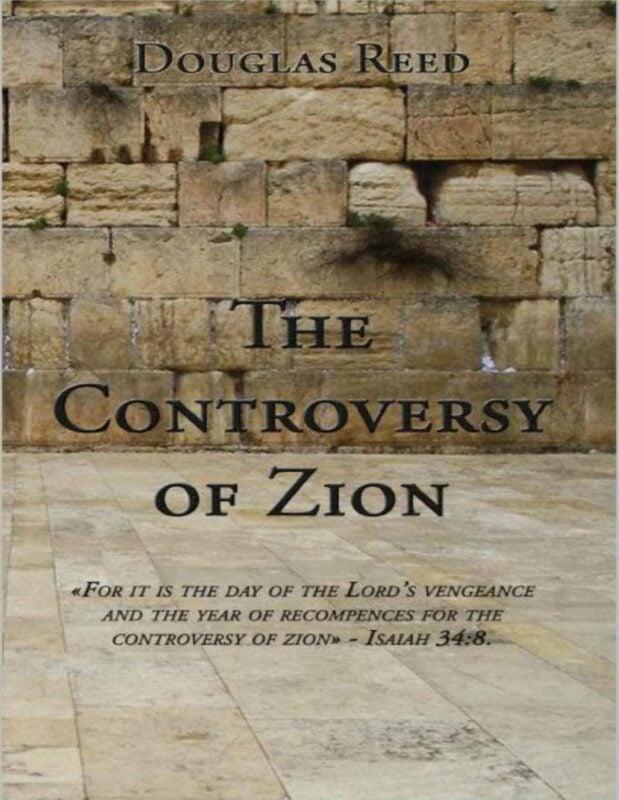
The Controversy of Zion by Douglas Reed reshapes the historical field with a thesis that anchors two millennia of Western history in the religious and political developments that arose from the tribe of Judah. Reed, drawing on decades of journalism and research, frames the emergence of the Judaic Law as the pivotal moment from which the arc of Talmudic Zionism began. He recounts the genesis of the Law in 458 BC, when the Levites, masters of the tribe of Judah, codified a doctrine that defined the Judahites as the “chosen people,” set apart by divine injunction and charged with a mission that would reverberate through the centuries.
Origins of the Doctrine: Judah, Israel, and the Levites
The narrative traces the early division between Israel and Judah, identifying the latter as the bearer of a creed that distinguished itself by exclusivity, separation, and a drive for dominion. Israel, identified with a universal, inclusive religious impulse, merged with surrounding peoples, leaving Judah to embody and transmit the doctrine of chosenness. Reed asserts that the Levites transformed oral tradition into a written code—the Law—which bound Judah to a program of self-segregation and spiritual militancy. Through this transformation, a vision of a universal God receded as the idea of a jealous, particularist deity gained ascendancy.
Reed’s analysis foregrounds the historical moment when the Levites produced Deuteronomy, which he asserts was the true origin of the Mosaic Law. This law did not merely serve as a religious code; it became the basis for a political program of conquest and the eventual dream of world rule. The Law embedded the idea that obedience to statutes and judgments would yield material rewards—territory, wealth, supremacy—while failure invited punishment, exile, and destruction.
Deuteronomy and the Foundations of Talmudic Power
Deuteronomy, Reed contends, acts as the keystone of Judaic religious authority. He maintains that it justified acts of “utter destruction” and commanded an unyielding intolerance toward neighboring peoples and alternative faiths. The Law dictated that other nations serve as targets of conquest, and it conferred legitimacy upon acts of violence, subjugation, and dispossession. Reed points to the numerous passages in Deuteronomy that require the destruction of rival peoples and the absolute separation of the Judahites from “the stranger.”
The book exposes the mechanism by which the Law operates: it sets up a rigid binary between the chosen people and the rest of humanity, rendering coexistence a condition of subjugation for outsiders. The Law incentivizes obedience with promises of dominance, while embedding fear of curses and annihilation for noncompliance. Reed asserts that this structure of reward and terror gave the Levites unparalleled control over Judah’s collective destiny.
Judah, Reed explains, soon became synonymous with the new doctrine, while Israel faded into assimilation with other cultures. The drive for absolute separation became the chief characteristic of Judah’s religious identity, as articulated by the Levite priesthood. The myth of Israel’s “vanishing” into history allowed the Judahites to claim sole possession of the covenant and the legacy of Abraham, even as the Levites denounced those Israelites who resisted the creed of exclusivity and vengeance.
The Prophets and Internal Dissent
The narrative does not proceed as a monolith of doctrinal certainty. Reed explores the tension created by the Hebrew prophets—Amos, Hosea, Micah, and others—whose voices challenged the Levitical order from within. These prophets, often from the northern Israelite tribes, championed justice, mercy, and the notion of a universal God accessible to all peoples. Their dissent forms a countermelody in the historical record, pointing to a struggle within the Jewish tradition itself.
Reed identifies this internal critique as a persistent thread that complicated the otherwise stark trajectory of exclusion and vengeance set by the Levites. The prophets condemned ritual sacrifice, the cult of blood, and the subjugation of others, urging a return to ethical conduct and neighborliness. Yet, as Reed demonstrates, the Levites reasserted their dominance by codifying the Law, enshrining doctrines that made dissent a punishable offense.
The Shift from Religion to Political Program
Reed sharpens his focus on the historical moment when religious law became a program of political action. The transition from the oral to the written Torah marked the consolidation of priestly power. The Law’s statutes did not remain confined to religious ritual; they structured the social, legal, and political order of Judah. The Levites positioned themselves as the sole interpreters of God’s will, and their authority depended on continuous observance of the Law’s most severe provisions.
Deuteronomy’s program of “utter destruction” laid the ideological groundwork for future historical movements. Reed draws a through-line from the law codes of the ancient Judahites to the doctrines of Talmudic Judaism, and from there to the development of modern Zionism. He identifies the establishment of the state of Israel and its actions in the 20th century as extensions of a tradition that privileges separation, expansion, and exclusivity.
Modernity, Zionism, and Geopolitical Outcomes
Reed moves his analysis into the 19th and 20th centuries, tracking how the revival of the Zionist movement renewed ancient themes for a modern age. He situates the birth of political Zionism in the late 19th century, highlighting the leadership of Theodor Herzl and others who articulated a vision for a Jewish national home in Palestine. Reed’s account scrutinizes the ideological lineage from the ancient Law to the founding texts of Zionism, revealing continuities in the logic of separation, entitlement, and mission.
He examines the political processes that enabled the Zionist project, including the Balfour Declaration, the support of Western powers, and the creation of the World Zionist Organization. Reed describes how these developments catalyzed conflict in the Middle East, especially during the foundation of Israel in 1948, the Suez Crisis, and subsequent wars. He claims that these events exemplify the persistence of a doctrine that defines security through domination and expansion.
Reed interrogates the logic that underlies the naming of the state of Israel. He asserts that the historical Israelites rejected the Levite doctrine and disappeared into other nations, making “Israel” a misnomer for the modern state. Instead, Reed claims, the state should identify as the heir of Judah, the true bearer of the separatist doctrine.
Media, Suppression, and the Power to Define History
Reed recounts the reception of his own work and his contemporaries. He observes a pattern of suppression and marginalization, interpreting the postwar disappearance of his books from Western publishers as evidence of a broader reluctance to confront the doctrines at the heart of Talmudic Zionism. Reed treats this phenomenon as part of the same logic that drove the Levitical project: control over narrative, monopoly on interpretation, and suppression of dissent.
He explores the role of the press, publishing industry, and political elites in managing the discourse around Zionism and Jewish history. Reed contends that the failure to engage critically with these doctrines distorts public understanding of world events. He urges readers to recognize the persistent power of religious ideas in shaping policy and perception.
Moral Argument and the Prospect of Change
Reed anchors his work in a moral vision that seeks the transcendence of separatist doctrines. He draws from the internal critiques within the Jewish tradition to argue for the possibility of a new historical synthesis. He claims that the forces unleashed by the Levites are not immutable; the future depends on the willingness of Jews and non-Jews to move beyond the idea of chosenness and exclusion.
He predicts a reckoning with the destructive legacy of revolutionary Zionism, suggesting that Jews, observing the outcomes of conflict, may reject the exclusivist creed in favor of integration with common humanity. Reed frames this not as an act of assimilation but as a return to the prophetic ideals of justice, compassion, and participation in the world’s destiny.
The Structure of Reed’s Historical Synthesis
Reed’s book follows a clear trajectory from ancient origins through the development of doctrine, the assertion of priestly power, the challenges of the prophets, and the consolidation of law as political program. The analysis extends through the rise of modern Zionism, the formation of the state of Israel, and the dynamics of global politics. Reed’s narrative interweaves textual analysis, historical episode, and contemporary observation, generating a synthesis that seeks to render intelligible patterns that have shaped modern history.
He claims that the impact of Talmudic Zionism cannot be understood apart from the scriptural foundations laid in the centuries before the common era. The Law’s promises, threats, and mechanisms of control did not remain relics of the past; they informed the logic of political Zionism and the conduct of statecraft. Reed positions his work as an attempt to break the silence around these continuities and invite a new debate.
The Legacy and Influence of The Controversy of Zion
Douglas Reed’s book situates itself as both a historical intervention and a call to action. He asserts that the capacity of doctrines to shape events persists in the present. The enduring tensions in the Middle East, the character of Western support for Israel, and the cycles of conflict that have marked recent decades converge within a logic Reed traces to the Levitical Law. He does not merely recount events; he links outcomes to causes, establishing a chain of influence that extends from the ancient world to current headlines.
Reed closes with a vision of historical possibility. He urges readers to recognize the structural forces at play and to participate in a process of historical re-evaluation. He calls for an end to the invisible censorship that constrains debate and for the cultivation of new relationships grounded in shared humanity. The Controversy of Zion insists that the doctrines of separation, exclusivity, and vengeance do not stand as historical inevitabilities. They present themselves as problems for resolution and opportunities for moral and political renewal. Reed’s work, refusing resolution in nostalgia or denial, invites its audience to confront the past as a living influence and to take responsibility for shaping a different future.

About the Book