For The Time is at Hand An Account of the Prophesies of HENRY WENTWORTH MONK of Ottawa, Friend of the Jews, and Pioneer of World Peace
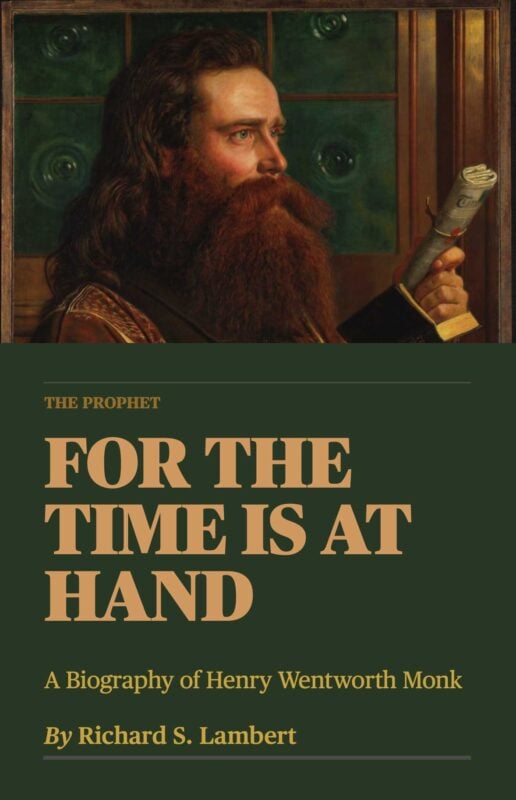
For The Time is at Hand by Richard S. Lambert traces the radical life and thought of Henry Wentworth Monk, a Canadian visionary who prophesied global war, advocated for Jewish restoration in Palestine, and articulated the foundational structure of a future United Nations before the end of the 19th century. Monk’s journey from the Canadian frontier to London’s Christ’s Hospital, from conversations with Abraham Lincoln to correspondence with John Ruskin, reveals a prophetic mission rooted in biblical justice, spiritual urgency, and geopolitical foresight.
A Childhood in March
Monk was born in 1827 in March, a planned military settlement west of Ottawa. His father, Captain Benning Monk, was one of several British officers granted land to build a new Eden after the Napoleonic Wars. The settlement embodied the aspirations of empire and the illusions of permanence. It featured large stone mansions, Anglican churches, and feudal hierarchies imposed on Canadian wilderness. Monk grew up in this utopian enclosure, shaped by Anglican orthodoxy from his father and Catholic devotion from his Irish mother. These dual religious influences embedded in him a sense of spiritual multiplicity and early ecumenism.
Christ’s Hospital and the Loss of Eden
At age seven, Monk was removed from March and sent to Christ’s Hospital, a London boarding school founded by Edward VI to educate poor but promising boys. The transition from river valley to urban prison altered his psychic structure. He endured strict routines, scant rations, rigid Anglican liturgy, and the alienation of colonial difference. He wore a distinctive bluecoat uniform, lived under public observation, and internalized a consciousness of otherness. At Christ’s Hospital, Monk devoured scripture, developed a capacity for allegorical reading, and began identifying current events with prophetic patterns. His experience of dislocation forged a lifelong alignment with the exiled, the stateless, and the outcast.
Encounter with London’s Industrial Future
Monk’s years in London coincided with the city’s technological transformation. Steam locomotion, electric telegraphy, and industrial acceleration reshaped the scale of human communication and transportation. These shifts triggered in Monk a theological insight: that technology was the instrument by which divine prophecy could become geopolitical reality. He interpreted Isaiah’s references to “chariots of fire” as predictions of railway expansion and saw in telegraphy a new tower of Babel to be reconstituted under divine unity. The convergence of biblical prophecy with modern machinery formed the core of Monk’s global vision.
The American Civil War and Abraham Lincoln
Monk crossed the Atlantic multiple times and lived for periods in the United States. During the American Civil War, he traveled to Washington and secured an interview with Abraham Lincoln. Lambert describes the meeting as pivotal: Monk implored Lincoln to end slavery not only as a national imperative but as a sacred obligation linked to world peace. He argued that justice for African Americans was spiritually contiguous with justice for Jews in Europe. Lincoln listened respectfully but did not act on Monk’s broader proposals. Still, the encounter symbolized Monk’s method: to address heads of state with the voice of a prophet, urging them to see policy through the lens of redemption.
The Vision of a Restored Palestine
Central to Monk’s theology was the conviction that peace required a return of the Jewish people to their ancestral homeland. He argued that anti-Semitism represented the moral failure of Christian civilization and that only by reversing the exile could Europe atone for its crimes. Palestine, he claimed, must become a “peace city” governed jointly by Jewish and Christian stewardship, with Jerusalem as the seat of a global tribunal. He outlined the architecture of this international order: a parliament of nations, a legal code, an international court, and an armed peace force. He proposed that Britain, the United States, and Canada—the “Big Three”—summon an international convention to formalize the federation.
The Letters to Balfour and the Roots of the Declaration
Two decades before the Balfour Declaration, Monk wrote directly to Lord Balfour to argue for the necessity of a Jewish national home in Palestine. Lambert provides the letter in detail, showing its theological, ethical, and logistical components. Monk described Jewish restoration not as a gift from empire but as an act of restitution. He envisioned Jerusalem as a beacon of legal justice and scientific progress. His emphasis on agriculture, harbor infrastructure, and water conservation foreshadowed later Zionist development plans. His influence remained unofficial but formative, his ideas filtering into British policy through personal networks and spiritual resonance.
Holman Hunt and the Power of Art
Monk’s closest cultural collaborator was Holman Hunt, the pre-Raphaelite painter whose religious scenes became canvases for Monk’s theology. They met in London and maintained a creative alliance for over forty years. Hunt’s famous painting “The Scapegoat,” inspired by a shared trip to the Dead Sea, visually represented Monk’s view of Jewish suffering as the foundation for world redemption. Hunt's “The Light of the World” and “The Finding of Christ in the Temple” also echoed Monk’s interpretation of scripture as historical directive. Lambert presents their friendship as a confluence of mysticism and visual prophecy, where painting functioned as theological action.
John Ruskin and the Philosophical Frame
John Ruskin, the Victorian art critic and moral philosopher, supported Monk’s ambitions. They exchanged letters, debated eschatology, and found common cause in their belief that material progress must serve moral purpose. Ruskin admired Monk’s synthesis of scripture and politics, viewing him as a necessary counterweight to the mechanized nihilism of the industrial age. Monk’s proposals gave Ruskin a frame through which to imagine ethical empire and civic internationalism. Lambert documents these exchanges to show how Monk influenced not just political thought but the deeper structure of moral philosophy among Britain’s leading intellectuals.
The Hague and the Precursor to the United Nations
In the 1890s, Monk’s advocacy contributed to the intellectual climate that led to the Hague Conferences. He lobbied for an international tribunal, corresponded with diplomats, and published tracts outlining the legal basis for peace enforcement. Lambert identifies Monk’s writings as precursors to the institutions later formalized in the League of Nations and the United Nations. Monk coined the term “United Nations” in the 1850s and used it consistently in his publications. He framed international order not as a balance of power but as an act of collective justice, anchored in spiritual reconciliation and the restoration of the Jewish people.
The Distortion and Afterlife of a Vision
Monk’s prophetic clarity also made him vulnerable to distortion. Anti-Semitic propagandists later appropriated aspects of his vision, twisting his public appeals into the fabricated Protocols of the Elders of Zion. Lambert confronts this legacy directly, emphasizing that Monk’s goal was not domination but reparation. His life’s work aimed to redeem Western civilization through justice, beginning with the most persecuted. His writings became both source and target—used by bigots, ignored by statesmen, preserved by descendants.
A Blueprint for Peace
For The Time is at Hand positions Monk not merely as a forgotten reformer but as an architect of world consciousness. His integration of scriptural mandate, geopolitical design, and technological insight provided a framework for peace that persists in contemporary diplomacy. He named global structures before they existed, offered restitution before genocide, and imagined unity before collapse. His letters remain blueprints. His theology, a form of political engineering. His life, an instrument for awakening moral possibility in international affairs.
About the Book