The Thirteenth Tribe
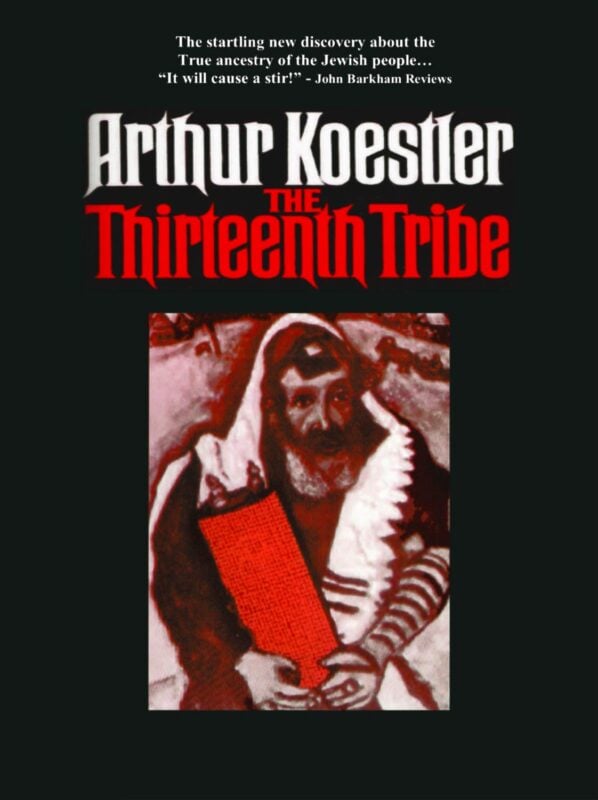
The Thirteenth Tribe by Arthur Koestler reconstructs the historical trajectory of the Khazar Empire, a once-powerful political and military entity that shaped the geopolitical contours of Eastern Europe between the seventh and tenth centuries. Koestler charts a meticulously documented narrative revealing how a Turkic-speaking people converted en masse to Judaism and later became a foundational demographic in the composition of Eastern European Jewry.
Khazaria’s Geopolitical Command
At its height, the Khazar Empire extended from the Caucasus to the Volga, securing the critical corridor between the Caspian and Black Seas. This geographical command placed the Khazars at the nexus of major civilizations, enabling them to halt the northern advance of the Islamic Caliphate. As Arab forces surged out of Arabia, toppling the Sassanid Empire and pressing into Byzantium, the Khazars resisted their incursions at the Darband and Dariel passes. Over a century of warfare followed, during which Khazar cavalry blocked repeated Arab attempts to capture key strategic cities such as Balanjar and Samandar. Military resilience turned the Khazar frontier into a bulwark defending the Christian Byzantine Empire’s eastern flank and prevented Muslim armies from penetrating into the steppes of Eastern Europe.
Conversion and Political Realignment
Around 740 CE, the Khazar ruling elite embraced Judaism, establishing it as the state religion. This radical transformation created a unique cultural synthesis in a region dominated by Christianity and Islam. The Khazar king, or Kagan, his court, and the military aristocracy adopted Jewish laws, rituals, and scriptural traditions. This decision solidified Khazaria’s political independence from both Byzantine and Muslim spheres of influence. Historical sources from Arab, Byzantine, and Hebrew records independently confirm this extraordinary act. Arab chroniclers puzzled over the political implications of a sovereign Jewish kingdom, while Byzantine historians documented diplomatic exchanges with a polity that resisted religious proselytization and geopolitical subjugation.
Social Structure and Imperial Complexity
The Khazar administration developed a sophisticated bureaucratic structure. The Kagan served as a ceremonial sovereign, while his deputy, the Bek, exercised executive power, leading armies and managing civil affairs. Tribal groups under Khazar suzerainty, including the Bulgars, Burtas, Ghuzz, and Magyars, were integrated through tribute systems and fortified settlements. Archaeological evidence of circular house foundations, advanced metallurgy, and cattle-based agriculture underscores the Khazars’ transition from nomadic horse culture to a semi-sedentary state economy. Fortifications stretching from the Don to the Volga marked the military boundaries of this expansive empire.
The Mystery of Post-Empire Migration
Following the collapse of the Khazar Empire under the pressure of Kievan Rus and Mongol invasions, the fate of its Jewish population became a central historical question. Koestler assembles fragmentary but corroborative evidence indicating a westward migration of Khazar Jews into Crimea, Ukraine, Poland, and Lithuania. Late medieval settlements and linguistic, cultural, and anthropological traces suggest a continuity between Khazar Jewry and Ashkenazi populations in Eastern Europe. This hypothesis, if validated, implies that a significant portion of Eastern European Jewry descends not from Semitic tribes of ancient Palestine but from Turkic converts of the Volga-Caspian steppes.
Historiographic Caution and Political Implications
Koestler acknowledges the academic reticence surrounding Khazar ancestry theories. He examines the editorial separation of historical articles in publications like the Encyclopaedia Judaica to illustrate the tension between historical curiosity and ideological orthodoxy. Scholars such as A.N. Poliak of Tel Aviv University assert that Eastern European Jewish communities trace their lineage primarily to Khazaria. If accurate, this thesis transforms contemporary understandings of Jewish ethnogenesis. It challenges the semantic foundation of terms like “anti-Semitism,” which presuppose racial continuity from ancient Israel to modern Europe.
Economic Networks and Strategic Diplomacy
Khazaria thrived economically through control of trade routes linking China to the Mediterranean. Merchants from Byzantium, Baghdad, and Kievan Rus converged on Khazar markets, facilitating cultural exchange and diplomatic engagement. The capital, Itil, situated on the Volga, hosted distinct quarters for Muslims, Jews, Christians, and pagans, each governed by its own legal system under the Khazar umbrella. Ibn Fadlan’s travel accounts describe the governance structure, burial customs, and cosmopolitan urban design of Itil. Khazar policy tolerated diverse religious communities while maintaining the primacy of its Jewish ruling class.
Dynastic Interventions and Imperial Leverage
Koestler documents Khazar involvement in Byzantine court politics, including marriage alliances and intervention in imperial succession crises. The Kagan’s daughter married Emperor Constantine V, linking the Jewish Khazar court to the Christian Byzantine throne. During periods of instability, Khazar leaders provided military support or sanctuary to exiled emperors, leveraging their strategic position to influence outcomes in Constantinople. These interventions underscore Khazaria’s importance as both a regional power and a pivot in broader imperial dynamics.
Ethnographic Portraits and Physical Descriptions
Arab, Georgian, and Armenian sources provide varying descriptions of Khazar appearance, sometimes contradictory or mythologized. Some accounts distinguish between Ak-Khazars (White Khazars) and Kara-Khazars (Black Khazars), reflecting class distinctions rather than physical traits. Ethnological speculation links Khazars to other Turkic tribes, including Uigurs and Bulgars, with language playing a decisive role in classification. Koestler notes that “Turkic” as used by medieval sources denotes linguistic affiliation rather than biological lineage.
Ritual Practice and Religious Synthesis
Khazar Judaism, though state-imposed, exhibited syncretic features. Pagan customs, including ritual sacrifice and funeral architecture, persisted alongside rabbinical tradition. Ibn Fadlan and other travelers observed that Khazar kings underwent elaborate burial ceremonies involving sealed tombs and hidden graves, guarded by ritual executions to prevent desecration. These practices reflected a hybrid culture negotiating its spiritual identity through institutionalized religion and inherited tribal rites.
Khazaria as a Historical Precedent
Koestler situates the Khazar Empire within the lineage of Eurasian nomadic states, comparing its administrative sophistication to the Mongols and its military capacity to the Huns. Khazaria served as a model for how nomadic polities adapted to settled governance, facilitated trade networks, and projected power through diplomacy rather than conquest. Its absorption into the Kievan Rus marked a transition point from steppe imperialism to Slavic consolidation, setting the stage for medieval Eastern Europe’s political evolution.
Legacy and Interpretive Stakes
The Thirteenth Tribe challenges static conceptions of ethnicity and national identity. Koestler’s thesis reframes Jewish history through the lens of conversion, migration, and political contingency. He argues that historical identity emerges not from genetic determinism but from cultural transformation and institutional memory. The Khazar narrative illustrates how sovereignty, religious reform, and geopolitical survival shape communal legacies. By examining Khazaria’s rise and integration into European Jewish ancestry, Koestler offers a profound meditation on the forces that define collective identity across time and geography.


About the Book