The Jewish Revolutionary Spirit
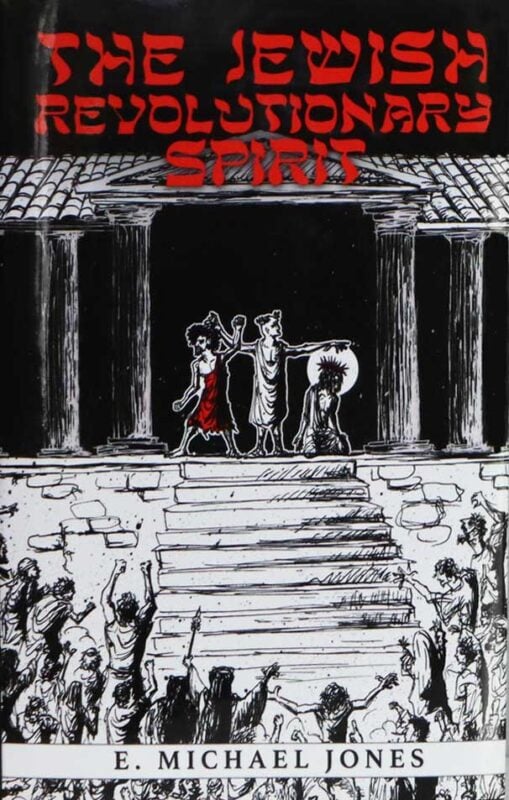
The Jewish Revolutionary Spirit and Its Impact on World History by E. Michael Jones positions the Jewish rejection of Christ as the central axis of Western revolutionary dynamics. Jones argues that the refusal to accept Jesus as the Messiah generated a spiritual rift, one that reoriented Jewish identity toward a persistent opposition to Logos—divine reason and order. This rejection, Jones claims, instilled a revolutionary impulse that has manifested in religious, cultural, and political upheavals throughout Western history.
Messiah Rejected, Revolution Born
Jones locates the decisive moment of transformation at the crucifixion. The choice to deny Jesus marked a theological and civilizational break. Jews who accepted Christ ceased to be identified as Jews; they became Christians. Those who did not became the standard-bearers of an anti-Logos tradition. This pivot transformed the Messianic expectation from a spiritual deliverance into a political ambition for worldly liberation, directed against the Christian order.
From Temple to Talmud: The Emergence of a New Judaism
Following the destruction of the Temple in 70 AD and the failure of the Bar Kokhba revolt, Rabbinic Judaism emerged as a codified religious system rooted in the Talmud. Jones identifies this moment as the genesis of modern Judaism, centered not on sacrifice or temple worship but on dialectical legalism. This transformation entrenched a worldview defined by argumentation, legal reinterpretation, and resistance to the Logos-infused structure of Christianity. The Talmud became not just a religious text but a method of organizing intellectual rebellion.
The Synagogue and the Empire: Clashing Orders
Roman political order, structured around hierarchy, duty, and natural law, encountered a theological adversary in post-Temple Judaism. Jones emphasizes how Roman officials, from Pompey to Titus, faced Jewish insurrections not merely as political revolts but as metaphysical refusals to submit to divine reason. These were not conflicts over territory or governance alone. They represented incompatible cosmologies—Rome as executor of divine order; the revolutionary Jew as challenger of that order’s legitimacy.
From Heresy to Revolution: The Symbiosis of Dissent
Jones identifies key historical episodes where Jewish thought and Christian heresy intersected. In the Arian crisis, Jews found common cause with those who denied the divinity of Christ. Later, during the Protestant Reformation, figures such as Pfefferkorn and Reuchlin reveal how Jewish texts and polemics fueled internal ruptures within the Church. The rejection of Logos metastasized into doctrinal rebellion, leading to broader political consequences.
Messianic Politics and Revolutionary Movements
The revolutionary impulse, shaped by theological denial, extended into secular political movements. From the Enlightenment to the Bolshevik Revolution, Jones traces how Jewish intellectuals and activists played disproportionate roles in dismantling monarchies, destabilizing Christian moral authority, and replacing metaphysical purpose with political will. The revolution becomes an ongoing replacement of Logos with self-created meaning, justified by historical grievance and utopian aspiration.
The American Moment: Cultural Reinscription
Jones devotes substantial analysis to Jewish involvement in reshaping American identity. From Hollywood’s foundational myths to the Civil Rights movement’s ideological architects, the narrative of marginalization empowered a cultural revolution. The emphasis on expressive individualism, moral relativism, and sexual liberation, championed in part by Jewish activists, is presented not as assimilation but as cultural conquest—redirecting the moral trajectory of the United States from Christian Logos to revolutionary will.
Neoconservatism and the Geopolitical Expansion
A later chapter examines the rise of Jewish influence in post-Vatican II Catholicism and American foreign policy. Neoconservatism, in Jones’s account, represents a merger of Jewish historical grievance with American military power. The wars in the Middle East, particularly Iraq, become the outgrowth of a theological displacement. The pursuit of American interests aligns with Israel’s strategic aims, but the deeper logic, Jones argues, stems from a messianic impulse to reorder the world by force.
Theological Roots of Modern Social Ideologies
Jones links abortion, feminism, and sexual liberation to a denial of divine Logos. He explores how Jewish legalism—devoid of sacramental grace—recasts moral law as a matter of human judgment. The transformation of morality into legislation and rights discourse reflects, in this framework, a deeper spiritual war. Activism against Christian morality is not an accident of politics but the extension of a tradition built around a central negation.
Vatican II and the Church’s Retreat
The Second Vatican Council and particularly Nostra Aetate receive pointed critique. Jones argues that Catholic engagement with Judaism, framed as dialogue, surrendered theological clarity. The replacement of mission with interfaith diplomacy obscured the Church’s duty to call the Jewish people to conversion. The result was doctrinal confusion and the Church’s diminishing capacity to withstand cultural revolution.
Toward Restoration: The Call to Logos
Jones proposes no political program. His solution is theological. He urges a recovery of Logos within the Church and a renewed insistence on the necessity of conversion. The Jewish revolutionary spirit, as he defines it, cannot be countered by diplomacy, accommodation, or ecumenism. Only the restoration of truth—rooted in Christ as the incarnate Logos—can address the structural rebellion at the heart of Western decline.
The Book’s Polemical Edge and Structural Argument
The Jewish Revolutionary Spirit and Its Impact on World History does not follow a chronological narrative. Instead, it constructs a cumulative case across time periods and geographies. The chapters build by thematic resonance rather than linear progression. Each revolutionary episode—religious schism, political upheaval, cultural rebellion—illustrates a new manifestation of the same foundational rupture.
The book’s central claim holds constant: the rejection of Christ creates a revolutionary energy that undermines divine order. This energy does not dissipate. It mutates across historical epochs. The revolutionary spirit, once unleashed, travels through institutions, ideologies, and cultures, reshaping them in opposition to their Logos-rooted foundations.
From Rejection to Redefinition: The Mechanics of Spiritual Conflict
Jewish identity, in Jones’s structure, does not exist as a static ethnicity or religious category. It operates through redefinition. The revolutionary Jew, conscious or not, recasts identity to serve each moment’s confrontation with Logos. Whether by producing ideological movements, funding cultural upheavals, or promoting secular theories of liberation, the revolutionary spirit persists through adaptability.
Christian Responsibility and Historical Clarity
Jones does not exempt Christians. He critiques Catholics who abandon evangelization for appeasement. The revolutionary spirit thrives where conviction erodes. Christian failure to confront falsehood opens space for ideological subversion. Without reclaiming its theological center, the Church cannot offer a coherent response to revolution.
Logos as the Measure of History
History, in this framework, becomes a struggle between two logics: one founded in divine reason, the other in autonomous will. The Jewish revolutionary spirit rejects the order of Logos not in abstract terms but through concrete actions: infiltration, redefinition, and transformation of the institutions it opposes. Where Logos gives form, revolution unravels. Where Christ restores, the revolutionary spirit ruptures.
Conclusion: A Future Shaped by Faithfulness or Fragmentation
The Jewish Revolutionary Spirit and Its Impact on World History presents a high-stakes theological interpretation of history. It does not offer cultural critique for its own sake. It calls for clarity, confession, and conversion. The stakes are not political success or institutional reform but the spiritual fate of civilization. Who defines history—Logos or revolution? The answer shapes not only the past but the path forward.
About the Book