Where Are We Now?: The Epidemic as Politics
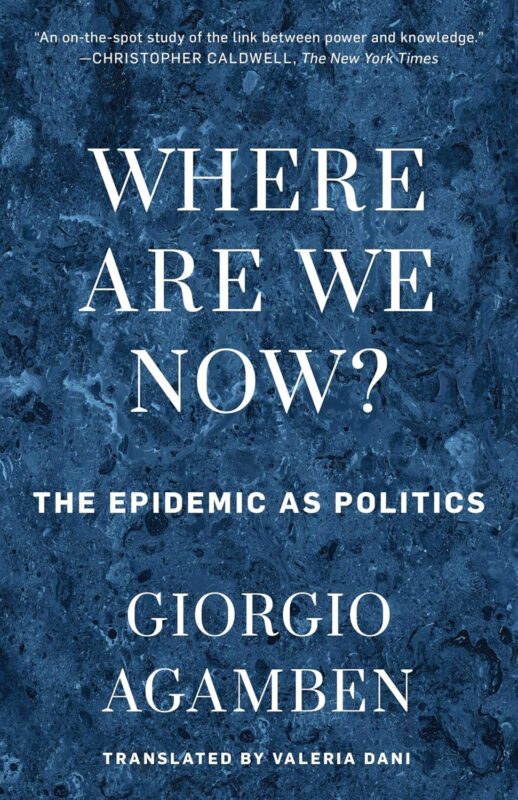
Where Are We Now? by Giorgio Agamben interrogates the political and ethical consequences of emergency measures introduced during the COVID-19 pandemic. The book positions the state of exception as the fulcrum of contemporary governance, tracing how crisis management has evolved into a mechanism for permanent control.
The Invention of the Crisis
Agamben identifies the early pandemic response as an inflection point in political technique. Authorities activated states of exception not based on demonstrated catastrophe, but on the anticipation of risk. Legal decrees shut down schools, prohibited assembly, and restricted movement in the absence of concrete emergency. This shift redefined the logic of power: from acting on present realities to governing through hypothetical threats. Institutions replaced deliberation with immediacy, treating fear as a mandate for authoritarian imposition.
This method of governance recodes basic civic activity as latent danger. The structure of everyday life reorganizes under a rubric of suspicion. Interpersonal contact becomes exposure. Movement becomes threat. Citizens adopt surveillance as a mode of responsibility. Compliance becomes moralized. This transformation erodes the distinction between civic duty and coerced behavior.
The Rise of Biosecurity
Agamben defines biosecurity as the convergence of health management, political control, and digital mediation. The apparatus advances not through new laws, but through the suspension of law. Constitutional guarantees do not disappear; they remain dormant under perpetual exception. Power no longer justifies itself through consensus or legal continuity. It materializes through emergency decrees backed by technocratic authority and public fear.
The health mandate functions not as a right, but as a compulsory obligation. The citizen bears a new burden—not to demand health protections, but to remain healthy under penalty of exclusion. Surveillance technologies and medical protocols regulate access to public life. This bio-political threshold creates a new civil identity, premised not on rights but on hygiene.
Contagion as Cultural Infrastructure
Contagion no longer describes viral transmission alone. It governs the spatial, relational, and symbolic fabric of society. The rhetoric of infection justifies the annihilation of proximity. Physical presence becomes deviant. Social distancing converts the neighbor into a liability. The principle of care recedes behind a barrier of distrust. Agamben identifies this logic as the collapse of human relationality. The shared space of politics, love, mourning, and resistance disintegrates into fragmented digital interfaces.
The abandonment of the dead exemplifies this rupture. Funeral rites vanish. Bodies disappear without witness. Ritual, which once stabilized meaning in the face of death, dissolves under sanitary prohibitions. A society that excludes grief excludes its own ethical foundations.
The New Cult of Medicine
Medicine acquires theological dimensions. Its authority exceeds clinical practice. It dictates rituals, defines moral behavior, and structures collective life. Agamben calls this the religion of health. Its dogma emerges from virology. Its clergy includes epidemiologists and health administrators. The faithful submit not through belief, but through behavioral compliance.
The rituals of this cultic structure include mask-wearing, isolation, testing, and digital self-certification. These acts do not resolve risk; they express belonging to the regime of biosecurity. The symbolic economy of obedience replaces inquiry. Doubt becomes heresy. Dissent becomes dangerous. The state and medicine converge to demand uncritical assent.
The architecture of this medical-religious regime functions independently of scientific consensus. Contradictory findings circulate without synthesis. Statistical inconsistencies do not provoke reappraisal. Truth recedes behind the operational priority of control. The pandemic legitimizes a form of knowledge production that privileges utility over coherence.
Digital Isolation and the End of the Polis
Technological mediation replaces public space. Schools, workplaces, and communities migrate online. The shift does not respond to necessity alone—it conforms to a broader trajectory of de-socialization. Agamben observes that the pandemic merely accelerated a long-standing effort to digitize human interaction and fragment collective agency.
Social distancing, in this view, is not temporary. It expresses a foundational premise of the emerging order: the incompatibility of community with risk. Under this regime, the political subject no longer congregates, deliberates, or resists in person. The crowd becomes a threat. Physical density becomes illegible. Governance aims at rarefaction, not cohesion.
This reordering collapses democratic frameworks. The separation of powers gives way to executive decree. Courts retreat. Parliaments acquiesce. Civil liberties become conditional. The law no longer functions through negotiation. It manifests as command. Agamben argues that this transformation renders traditional political categories obsolete.
The Political Role of Fear
Fear becomes an organizing principle. It operates not through coercion alone, but through internalization. Citizens do not merely obey; they affirm the necessity of control. The structure of fear stabilizes consensus and preempts opposition. Panic supplies the rationale for radical interventions, the justification for their indefinite extension, and the silence of institutional watchdogs.
This economy of fear transforms civil society. Activism suspends itself. Public discourse fragments. Churches abandon pastoral care. Universities cease to assemble. The sites of ethical and intellectual contestation dissipate. In their place, a technocratic elite issues protocols in the name of safety.
The Suppression of Ethical Language
Agamben insists that the ethical crisis exceeds the pandemic. It reveals long-standing trends: the subordination of values to data, the marginalization of the sacred, the reduction of justice to logistics. The theological, philosophical, and juridical traditions that once constrained power remain inert. Their silence signals complicity.
The denial of funerals, the prohibition of last rites, and the reduction of human presence to statistical input exemplify this collapse. The state of exception erases human dignity under the guise of preservation. It demands that society sacrifice meaning for survival.
Resistance and the Question of the Future
Agamben poses a question: where are we now? The inquiry refuses speculation. It demands attention to the present architecture of control. He asserts that the political project of our time lies in confronting this architecture, exposing its premises, and refusing its inevitability.
He does not propose a return. He demands reconstitution. Resistance begins by reclaiming language, space, and presence. It requires a politics that restores ethical visibility and communal practice.
The pandemic marks a watershed in political ontology. It inaugurates a form of life structured by risk aversion, behavioral programming, and algorithmic governance. This life does not emerge spontaneously. It requires ongoing consent. To interrupt its expansion, Agamben calls for new forms of thought, relation, and action rooted in freedom rather than fear.