No Treason: The Constitution of No Authority
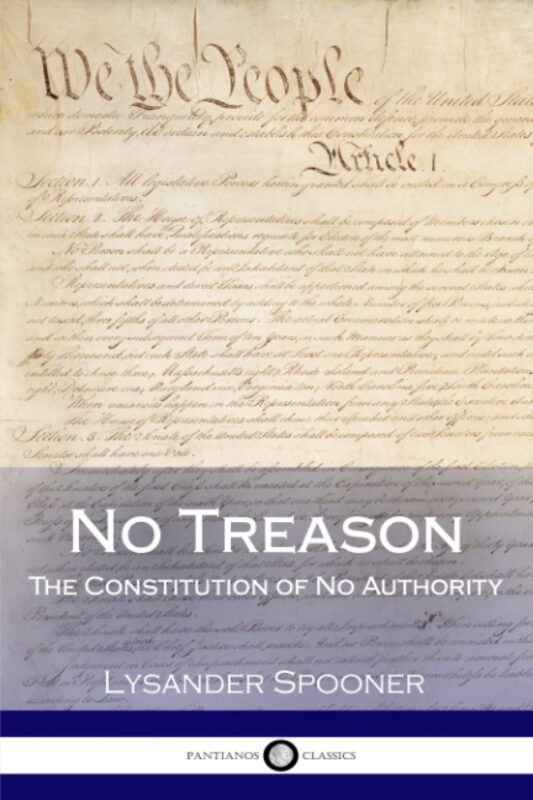
No Treason: The Constitution of No Authority by Lysander Spooner demands direct confrontation with the foundational beliefs underpinning American government. Spooner scrutinizes the legitimacy of the United States Constitution, beginning with the assertion that the document lacks any binding force over people living in the present. He grounds this argument in contract law, historical context, and the observable realities of government practice. Spooner creates a logical architecture that forces readers to question the legal and moral basis of political authority in America.
The Constitution as a Non-Binding Document
Spooner establishes that the U.S. Constitution claims authority only through the preamble’s phrase, “We the People,” a formulation referencing those alive in the late eighteenth century. The text, he observes, contains no mechanism or clause that commits their descendants to continued obedience. Spooner contends that a contract binds only its signatories, never unnamed successors. He advances this thesis by noting that the original ratifiers have died, leaving no ongoing party to the agreement. This disconnect between signatory and subject forms the cornerstone of Spooner’s argument that current generations stand outside any obligation to the Constitution.
Absence of Express Consent and Contractual Authority
Spooner applies the standards of contract law, insisting that genuine contracts require explicit consent, signatures, and clear parties. The Constitution lacks these elements. Spooner dissects the language of the preamble, finding only aspiration—never legal commitment. He asserts that neither the framers nor the text ever attempted to bind future generations. He draws analogies: a person who builds a house or plants a tree for posterity does so with hope, not power to compel. Spooner’s insistence on clear, actionable contracts underpins his rejection of tacit or inherited obligations.
The Illusion of Consent: Voting and Taxation
Spooner interrogates voting, a practice often cited as evidence of popular consent. He asserts that voting under compulsion or necessity does not equate to free agreement. For significant portions of American history, only a small fraction of the population could vote—often limited by property, race, or gender. Even now, he claims, voting operates more as a defense against state power than as enthusiastic consent. Spooner argues that the secrecy of the ballot, combined with compulsory taxation, negates any claim to open, voluntary support for the Constitution.
Spooner’s analysis extends to taxation. He compares the tax collector to a highwayman demanding “your money or your life.” Taxpayers surrender funds not through voluntary contract but under threat of punishment. This dynamic, he claims, produces a coercive relationship, not a mutually agreed insurance scheme. Spooner attacks the notion that being forced to pay constitutes agreement. He exposes the psychological and structural mechanisms that governments employ to cloak compulsion in the rhetoric of protection and order.
Voting as a Defensive Maneuver
Spooner parses the act of voting, emphasizing that people often vote from necessity or fear rather than true support. He contends that when voters use the ballot, many do so only to limit the damage government might inflict upon them, not because they affirm its legitimacy. Voting becomes a means of self-defense, not contract. By describing secret ballots and the anonymity of the process, Spooner highlights the absence of open, personal responsibility. No individual claims open agency for the actions of government, leaving the supposed principle of consent hollow.
Representatives Without Principals
Spooner confronts the structure of representative democracy, showing that so-called agents of the people act without clear, known principals. Voters act anonymously, delegating power without personal responsibility. He argues that agents who lack clearly identified principals function as autonomous actors, not true representatives. Spooner claims that this structure transforms political actors into a self-perpetuating class who rule under the cover of abstract authority, insulated from accountability and direct consequence.
The Role of Oaths and Legal Ritual
Government officials swear oaths to uphold the Constitution. Spooner scrutinizes these oaths, arguing that a pledge given to “the people” lacks the necessary elements of a contract. Since no identifiable individual or group receives the oath as a party, it binds no one and promises nothing specific. Spooner draws upon legal theory to underscore the lack of reciprocity, recognition, and mutual assent. Oaths to abstractions dissipate in the air, he insists, carrying no contractual or moral force.
Structural Power and Coercion
Spooner explores how money and military force underpin government. He observes that governments, having acquired initial resources, use them to hire soldiers, enforce taxation, and suppress resistance. This dynamic creates a self-reinforcing cycle of coercion, with the accumulation of power feeding further exactions and control. Spooner urges readers to recognize that this logic mirrors Caesar’s observation that “money and soldiers mutually support each other.” The structure persists not through voluntary engagement, but through the constant interplay of force and expropriation.
Legitimacy and Voluntary Association
He asserts that true political liberty arises only when individuals retain control over their resources until they receive credible assurances regarding their use. Spooner insists that only open, explicit, voluntary contracts—signed, delivered, and acknowledged—can claim legitimacy over the conduct of free people. He urges supporters of constitutional government to enact laws among themselves, by open agreement, before presuming to impose such rules on others. Without such voluntary consent, the claim to authority, he argues, remains void.
The Fiction of “The People” and Secret Government
Spooner challenges the notion that a government can derive legitimate authority from the vague and amorphous concept of “the people.” He contends that real government consists of only a handful of individuals acting in concert, relying on secret ballots and abstract representations. The absence of open, personal agency and responsibility creates what he calls a “secret band of robbers and murderers,” operating with the sanction of the mythic “people of the United States.” He explores the consequences of this structure: secret governance fosters mistrust, rewards coercion, and destroys the prospects for genuine justice.
Power Without Personal Responsibility
Spooner contends that the concealment of agency inherent in the American political system produces impunity. Government agents, acting anonymously or under collective authority, avoid the personal responsibility that characterizes lawful relationships. He observes that if individuals had to sign and openly accept accountability for their actions in government, support for coercive laws would diminish. Spooner exposes how secret ballots and concealed agency sustain a system where power acts without consequence or recourse.
Majority Rule and Structural Authority
The system of majority rule, in Spooner’s analysis, fails to generate true legitimacy. Majority votes, recorded and acted upon in secrecy, confer power without requiring individual responsibility for outcomes. Spooner contends that a person remains a slave regardless of whether allowed to select his master periodically. The right to choose among rulers, he claims, does not generate liberty when the structure retains absolute and irresponsible dominion over the people. He draws attention to the legal structure in which legislators, protected by constitutional provisions, cannot be held to account for their decisions, thus wielding unchecked authority.
Implications for Law and Society
Spooner urges a reassessment of the mechanisms through which people consent to government. He concludes that the only defensible form of authority comes from open, explicit, and individually accountable contracts. Political power that operates without such consent qualifies as usurpation. Spooner’s framework draws upon historical legal practices—requirements for signatures, delivery, witnesses, and explicit agreement—to reinforce his call for genuine contractual governance. He encourages readers to seek liberty through personal autonomy and responsible, voluntary association, rather than reliance on inherited or assumed obligations.
The Constitution as Historical Artifact
Spooner situates the Constitution as a document written by individuals who exercised no legitimate power to bind future persons. He argues that those who now claim its authority do so in the absence of signed, delivered, and acknowledged agreement. The document, he claims, functions more as a relic than as a genuine contract. Spooner encourages contemporary readers to examine their relationship to the Constitution with the same rigor and skepticism they would apply to any contract or agreement in private life.
A Call for Authentic Consent
Spooner closes with a challenge: supporters of the Constitution should gather, sign the instrument, and enact their chosen government among themselves before imposing its rules on others. He frames this as the ultimate test of conviction and legitimacy. Genuine liberty, Spooner contends, depends on voluntary, explicit, and open agreements—never on inherited, presumed, or secret claims. The path toward a just society, he argues, runs through the principles of clear consent, individual responsibility, and the abolition of imposed authority.
Enduring Relevance and Search Value
No Treason: The Constitution of No Authority by Lysander Spooner offers foundational arguments for those investigating the philosophical roots of American government, libertarian theory, and the boundaries of consent in political structures. Its themes reverberate through debates over the nature of legitimacy, contractual obligation, and the limits of state power. Spooner’s analysis provides a structural framework for questioning the very basis of authority in society, making this text essential for researchers, legal theorists, historians, and anyone seeking to understand the philosophical challenges to constitutional governance. Spooner’s clarity, logical rigor, and unapologetic stance continue to spark inquiry among those questioning inherited political frameworks and searching for the roots of legitimate power.