The Globalization of Poverty and the New World Order
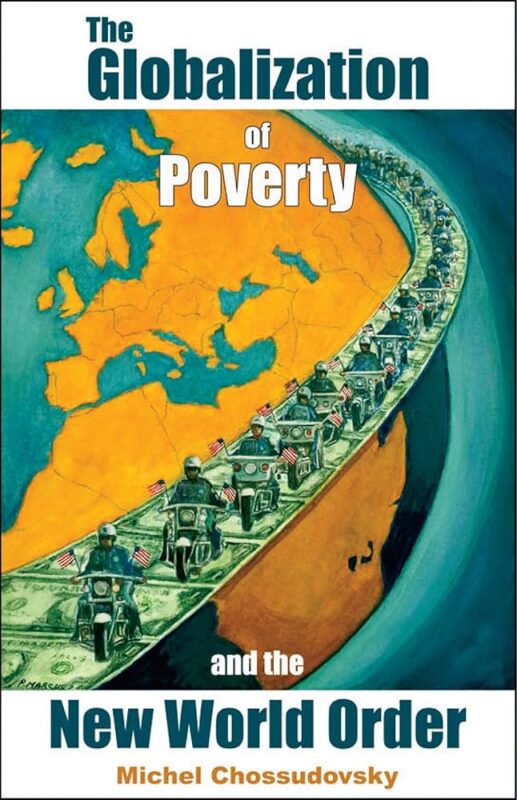
The Globalization of Poverty and the New World Order by Michel Chossudovsky exposes the machinery of international economic governance, tracing the impact of IMF and World Bank policies across the developing world. Chossudovsky enters the field with direct country-level research, mapping the lived consequences of structural adjustment programs in regions from Latin America and Sub-Saharan Africa to the former Soviet Union and Southeast Asia. Governments, international lenders, and multinational investors converge in a system that transforms national economies, shifts ownership, and reconfigures social relations under the rubric of “reform.” Who bears the consequences when monetary policy, debt management, and privatization synchronize under global oversight? Chossudovsky forces this question, refusing to allow economic theory to mask the lived consequences of policy.
Global Economic Policy and the Architecture of Adjustment
Chossudovsky dissects the framework of structural adjustment. The IMF and World Bank, operating as central authorities, impose conditional lending on governments facing economic crisis. Their terms mandate currency devaluation, market liberalization, privatization of state enterprises, and drastic reductions in government spending. These measures drive economic restructuring. When the IMF demands devaluation and public sector retrenchment, currencies lose value, domestic wages collapse, and the real cost of living rises. Local populations watch purchasing power evaporate. The state, reduced to a manager of debt service and fiscal austerity, loses control over its own developmental agenda.
The central aim of adjustment focuses on debt repayment and macroeconomic stability. Conditional loans force governments to reallocate budgets, shifting resources away from health, education, and food security toward interest payments and the maintenance of currency stability. Chossudovsky identifies the mechanism: to access new funds, countries comply with policies that dismantle social protection, opening their economies to foreign capital and speculative flows. The argument advances not by rhetorical flourish, but by tracing the observable outcomes—mass layoffs, malnutrition, migration, and the disintegration of community ties.
Case Study: Latin America and the Descent into Crisis
Chossudovsky follows the chain of causality in Peru and Bolivia. As hyperinflation swept through Peru, the IMF’s stabilization package enforced a rapid devaluation, a unification of exchange rates, and deep spending cuts. Fuel prices spiked nearly 3,000 percent in a single day, bread prices by more than 1,000 percent. These shifts reverberated: the minimum wage plummeted by 58 percent, purchasing power collapsed by over a third in four years, and malnutrition spread as food prices rose beyond the reach of workers. Government decentralization stripped communities of access to hospitals, banks, and schools, leaving families exposed. A new famine took shape, not from food scarcity, but from the systemic conversion of agriculture to export cash crops. The cycle of poverty grew as children’s health faltered, and the fertility rate soared in response to rising child mortality.
Bolivia’s “success story” according to the IMF, hides a landscape of structural unemployment and social breakdown. The hyperinflationary spiral yielded to stabilization, but at the price of mass layoffs—over 50,000 lost state jobs, with a further 23,000 dismissed from the mining sector. Real wages fell as the government deregulated labor and slashed spending. Small farmers lost their local markets as trade barriers dropped and imported goods undercut domestic production. Survival strategies narrowed: the expansion of coca cultivation offered one of the few lucrative paths, entrenching a narco-economy linked to international drug markets. Chossudovsky tracks the currency flows: dollars gained through coca exports or illicit trades recycled through the banking system, converting “dirty money” into real estate, business, and political power.
Decentralization, Privatization, and the Politics of Dependency
The structural adjustment paradigm demands privatization of state assets. International advisers, armed with reform blueprints, oversee the liquidation of public banks, utilities, and industries. Local legislation—crafted under Western direction—prioritizes creditors’ rights, fast-tracks bankruptcy, and lowers barriers for foreign investment. Privatization agencies value assets at fire-sale prices, accelerating the transfer of ownership to multinationals and foreign investors. Workers, stripped of employment and social guarantees, face uncertain futures. Social safety nets fray, with health and education budgets sacrificed on the altar of fiscal discipline.
In Chossudovsky’s analysis, privatization does not only move ownership; it shifts decision-making power and future profits out of national hands. Foreign capital, entering through legal and financial channels, acquires strategic sectors—banks, land, energy, communications. The process unfolds in legal terms but maps as a political reordering: governments dependent on new loans, public policy shaped by the requirements of creditors, and sovereignty eroded by the logic of international finance. Local elites, often installed or rewarded through the process, accumulate wealth and power as intermediaries.
The Rise of the Narco-Economy and Structural Illegality
As structural adjustment undermines traditional agriculture, farmers in Peru and Bolivia pivot to cash crops demanded by global markets—most infamously, coca. Narco-dollars sustain national economies and provide governments with hard currency to meet IMF repayment schedules. Drug economies become embedded in the social structure, financing urban development, real estate booms, and political campaigns. The phenomenon does not exist in isolation; it arises directly from the pressures imposed by external adjustment programs. The global fight against drugs cannot disentangle itself from the economic strategies imposed on vulnerable states.
Chossudovsky traces complicity and convergence: intelligence agencies, multinational banks, and foreign investors intersect with local political elites. Money laundering merges with formal economic flows. The result is a system in which “dirty money” legitimizes itself through the formal economy, financing the very structures that adjustment policies claim to modernize. The impact: social dislocation, erosion of legitimate economic activity, and the entrenchment of organized crime as a parallel authority.
Health, Hunger, and Social Disintegration
Chossudovsky details how SAPs hollow out social services. Budget cuts driven by IMF conditionality slash funding for health, education, and food security. Hospitals close or shift to fee-based systems, leaving the poor without access to care. Malnutrition rises as staple foods become unaffordable and subsistence farming collapses under pressure from cash crop expansion. Disease outbreaks follow, mortality rates rise, and the capacity of communities to reproduce themselves shrinks.
In Peru, infant mortality surges as government health programs falter and rural families lose both income and land. Famine takes root in new forms, even in the presence of food abundance, as economic policies detach supply from access. The ripple effects persist for generations, shaping demographic patterns and weakening the foundations of collective resilience. The same patterns replicate in countries subjected to adjustment, each instance reinforcing the structural argument.
Bankruptcy and Ownership in Eastern Europe and the Balkans
Chossudovsky’s narrative sharpens as he investigates Eastern Europe and the Balkans. In Yugoslavia, a model of “market socialism” disintegrates under waves of IMF and World Bank reforms. The reform packages demand fiscal contraction, wage freezes, currency devaluation, and, most crucially, the dismantling of the public sector. As state enterprises move toward bankruptcy, hundreds of thousands lose their jobs. Creditors gain authority to liquidate or acquire enterprises at a fraction of their value. Industrial output plunges, GDP contracts, and social protections vanish.
These economic ruptures precede and enable political fracture. Ethnic and regional tensions sharpen amid economic deprivation. Chossudovsky demonstrates that the collapse of Yugoslavia—far from a sudden outbreak of ancient hatreds—arises from a decade of economic destabilization. The Dayton Accords, and the subsequent peace settlement, transfer economic sovereignty to international bodies. The IMF and World Bank oversee fiscal policy, banking regulation, and the privatization process, while foreign investors gain privileged access to key sectors. International officials, not local citizens, hold ultimate decision-making power.
Debt, Dependency, and the Logic of Aid
Chossudovsky exposes the recursive logic of international lending. New loans finance old debts, rarely supporting productive investment. Aid cycles back to creditor countries as interest payments, consultancy fees, and profit remittances. Governments find themselves in a condition of perpetual restructuring, forced to comply with the latest policy package in order to secure the next round of financing. The structure sustains itself not by resolving crisis, but by managing it—producing a permanent condition of dependency.
In Bosnia-Herzegovina, Macedonia, and Croatia, the post-conflict “reconstruction” process centers on debt rescheduling and privatization. New states inherit portions of the former Yugoslavia’s external debt. Reconstruction loans serve more to refinance arrears and pay off multilateral creditors than to rebuild infrastructure or social services. As a result, social dislocation persists, unemployment remains high, and public assets transfer to private, often foreign, hands.
The Logic of Structural Adjustment: Mechanisms of Control
Structural adjustment advances not through explicit coercion, but through institutional design and financial conditionality. By attaching policy changes to the flow of funds, international financial institutions shape domestic priorities. Laws change to enable bankruptcy and asset transfer; regulations shift to favor foreign investment; fiscal policy aligns with debt servicing. Government ministers become managers of compliance, accountable to external evaluators. This framework does not simply dictate policy—it establishes a new mode of governance in which international institutions exercise ultimate authority.
Foreign investors, often institutional funds and multinational corporations, exploit the opening. They acquire banks, utilities, factories, and agricultural land, securing positions that generate profit streams for decades. The process accelerates the outward flow of wealth, deepens inequality, and embeds external control in the fabric of national economies.
The Social Fabric and the Loss of Sovereignty
As state sectors collapse and ownership migrates outward, societies experience fragmentation. Unemployment, poverty, and malnutrition undermine family structures and communal bonds. The retreat of the welfare state removes the last safety net, leaving the vulnerable exposed. Political legitimacy erodes as citizens perceive governments as agents of foreign interests rather than protectors of national welfare.
Chossudovsky’s narrative insists that this is not a natural evolution or a technical process; it is a politically constructed system that privileges creditor interests and global capital. The outcomes follow logically from the design: rising inequality, the concentration of wealth, the persistence of poverty, and the hollowing out of national sovereignty. Societies find themselves locked in a cycle—restructuring, borrowing, paying, and restructuring again.
Conclusion: The Architecture of Global Inequality
The Globalization of Poverty and the New World Order delivers a sustained analysis of how global economic governance, enforced through the IMF and World Bank, structures the distribution of power and resources in the modern world. Chossudovsky insists on the observable connection between policy design and social outcome. When governments surrender fiscal autonomy, privatize public assets, and liberalize markets under external supervision, they set in motion patterns of dispossession and dependency that reverberate for generations. The resulting order, far from eradicating poverty, generates new forms of inequality and entrenches financial colonialism within the legal and economic architecture of globalization. The book’s detailed case studies and structural analysis force the question: what system of accountability can disrupt this pattern and return the power to define development to the people most affected by its outcomes?


About the Book