The Shadows of Power
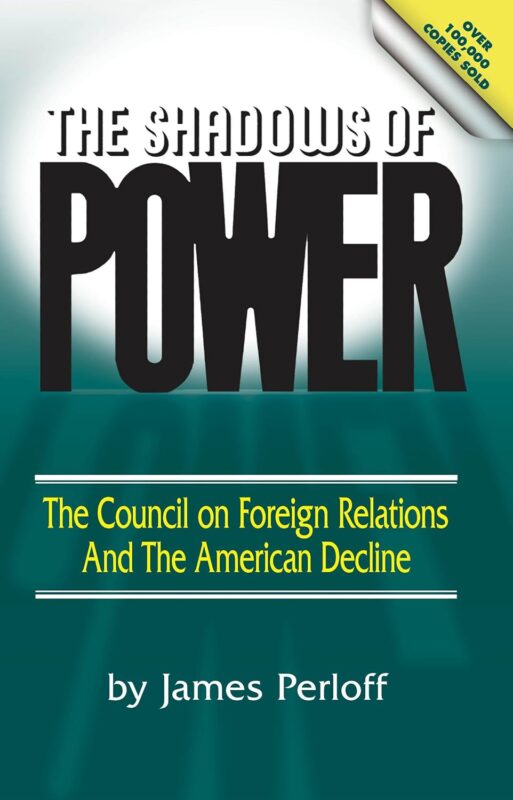
The Shadows of Power: The Council on Foreign Relations and the American Decline by James Perloff investigates the origins, structure, and sweeping influence of the Council on Foreign Relations (CFR), tracing how a network of elite financiers, politicians, and intellectuals have steered United States policy toward globalism, internationalist frameworks, and economic integration.
Establishment of an Elite Network
James Perloff begins with an assertion that a hidden hierarchy shapes American political life. Early American leaders and commentators recognized a power operating behind visible institutions. Statements from Supreme Court Justice Felix Frankfurter and New York Mayor John Hylan established the vocabulary of “invisible government” and “international bankers,” anchoring the argument in public record. The CFR, founded in 1921, organized the ambitions of these elites, serving as the main bridge between private power and public office.
CFR membership does not represent the public at large. It consists of influential bankers, lawyers, executives, academics, and journalists, many drawn from old-line Northeastern families and elite universities. The structure of recruitment fosters exclusivity, with new members invited by those already within the circle. The book chronicles the social pathways that prepare candidates for the CFR, from preparatory schools to Ivy League universities, exclusive fraternities, and on to Wall Street or policy think tanks. This pipeline consolidates power, creating a cadre capable of moving seamlessly between corporate, financial, and government roles.
Mechanisms of Influence
The CFR’s function extends beyond its public description as a nonprofit, nonpartisan think tank. Through private meetings, study groups, and its influential journal Foreign Affairs, the CFR supplies intellectual direction and practical frameworks for foreign policy. Members host government officials, corporate executives, and foreign dignitaries for off-the-record discussions, enabling candid dialogue shielded from public scrutiny. The policy study groups produce reports and books that reach the desks of policymakers and the media.
Direct recruitment of government personnel cements this influence. The book details a continuous stream of CFR members into cabinet-level positions: secretaries of state, treasury, and defense. The phenomenon extends across political parties and presidential administrations, creating structural continuity in policy. When a new administration takes office, its appointees often emerge from the CFR roster, drawing on shared philosophies and social loyalties.
Perloff describes a self-reinforcing dynamic: CFR alumni in government invite fellow members to fill secondary positions. This process multiplies the influence of the group, generating networks of mutual obligation and ideological cohesion. As new policy initiatives arise, the same group that developed them in private can implement them in public office.
Promotion of Globalism
The core agenda, as documented in the book, centers on globalism—the belief that world peace and economic stability require coordinated international authority. Foreign Affairs articles and CFR position papers have for decades advanced the idea that nation-states must surrender elements of sovereignty to supranational organizations and legal frameworks. As the book traces, these writings often propose new international institutions or advocate for expansion of existing bodies such as the United Nations and International Court of Justice.
Specific evidence from the early years of Foreign Affairs reveals a persistent critique of “America First” sentiments and an explicit call for the dissolution of independent national policy in favor of collective security arrangements. Policy blueprints drafted by CFR study groups often urge the United States to “build a new international order,” advocating for stronger regional alliances and gradual increases in global governance powers.
The argument develops as Perloff shows that the public rationale for such globalism frequently invokes the need to contain threats, whether German militarism, communist expansion, or economic instability. In each era, CFR proposals align with moves toward tighter international integration: support for the League of Nations, advocacy for the United Nations, and repeated calls for the expansion of global legal and economic mechanisms.
Foundations of Financial Power
The financial foundation of the CFR links to the great banking dynasties of the early twentieth century. The book documents how families like the Rothschilds, Morgans, Rockefellers, and Schiffs developed and controlled central banks in Europe and the United States. By 1913, the creation of the Federal Reserve marked a culmination of these efforts: the installation of a central banking system with private oversight and the power to issue currency, regulate credit, and manage national monetary policy.
The establishment of the Federal Reserve required coordination among key financiers, many of whom later played roles in the founding and funding of the CFR. Perloff details how the same individuals and their networks promoted the introduction of the income tax, which provided the federal government with an elastic source of revenue and increased opportunities for borrowing and spending. The interplay between central banking and government indebtedness created ongoing opportunities for bankers to exercise policy leverage through control of public finance.
Tax-exempt foundations, such as the Rockefeller, Carnegie, and Ford foundations, supplied ongoing funding to the CFR and similar organizations. These institutions allowed wealthy families to shape intellectual and policy life through grants, scholarships, and program support, consolidating their influence and advancing their globalist philosophy.
CFR and Ideological Convergence
The narrative moves beyond financial and organizational structures, exploring the ideological sympathies and affiliations of CFR leaders. Perloff argues that CFR members display a distinctive openness to the ideas and personnel of the socialist and communist world. The evidence appears in the CFR’s invitations to leftist leaders and its publication of socialist writers in Foreign Affairs. The group hosted guests such as Fidel Castro, Nikita Khrushchev, and Daniel Ortega, and published articles by figures like Leon Trotsky and other Marxist theorists.
Rather than focusing on anti-communist opposition, CFR publications tend to frame global integration as the ultimate solution to ideological conflict. Arguments within the organization suggest that the best way to address communist threats lies in building stronger world institutions and promoting international legal authority. In this perspective, the convergence of American and Soviet systems forms a logical endpoint for global governance.
Media and Public Awareness
The book explores why the CFR remains largely unknown to the American public. Despite its preeminent role in shaping policy, the mainstream media rarely mentions the group or investigates its activities. Major newspapers and magazines have seldom run feature articles on the CFR, particularly in its early decades. Perloff attributes this silence to overlapping social and financial interests: media executives, owners, and key journalists are often themselves CFR members or beneficiaries of the same foundation networks.
The result is a public that encounters policies without access to the deliberative processes that produced them. Voters see outcomes without seeing the causal pathways. When dramatic shifts occur in foreign policy—alliances, treaties, wars, or interventions—the rationale can appear opaque, because the debates that preceded them unfolded out of public view.
Historical Episodes and Patterns
Perloff’s analysis deepens with a historical review of the CFR’s impact on key episodes in U.S. and world affairs. The founding generation, operating in the wake of World War I, mobilized to bring the United States into the League of Nations. The Senate’s rejection of the League catalyzed the formation of the CFR, which then set out to influence public and elite opinion toward internationalist policies.
During the interwar years and beyond, the CFR developed a reputation as a recruiting ground for those destined to shape American policy. World War II, the creation of the United Nations, and subsequent Cold War initiatives unfolded with CFR members occupying decisive roles. In period after period, CFR study groups anticipated government policy by months or years, supplying intellectual justification for decisions that would later become official.
The CFR’s relationships extended internationally, especially through connections with the British Royal Institute of International Affairs (RIIA). The “Anglo-American establishment” described in the book emerges as a transatlantic web of influence, coordinating policy positions and sharing strategies for the development of international institutions.
Consequences and Patterns of Decline
The book’s core thesis asserts that the concentration of power within the CFR and its commitment to globalist ideology have contributed directly to the weakening of American sovereignty and the relative decline of national self-determination. The repeated transfer of authority to supranational bodies and the entanglement in international alliances have reshaped the constitutional order, shifting power away from democratic and legislative processes.
The CFR’s vision of global order places economic integration and managed diplomacy at the center, subordinating local interests to the imperatives of international stability. This perspective accepts that trade-offs are necessary, and that the governance of a diverse planet requires technocratic management and expert coordination. The book questions what happens when the expertise and values of a narrow group set the trajectory for an entire nation.
Conclusion and Structural Implications
James Perloff’s investigation of the CFR reveals a pattern of elite coordination and strategic influence, operating through personal networks, institutional funding, and intellectual advocacy. The Council on Foreign Relations, as described in this book, functions as the organizing center for a distinctive vision of world order, where national sovereignty gives way to global governance, and American policy aligns with the interests of an interconnected transatlantic elite.
The structures analyzed in The Shadows of Power do not operate through public debate or transparent elections, but through private deliberation, foundation funding, and selective recruitment. The narrative does not offer a redemptive arc or a reversal; it presents a logic of convergence and consolidation, urging the reader to observe the consequences for national autonomy, public oversight, and the future shape of American society.