The Most Dangerous Superstition
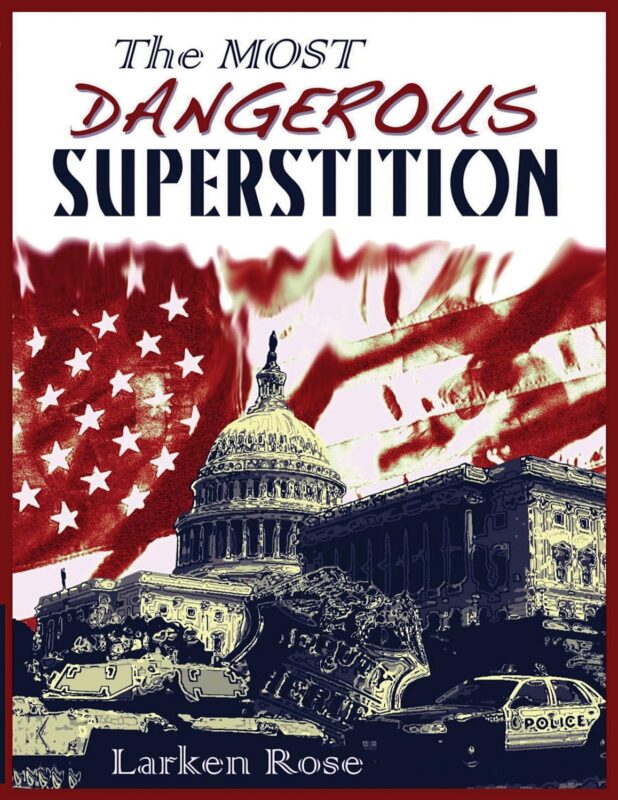
The Most Dangerous Superstition by Larken Rose presents a direct challenge to conventional political thought, arguing that the root cause of historical violence and societal injustice can be traced to the widespread belief in the legitimacy of authority. This book asserts that the acceptance of government as a moral and necessary institution constitutes a superstition, one more powerful and insidious than any traditional religious dogma.
Unmasking Authority: The Central Thesis
Larken Rose sets forth the proposition that the belief in authority—the idea that some individuals possess a special moral right to command and others incur a duty to obey—drives much of the world’s suffering. History records countless atrocities carried out under the banner of law, enforcement, and governance, yet the underlying premise that grants legitimacy to these acts seldom faces scrutiny. The author contends that the idea of authority exists only as a mental construct, perpetuated through cultural indoctrination rather than objective evidence or logic.
What constitutes authority? Rose defines it as the supposed moral right to rule, setting it apart from simple coercion or force. Governments do not merely wield power; they claim legitimacy and seek acceptance as rightful rulers. Citizens comply not simply from fear of punishment, but from an internalized sense of duty, shaped from childhood through lessons in obedience to parents, teachers, and finally, political rulers.
From Indoctrination to Obedience: The Origins of the Superstition
From early childhood, individuals absorb the message that obedience equates to goodness. Society rewards those who comply and marks dissenters as threats to order. Larken Rose traces this phenomenon through families, schools, workplaces, and the broader political sphere. The merging of morality and obedience conditions individuals to conflate virtue with compliance.
This process shapes collective perceptions. People begin to wear labels like “law-abiding taxpayer” as badges of honor, reinforcing the notion that adherence to authority defines personal worth. The difference between the commands of a common thief and those of a legislator rests in perception—one is condemned as criminal, the other lauded as legitimate. The distinction arises not from objective morality but from the shared belief in authority.
Language, Law, and the Machinery of Control
Rose analyzes the language that sustains the superstition. The word “law” acquires a sacred aura, invoked as if it emerges from some objective, transcendent order. In practice, law consists of commands issued by people who claim the right to rule. The legal system enforces these rules through the threat or application of violence, yet the language of law and government cloaks these mechanisms in legitimacy.
“Law enforcement” becomes a hallowed profession, its representatives seen as agents of a higher moral code. The same actions—extorting money, restricting movement, imposing regulations—would attract condemnation if performed by anyone outside the government structure. Within that structure, such acts become normal and necessary.
The concept of “country” or “nation” serves to reinforce authority’s reach. Borders exist as lines demarcating the zones of control assigned to competing ruling classes. Patriotism and national loyalty encourage individuals to internalize their subjugation as a virtue.
Debunking Consent: The Flaws in Democratic Mythology
Rose scrutinizes the popular slogans that governments employ to legitimize their rule. Phrases such as “consent of the governed” and “government by the people” saturate civic rituals, yet fail under critical examination. Consent presupposes voluntary agreement between parties. Governance, by definition, involves coercion. The assertion that residing within a jurisdiction constitutes consent ignores the reality that exit entails forfeiture of property, relationships, and personal investment. Majority rule cannot create valid consent for those who disagree. To claim otherwise is to redefine the meaning of consent beyond recognition.
Representative government does not escape critique. Elected officials routinely enact policies that contradict the wishes and interests of constituents. The notion that officials “work for the people” collapses under the evidence of unilateral power, compulsory taxation, and enforced obedience. Rose observes that voters seldom assume moral responsibility for the actions of their supposed representatives. This reveals a disconnect between political rhetoric and actual experience, exposing the structure as a master-slave hierarchy rather than a system of popular representation.
The Illusion of Necessity: The False Dilemma of Order and Chaos
Political discourse often invokes the necessity of authority to justify its existence. Proponents claim that chaos and violence will fill the void if government ceases to rule. Rose challenges this claim by interrogating its premises. If human nature is so untrustworthy as to require rulers, then no mechanism exists to ensure that the rulers themselves will transcend those flaws. In practice, granting a subset of the population special rights to coerce and command produces greater risks of abuse, not fewer.
What drives people to cling to the hope of benevolent authority? The desire for security, order, and justice persists, but the machinery of government cannot guarantee these outcomes. Rather, it establishes a hierarchy where those who seek power become arbiters of law, unconstrained by the will or well-being of the population.
Government as Religion: Ritual, Faith, and Symbolic Power
Rose explores the religious character of belief in authority. Ceremonies, pledges, and veneration of flags or constitutions transform government into a sacred entity, one that commands reverence and punishes heresy. When legal or moral codes from other traditions conflict with the edicts of government, citizens routinely submit to the state’s dictates, revealing the primacy of this secular faith.
The emotional intensity that accompanies discussions of government rivals or exceeds that attached to conventional religion. Public rituals reinforce collective allegiance, while dissent invites accusations of blasphemy or subversion. The underlying structure mirrors the features of organized religion—dogma, priesthood, sacred texts, rituals, and unquestioned obedience.
Deconstructing the Existence of Government
Rose moves beyond theoretical critique to a categorical disavowal of government’s existence. He distinguishes between the tangible presence of politicians, police, and bureaucrats, and the abstract authority they claim. The claim to a moral right to rule, according to Rose, possesses no foundation in nature or logic. Authority exists only in the minds of those persuaded to accept it.
Political debate, by focusing on the question of what government should do, presupposes the legitimacy of the institution. Rose equates this to debating the policies of a mythological entity, a process that consumes resources and attention while reinforcing the original delusion.
Organizations that cooperate voluntarily—companies, associations, clubs—function without claiming authority over their members. When organizations assert the right to coerce, they cross the line into government. The distinction lies not in the scale of collective action, but in the claim to exclusive rights denied to others.
Consequences of the Superstition: From Atrocity to Everyday Oppression
The consequences of authority’s myth extend from history’s most infamous atrocities to the routine indignities of daily life. Rose points to the role of obedient citizens in enabling horrors such as the Holocaust, Stalin’s purges, and countless wars. The perpetrators of these acts seldom see themselves as monsters; they view themselves as agents of the law, fulfilling their duties as defined by authority.
On a smaller scale, the machinery of regulation, taxation, and law enforcement produces a steady flow of coercion, expropriation, and intrusion. The average person, conditioned to see these acts as legitimate, participates willingly, whether by paying taxes, reporting infractions, or enforcing social conformity.
Abolishing the Superstition: Envisioning Life Without Authority
Rose concludes by envisioning a society that has relinquished the belief in authority. He anticipates a world where individuals recognize their equal moral standing and resolve disputes through voluntary association, cooperation, and mutual respect. Without authority’s myth, organizations may arise to provide defense, arbitration, and infrastructure, but none would claim exclusive rights to rule.
He describes a transition that depends on mass awakening rather than revolution. No violent upheaval is required; the myth collapses when people cease to believe in it. The process mirrors the abandonment of other superstitions—once exposed, the spell dissipates.
Sharpening the Question: Who Benefits from Authority?
Who stands to gain from the perpetuation of authority’s myth? Rose identifies a class of individuals who seek power, wealth, and control under the guise of public service. Political actors, bureaucrats, and their supporters secure advantages unavailable in voluntary exchange. The rest of society, conditioned to obedience, consents to its own exploitation.
When people relinquish the belief in authority, the structures that sustain exploitation lose their foundation. Organized coercion, whether masked as taxation, regulation, or war, becomes impossible without willing compliance. The opportunity to construct relationships based on mutual consent, rather than imposed obligation, emerges.