Gangsters of Capitalism: Smedley Butler, the Marines, and the Making and Breaking of America’s Empire
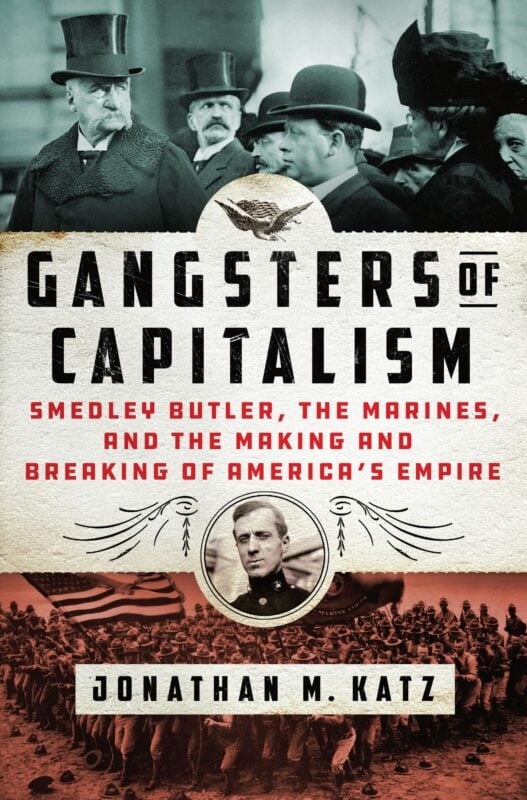
Gangsters of Capitalism by Jonathan M. Katz explores the imperial architecture of the United States through the life of General Smedley Butler, who spent his career advancing corporate interests before turning into one of America’s fiercest critics of militarism. Katz follows Butler’s deployments from the Caribbean to China and investigates how his experiences shaped a damning indictment of U.S. foreign policy.
The empire begins with a Quaker marine
Smedley Butler, raised in a pacifist Quaker household in Pennsylvania, joined the Marines at age sixteen, lying about his age to fight in the Spanish-American War. His first deployment took him to Guantánamo Bay, Cuba, where U.S. forces seized territory under the guise of liberation. Butler arrived after the fighting, but the implications of this occupation shaped his understanding of American motives abroad. In Haiti, Nicaragua, and the Philippines, Butler led military campaigns that suppressed uprisings and installed regimes favorable to American business. His participation established a pattern of intervention designed to protect capital under the pretense of promoting stability.
From decorated war hero to corporate enforcer
As Butler rose through the ranks, he acquired accolades that placed him among the most decorated Marines in history, including two Medals of Honor. Yet the rewards came not for defending democracy but for actions that served the financial interests of powerful elites. In Haiti, Butler helped implement a system of forced labor to build roads, reinforcing U.S. economic control. In Nicaragua, he backed banking interests by securing puppet leadership. In China, his presence during nationalist uprisings reinforced American commercial access. Butler internalized the role of military force as a tool for Wall Street, not national defense.
The business plot and the fascist undercurrent
After retiring, Butler was approached by Wall Street operatives with a proposal to lead a half-million-man coup against President Franklin D. Roosevelt. The plotters wanted to halt the New Deal and install a “secretary of general affairs” who would act as a de facto dictator. The men behind the scheme had ties to J.P. Morgan and DuPont, showing how elite discontent with democratic reforms aligned with authoritarian ambition. Butler feigned interest, then exposed the conspiracy to Congress. His testimony revealed the willingness of American capital to abandon democracy when threatened.
War is a racket and the making of dissent
Butler’s transformation crystalized in his pamphlet War Is a Racket, where he declared that he had served as “a high-class muscle man for Big Business.” He named companies and conflicts—Standard Oil in China, Brown Brothers in Nicaragua, National City Bank in the Caribbean—and traced the profits behind each intervention. The book gained popularity during the Great Depression and positioned Butler as a critic whose authority came from deep complicity. His speeches across the country drew crowds eager to hear from a general who now rejected the system he had helped enforce.
Imperial structure and domestic rot
Katz shows how Butler’s story reveals structural links between overseas empire and internal decay. The same financiers who backed coups abroad funded suppression of labor at home. Butler’s policing of Philadelphia during Prohibition mirrored the tactics he honed abroad: militarized enforcement, mass arrests, public spectacles of control. The feedback loop between imperial violence and domestic governance undercut the promise of American liberty. Katz draws these lines not as symbolic parallels but as operational continuities, traced through personnel, contracts, and legal regimes.
The myth of benevolence collapses
Katz dissects the cultural scaffolding that obscures the American empire. Textbooks, films, and museums favor narratives of liberation, omitting the coercion embedded in U.S. expansion. Katz challenges this mythology by chronicling how the U.S. constructed colonial infrastructures—military bases, puppet governments, client police forces—that enabled extraction and repression. The book insists that American imperialism functions not as an aberration but as a durable system anchored in economic imperatives and racial hierarchies.
From the Caribbean to the Pacific
Katz retraces Butler’s journey through sites of conquest: Guantánamo Bay, where the U.S. secured permanent control after ousting Spain; Haiti, where Marines executed insurgents and rewrote the constitution; the Philippines, where thousands died under U.S. occupation. These interventions consolidated American power across two oceans, securing shipping lanes, access to resources, and geopolitical leverage. Each mission followed a script: secure the perimeter, install loyal leadership, protect commercial assets, and suppress dissent. Katz positions Butler as both actor and witness to this imperial pattern.
Legacy, memory, and erasure
The U.S. military memorializes Butler for his battlefield courage but obscures his later criticism. His antiwar writings are excluded from Marine Corps libraries, while his tactical exploits are celebrated in boot camp chants. Katz probes this selective memory as an index of how institutions manage dissent. Butler’s disillusionment poses a threat to narratives that justify force as honorable service. Katz makes the case that understanding Butler in full—not just as a soldier but as a whistleblower—requires confronting the empire he helped build.
The unfinished reckoning
Katz connects Butler’s era to contemporary crises. The 2003 invasion of Iraq, military assistance in Latin America, and the ongoing presence at Guantánamo echo earlier imperial patterns. Katz links the rise of authoritarian movements in the U.S. to the unresolved contradictions Butler identified: a republic committed to liberty that defends oligarchy with force. The Business Plot reappears as a structural possibility, not an anomaly, when economic elites face redistributive threats. Katz argues that the United States cannot resolve its democratic deficits without confronting its imperial foundations.
The global counter-narrative
In former U.S. intervention zones, Butler’s name evokes repression, not liberation. In Haiti, he remains a symbol of exploitation, remembered for forced labor and racial humiliation. In China, where he intervened twice, Butler’s legacy exists within the broader narrative of foreign intrusion. Katz situates these memories as active counter-histories, drawn upon by governments and movements resisting American influence. China’s global strategy, invoking its past humiliation, positions itself as an alternative to U.S. hegemony, gaining credibility in part because of the history Butler embodies.
Structural inheritance of violence
Katz shows how the architecture Butler helped construct—military bases, alliances with oligarchs, armed police states—remains operational. The personnel have changed, but the systems endure. Troops deployed under the Global War on Terror trained at facilities shaped by Butler’s generation. Private contractors inherit the roles once played by Marines. The ideological justification shifts from anti-communism to counterterrorism, but the logistical imperatives remain constant: secure zones of control, neutralize threats, ensure profit flow.
Conclusion: empire without end
Gangsters of Capitalism positions Butler as a conduit through which readers confront the architecture of U.S. empire. Katz makes clear that imperialism is not a policy preference but a structural condition with deep roots in American power. Butler’s journey—from imperial enforcer to dissident general—offers not redemption but recognition. He personifies the costs and contradictions of a global order built on force. Katz calls for an honest reckoning with this history, asserting that only through confrontation can the U.S. chart a different path.