The Game of Nations
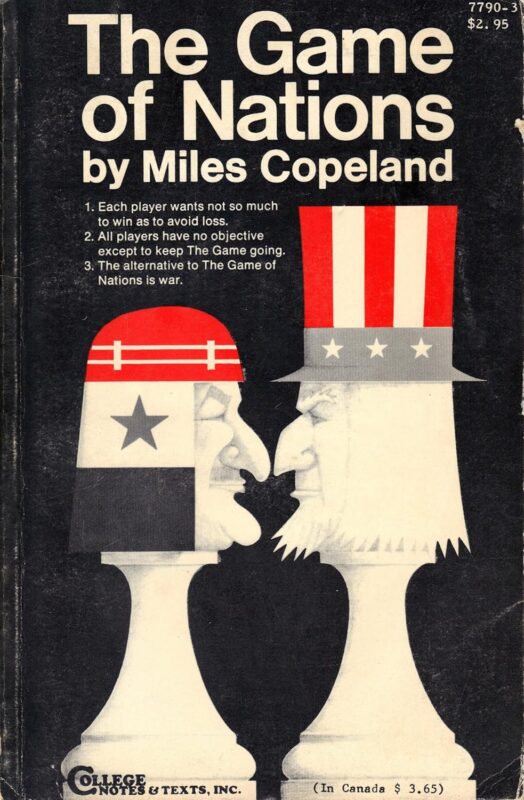
Miles Copeland Jr. is a former CIA officer who describes how the game of espionage is played, with particular reference to Egypt in the Nasser era. The author is a very seasoned operative. He writes with a straightforward attitude because he no longer cares. He is also the father of Miles Copeland III, manager of the Police, Sting, and his son Stewart Copeland.
The Game of Nations by Miles Copeland Jr. exposes the operational logic of covert U.S. foreign policy during the Cold War, focusing on the Middle East as a testing ground for cryptodiplomacy and strategic manipulation. Drawing from firsthand experience in intelligence operations, Copeland outlines the rules, mechanisms, and rationales of the “Game” that powerful nations play with weaker states to maintain influence without direct confrontation.
Understanding the Rules of Strategic Play
At the center of Copeland’s narrative lies a set of pragmatic assumptions: national leaders aim above all to stay in power; morality plays a role only to the extent that it aligns with national objectives; and decisions derive from calculations, not sentiment. These assumptions underpin the Washington “Peace Game” Center—a strategic simulation room where expert players role-play international actors, feed hypothetical actions into a decision-making model, and assess reactions based on intelligence inputs. The process treats foreign policy like a chessboard where moves matter more than motives.
The intelligence community used this framework to prepare for real-world diplomatic crises. Each participant impersonated world leaders, choosing moves grounded in the personality, goals, and pressures of those leaders. Simulations predicted foreign behavior and helped refine U.S. policy choices. Success depended on understanding local dynamics, recognizing leadership styles, and accepting that in many global arenas, instability wasn’t a threat to be eliminated but a tool to be leveraged.
Creating Leaders as Strategic Tools
The early Cold War created power vacuums as British imperial influence collapsed. The U.S. entered regions such as Syria and Egypt not to install democracies, but to cultivate players who could win the Game. Copeland presents Syria in the late 1940s as a test case in covert political action. Intelligence operatives worked to influence elections, shape public perception, and ensure the rise of leaders more aligned with U.S. goals.
Copeland does not veil the amorality of these efforts. Power struggles required interference, and interference required plausible deniability. Agents recruited from missionary, academic, and business backgrounds brought both idealism and naiveté to their assignments. As the U.S. worked to influence Syria’s future, operatives discovered that shaping political outcomes demanded more than ideology—it required a command of local culture, factional alliances, and the psychology of ambition.
Egypt and the Nasser Paradigm
Gamal Abdel Nasser emerges as the archetypal “player” in Copeland’s Game. Through detailed analysis, Copeland positions Nasser as a figure who combined national charisma with ruthless calculation. He understood the performance of sovereignty and the mechanics of global manipulation. Nasser’s style—firm control domestically, strategic ambiguity abroad—allowed him to secure Soviet arms, court American aid, and expand his influence among neutralist states.
Rather than resist Nasser, U.S. planners increasingly saw his type as optimal for regional control. A “Nasser-type” leader could repress opposition, hold together a fragmented society, and project ideological cohesion—all qualities necessary for geopolitical predictability. Copeland emphasizes that U.S. strategy evolved not to democratize the Middle East, but to find powerholders who could play the Game effectively while preserving U.S. interests.
Neutralism as Leverage
Positive neutralism, as practiced by Nasser, offered a tactical middle ground. By balancing overtures to both the U.S. and the USSR, neutralist leaders extracted aid, weapons, and legitimacy. Neutralism did not signal passivity; it created negotiating leverage. Nasser used this leverage to build transnational alliances and amplify Egypt’s voice across the Arab world.
Copeland views neutralism as both a strategy and a performance. Neutralist leaders needed to appear ideologically committed to independence while pragmatically accepting external support. The West, seeing the danger of unaligned powers becoming Soviet proxies, responded with offers designed to shift allegiance without overt domination.
Terrorism and Control Mechanisms
With influence came resistance. Nasser’s rise, and similar movements across the region, met internal opposition. To suppress dissent, regimes adopted increasingly authoritarian measures. Copeland links this repression to a strategic doctrine: dissent threatens the Game’s continuity, so repression becomes a precondition for participation.
Terrorism and counterterrorism emerge not as ideological extremes but as tactics for maintaining state control. Unionist ideologies justified violent suppression of opposition, portraying rivals as imperialist collaborators or religious reactionaries. For U.S. strategists, these moves were acceptable if they preserved a stable, pro-Western order or at least prevented Soviet infiltration.
The Illusion of Multipolarity
By the 1960s, the bipolar Cold War framework began to fragment. Decolonization, economic development, and ideological diversification generated a multipolar terrain. Copeland argues that this shift did not democratize international relations—it complicated the Game. More players meant more unpredictable moves. A formerly reliable client could realign, a small state could provoke major conflict, and regional alliances could splinter with a single assassination or coup.
This complexity required adaptive strategies. Intelligence agencies expanded operations. Diplomats developed local alliances beyond heads of state. The Game now included subnational actors, ideological movements, and media manipulation. Copeland portrays this evolution not as a failure of policy but as a natural consequence of increased interdependence and information flow.
The Suez Crisis and Strategic Reckoning
The 1956 Suez Crisis marks a pivotal moment in Copeland’s account. Nasser’s nationalization of the Suez Canal catalyzed British, French, and Israeli military action. The U.S., caught between alliances and strategic principles, used economic pressure and diplomatic leverage to halt the invasion. The event revealed a shift in global power: former imperial powers could no longer act unilaterally; the U.S. controlled the game board.
Copeland details the intelligence community’s internal debates leading up to the crisis. Simulation exercises had predicted Nasser’s actions. Planners had modeled British and Israeli responses. Yet the crisis exceeded the anticipated scripts. It demonstrated both the power and limits of predictive diplomacy.
The Game’s Moral Framework
Copeland challenges the reader to reconsider the ethical assumptions of foreign policy. He asserts that honesty, morality, and law function as tools within the Game, not constraints. Actions must be effective. Legitimacy flows from success. When the U.S. chooses to support or undermine a regime, it does so not for abstract ideals but because the move advances broader strategic imperatives.
This perspective demands a ruthless clarity. Policies cannot claim moral innocence while deploying covert agents, funding militias, or engineering coups. Copeland insists that the public face of diplomacy often conceals a hidden architecture of decisions based on realpolitik, not principle.
Implications for Future Strategy
As power shifts continue, Copeland sees the need for new frameworks. Intelligence must account for social movements, transnational networks, and the digital circulation of ideology. The Game adapts, and so must its players. Leaders who once responded predictably to pressure now command alternative funding sources, global media outlets, and decentralized loyalties.
Copeland suggests that success in this environment depends less on brute strength and more on interpretive accuracy. Intelligence becomes anthropology. Strategy becomes performance theory. The challenge lies not in controlling outcomes, but in anticipating intentions and responding with calibrated moves.
The Legacy of the Game
The Game of Nations presents a foundational account of American covert policy, framed not through idealism but through the lens of system logic. By depicting foreign relations as an evolving contest of moves, counter-moves, and silent interventions, Copeland equips readers to recognize the structures behind international events.
His narrative underscores the need for strategic literacy. Understanding the Game requires discarding illusions of neutrality and accepting that influence requires action. Whether crafting alliances, staging elections, or directing narratives, the agents of power play to sustain their advantage, not to balance justice. Copeland invites readers to watch the board carefully, learn the roles in play, and assess not just who holds power, but how that power behaves under pressure.