Welcome to Terrorland: Mohamed Atta & the 9-11 Cover-up in Florida
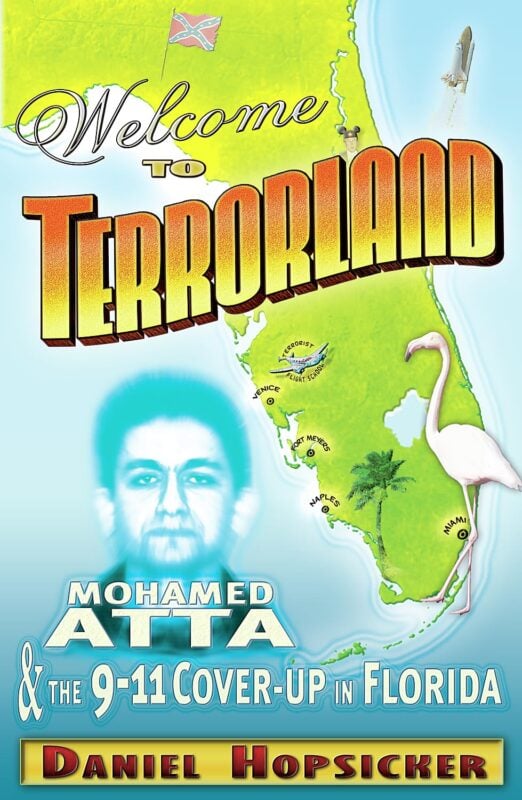
Daniel Hopsicker’s Welcome to Terrorland: Mohamed Atta & The 9/11 Cover-Up in Florida investigates the strange, unexplained nexus between America’s worst terrorist attack and a quiet town in Florida. Through a two-year inquiry into the life of Mohamed Atta and his network while based in Venice, Florida, Hopsicker uncovers a deeply tangled web linking U.S. intelligence, organized crime, covert operations, and the training of known terrorists in plain sight.
The True Origin of a Conspiracy
The hijackers’ presence in Florida was no accident. Fourteen of the nineteen 9/11 hijackers trained, traveled, and lived across several Florida cities. Venice, a sleepy retirement community, became a central staging ground. Hopsicker tracks how three of the four pilots—Mohamed Atta, Marwan Al-Shehhi, and Siad Al-Jarrah—learned to fly in Venice. These flight schools were not random; both were recently purchased by Dutch nationals, one of whom, Rudi Dekkers, had a documented criminal history and deep intelligence connections.
Government Knowledge and Intentional Blindness
Atta paid more than double the going rate for flight instruction. Huffman Aviation, where he trained, had been under scrutiny even before the attacks. Its financier, Wally Hilliard, owned a jet seized by the DEA with 43 pounds of heroin. Despite this, Hilliard’s operations continued uninterrupted. Hopsicker reveals that key local law enforcement files were confiscated by the FBI and flown to Washington aboard a military C-130 with Governor Jeb Bush present. Local police were left without access to their own records, unable to answer questions about Dekkers’ criminal history.
Witness Intimidation and Information Suppression
Amanda Keller, a former stripper and Atta’s American girlfriend, described Atta as controlling, erratic, and sadistic. After their breakup, she returned to their shared apartment to find their pets mutilated. The FBI pressured Keller into silence and warned local residents not to speak with reporters. Witnesses throughout Florida reported being visited by federal agents and told to keep quiet. Hopsicker collects testimonies from people who saw Atta and his associates drinking, using drugs, and associating with European men and wealthy Arabs—actions at odds with the image of devout fundamentalists.
Florida as Intelligence Backchannel
Florida has long functioned as a staging ground for covert operations. From narcotics trafficking to anti-Castro efforts, the state's infrastructure supports clandestine activity. The airports in Venice and nearby cities served as transit points for more than flight students. For decades, they moved drugs, arms, and personnel tied to both criminal syndicates and federal intelligence projects. Hopsicker outlines how Venice’s role in covert geopolitics dates back to Iran-Contra and continues through the shadowy figures linked to the 9/11 perpetrators.
The Attempted Assassination in Sarasota
Hours before the planes hit their targets, four Middle Eastern men arrived at President George W. Bush’s hotel in Longboat Key claiming to have a “poolside interview” scheduled with the president. Secret Service agents turned them away. That same morning, agents had received a tip from a Sudanese national that a known extremist had entered the area with possible intent to kill the president. The suspect, known as “Ghandi,” had made threats against Bush previously. The Secret Service detained multiple individuals but released them after brief questioning. The event vanished from the news cycle.
The FBI’s Timeline Collapses
Official narratives place Atta in and out of Florida on specific dates, but witnesses, receipts, and local reports contradict those claims. Atta was seen in Venice months after the FBI said he had left. He continued interacting with flight school staff and revisiting known locations. The FBI’s version omits key timelines and appears designed to sever connections that link Atta to specific actors and locations within Florida. When asked, local law enforcement officers confessed they could not provide answers—because the evidence was no longer in their possession.
The CIA’s Operational Shadow
Former CIA-connected aviation networks operated in parallel with the Venice flight schools. Hopsicker presents documentation and eyewitness accounts suggesting a pattern: many of the flight students were not mere hobbyists, but part of a broader logistical apparatus. Several eyewitnesses, including federal agents and journalists, report that the CIA not only knew about the foreign nationals training in Venice but coordinated their presence. The goal was not training alone—it was the cultivation of assets within a covert framework that spun out of control.
Atta’s Behavior Belied the Myth
The image of Atta as a pious zealot collapses under scrutiny. Witnesses describe him as sexually active, alcohol-consuming, and obsessed with control. He hosted drug parties, consorted with European men, and threatened women. One of his last known acts in Venice involved publicly berating Amanda Keller and threatening revenge, followed by the grotesque killing of animals. This portrait contrasts starkly with the sanitized version presented by the 9/11 Commission, which failed to explain how someone with no observable religious devotion became the mission's ringleader.
Political Obstruction and Federal Sabotage
Attempts to establish an independent investigation into the Florida connection were met with resistance. President Bush delayed the formation of the 9/11 Commission for over a year. When it was finally launched, Henry Kissinger was selected to lead it. The FBI closed its investigation within weeks, citing the anthrax threat as a higher priority. No public report on the Florida operation was issued. Journalists found themselves alone in the pursuit of answers, and many witnesses disappeared or refused to speak on the record.
Structural Protection of the Cover-Up
Throughout the book, Hopsicker argues that what happened in Florida constituted the largest uninvestigated crime scene in American history. The convergence of narcotics trafficking, intelligence operations, and terror logistics points to a systemic failure that was not accidental. Florida’s infrastructure enabled the conspiracy, and its secrecy apparatus ensured its burial. The deeper Hopsicker digs, the clearer the pattern becomes: concealment was not a response—it was a policy.
Who Were the Magic Dutch Boys?
The twin Dutch nationals who owned the two flight schools in Venice were more than businessmen. Rudi Dekkers and Arne Kruithof facilitated access, protected logistics, and moved within diplomatic circles with ease. Their backgrounds, financial anomalies, and unexplained government ties make them central figures in understanding how the hijackers operated without scrutiny. Despite clear red flags—fraud, drug ties, unpaid taxes—their businesses remained untouched, and their personal movements unrestricted.
Convergence in the Swamps of Florida
By placing Mohamed Atta in Florida and uncovering the extensive network that supported his movements, Hopsicker draws the reader into a harrowing realization: the 9/11 plot depended on more than foreign zealots. It required protected channels, cooperative institutions, and local silence. The story unfolds not through theory, but through pattern, evidence, and the collapse of official timelines under the weight of witness accounts.
Conclusion
Florida hosted a logistical pipeline for foreign operatives protected by structural blind spots and deliberate suppression. Mohamed Atta’s presence in Venice—and the strange immunity enjoyed by those who enabled him—forms the core of a concealed narrative about the 9/11 attacks. Daniel Hopsicker’s investigation reconfigures the geography of terror and redefines the scope of accountability. The cover-up, engineered at the intersection of intelligence, corruption, and neglect, persists not because it is hidden, but because it remains uninterrogated.