The Secret Team: The CIA and Its Allies in Control of the United States and the World
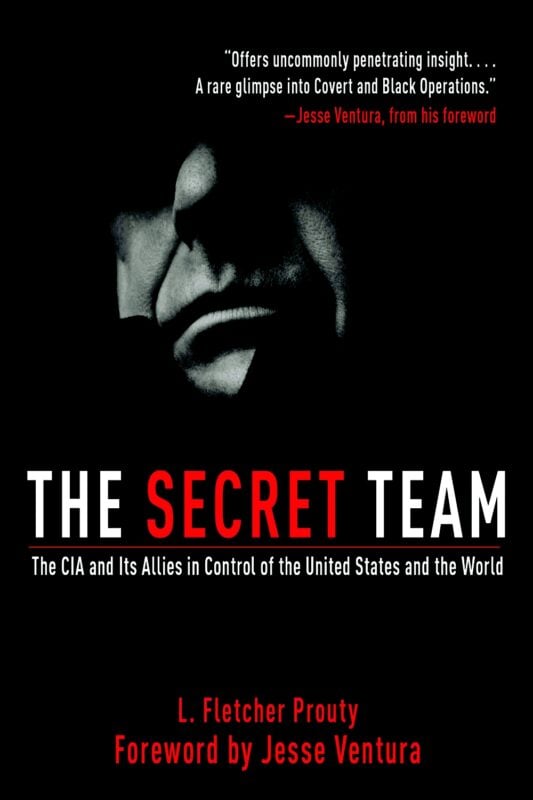
The Secret Team by L. Fletcher Prouty exposes the architecture of covert power in the modern American state. Prouty, a former Air Force colonel with deep ties to the Pentagon and the CIA, constructs a detailed account of how unaccountable, security-cleared operatives use intelligence, military logistics, and private industry to shape global events beyond the reach of constitutional governance. His argument centers on the emergence of a professionalized clandestine apparatus—the “Secret Team”—which directs policy not by directive from elected officials but through manipulation of information, covert action, and extrajudicial access to state resources.
The Structure of Invisible Command
The Secret Team operates through a decentralized but tightly connected matrix of intelligence officers, military personnel, civilian contractors, and foreign agents. These actors form a self-reinforcing mechanism of covert influence. Their power does not reside in official titles but in their access to classified intelligence and decision-makers. Prouty details how this structure emerged during World War II and institutionalized itself during the Cold War through the Office of Strategic Services, later formalized into the CIA under the National Security Act of 1947.
Within this structure, power concentrates through access and secrecy. The term “agency” signifies this reality: the CIA acts not on its own behalf, but as a proxy executing the will of clients who operate above public accountability. These clients include financial interests, multinational corporate executives, and elite members of transnational policy circles. The organizational ambiguity of the CIA permits deniability, allowing its operators to advance geopolitical goals with minimal exposure to legal or political consequences.
Covert Logistics and Global Reach
Prouty served as the Air Force’s focal point officer for CIA support, enabling him to observe how covert operations use the military’s logistical infrastructure for clandestine missions. Through this window, he reveals how the Team projects force without declaring war. Aircraft, weapons, and personnel move through official military channels under classified authorizations that bypass congressional oversight. This capacity grants the Team operational autonomy to conduct sabotage, coups, and psychological operations.
He illustrates how covert reach extends into nearly every continent, including operations in Southeast Asia, Latin America, Africa, and Europe. The narrative shows that logistics—transportation, communication, and supply chains—form the invisible architecture of covert power. When intelligence agencies operate with impunity inside military and civilian systems, they produce consequences far beyond the public’s grasp or control.
The Manipulation of Crisis
Crisis becomes the preferred medium for action. The Team manufactures, escalates, and exploits emergencies to justify intervention and conceal origins. Prouty provides case studies demonstrating how apparent international incidents stem from provocations staged by covert elements. These operations follow a pattern: create disorder, attribute blame, introduce covert forces, and manage escalation until policy objectives are secured.
Vietnam stands as the centerpiece of this logic. Prouty argues that American escalation followed a script shaped by covert narratives rather than battlefield necessity. Decisions hinged on briefings written not by generals but by CIA operatives and their civilian allies. These briefings filtered intelligence, shaped perceptions, and directed presidents toward preordained outcomes. The withdrawal timeline proposed to Kennedy, for example, appeared not as an objective forecast but as a mechanism to delay disengagement until political and operational advantages realigned.
Compartmentalization and Controlled Access
Operational secrecy depends on the compartmentalization of knowledge. The Team segments authority so thoroughly that its members often remain unaware of one another’s roles. Prouty recounts how even high-ranking military officials, including the Chairman of the Joint Chiefs of Staff, received only fragments of information about ongoing operations. The CIA controlled access to intelligence not to protect national security, but to control decision-making.
The structure creates artificial ignorance. Officers tasked with execution receive only the data relevant to their task, and those outside the Team’s inner circle cannot connect policy decisions to actual events. Prouty describes Pentagon offices designed with physical barriers to prevent accidental contact between CIA agents working on the same project. These tactics isolate participants, obscure authorship, and prevent coordinated oversight.
Information as Weapon
The Team’s command over information exceeds its command over force. Intelligence becomes a tool of influence rather than analysis. Reports written by operatives blend fact and interpretation into persuasive narratives that guide executive decision-making. The authors of these reports do not merely advise—they direct. Their language sets policy before officials realize the implications of their choices.
Prouty demonstrates how information circulates through classified channels insulated from media scrutiny or democratic debate. The content of briefings determines the trajectory of wars, the recognition of foreign governments, and the commitment of resources. Decision-makers act on scripts written by agents they cannot name, often without understanding the origins of the claims presented to them.
Corporate Alliance and Global Capital
The Team's operations serve a class of clients whose interests transcend national boundaries. Prouty identifies multinational corporations, international banks, and strategic resource consortiums as key beneficiaries of CIA intervention. Covert operations align with market expansion, resource extraction, and regime stabilization in favor of capital flows. The CIA functions as a service agency to these private interests, applying force when legal mechanisms prove insufficient.
Agreements such as the USA-USSR Trade and Economic Council, formed under Nixon and Shultz, illustrate this convergence. Ostensibly diplomatic initiatives functioned as frameworks for elite financial integration. Underneath the public diplomacy, the Team laid the operational groundwork—securing leaders, eliminating resistance, and establishing compliant regimes. Prouty highlights how such alignments shaped Cold War dynamics, not as ideological confrontations, but as contests over market control disguised as geopolitical necessity.
Presidential Power and Shadow Governance
Presidents do not command the Team. They inherit it. When Kennedy entered office, he attempted to impose constraints on the CIA after the Bay of Pigs failure. Prouty details how the Agency resisted oversight, continued unauthorized operations, and manipulated briefings to maintain autonomy. Kennedy’s directives were often ignored or reinterpreted to align with ongoing covert initiatives. His assassination, according to Prouty, solidified the Team’s dominance by removing the last major executive obstacle.
Successive presidents either acquiesced or remained unaware of the full extent of the Team’s operations. Prouty emphasizes that nominal authority conceals structural subordination. The real decisions occur within networks that transcend electoral cycles. When Dick Cheney declared that the Vice President was not part of the executive branch, he revealed the logic of shadow governance: real power operates where oversight cannot reach.
Media, Disinformation, and Official History
Official narratives obscure the Team’s existence. Prouty outlines how mainstream journalists receive curated leaks, planted stories, and background briefings designed to shape public perception. The CIA cultivates relationships with writers who act as intermediaries, publishing sanitized accounts that reinforce official myths. The Pentagon Papers, often portrayed as revelatory, appear in this light as partial disclosures shaped by internal power struggles rather than transparency.
Historiography becomes an extension of cover operations. Public understanding of foreign policy reflects the cumulative effect of disinformation. Prouty warns that most historical writing on intelligence, secrecy, and war originates from authors embedded within or dependent upon the very systems they describe. The result is not misinterpretation but structured illusion.
The Permanent Crisis Machine
The Team thrives under perpetual emergency. Cold War hysteria, anti-Communist campaigns, the war on terror—these paradigms enable ongoing covert operations by framing dissent as disloyalty and questioning as subversion. Prouty anticipates future iterations of this logic, suggesting that extraterrestrial threats could emerge as the next vehicle for global control narratives.
Crisis management ensures budgetary expansion, institutional survival, and strategic flexibility. Covert actors operate without interruption because crisis grants exemption from rules. The machine only requires a plausible enemy and a pretext for action. The rest follows through protocol already perfected.
The Collapse of Sovereignty
The emergence of the Secret Team marks a transformation in the nature of sovereignty. Decision-making authority no longer resides in elected assemblies or public debate. Instead, governance migrates to informal networks of classified influence. These networks determine war, peace, and global economic flows. The citizen becomes a spectator, subject to policies formed beyond reach or comprehension.
Prouty defines this system as post-sovereign power. The national state provides the facade. Behind it, covert structures manage outcomes through non-state means. Private capital, military logistics, and intelligence functions combine into a single operational entity.
The Enduring Legacy of the Secret Team
The patterns Prouty identifies continue. His work provides not only a historical record but a structural model. The Team is not a conspiracy. It is an institutional fact with enduring frameworks. Prouty demands recognition, not revelation. Understanding its operations requires tracing the convergence of secrecy, logistics, capital, and information. The pattern does not conceal itself. It embeds in the machinery of government, economy, and media.
What, then, sustains the illusion of democratic control? Who benefits from public ignorance? How does a society reclaim authority over structures designed to evade oversight? Prouty offers no blueprint. He presents the architecture. Recognition remains the first act of resistance.