Pre-Suasion: A Revolutionary Way to Influence and Persuade
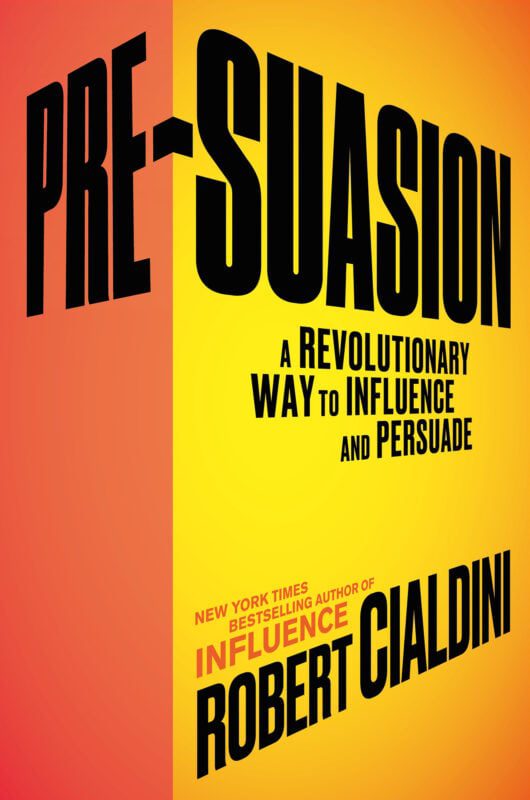
Pre-Suasion by Robert Cialdini investigates the critical role of attention in persuasive communication and offers a roadmap for ethically influencing others by shaping what they focus on before a message arrives. Cialdini’s years of research and real-world immersion in professions focused on gaining assent reveal the hidden mechanics behind successful persuasion, emphasizing the preparatory moves—what he calls “pre-suasion”—that determine whether an audience will be receptive even before they encounter a message’s content.
The Frontloading of Attention
Persuasion begins well before a direct request. Pre-Suasion asserts that the most successful communicators—salespeople, marketers, managers—spend significant energy preparing the psychological ground for their message. They do not merely refine the logic or clarity of their proposals; they arrange the environment so the audience is primed to receive the intended message with greater sympathy. Cialdini’s observations of top performers, such as the fire alarm salesman who built trust by subtly acting forgetful, showcase how effective persuaders create associative links—trust, openness, authority—prior to making requests.
The concept of privileged moments forms a central pillar in Cialdini’s argument. These moments represent windows of heightened receptivity, where the listener’s focus is aligned with the communicator’s goals. The timing and structure of an opener, or the element presented first, exerts significant power: what comes first changes how people experience what comes next. Whether through introducing a high number before stating a price, playing certain types of music in a wine store, or deploying evocative cues, pre-suaders set the context that frames all subsequent information.
Commanders of Attention
Cialdini details the features and stimuli that automatically command attention, explaining how elements such as the sexual, the threatening, and the different inherently pull focus. Beyond these “attractors,” he identifies “magnetizers”—the self-relevant, the unfinished, the mysterious—that keep attention anchored. The implications for persuaders are enormous: by skillfully managing what the audience attends to, communicators can make particular ideas seem more important or causal, shaping not only perception but also judgment and behavior.
The book illustrates the focusing illusion: nothing in life is as important as it seems when you are thinking about it. This principle, documented by Daniel Kahneman and leveraged in media agenda-setting, drives home that the act of focusing attention on an idea, person, or object grants it disproportionate significance. As a result, those who can direct and hold focus control the stakes of persuasion.
Processes of Association
Attention channels response not simply by elevating what’s noticed but by shaping the associations that follow. Cialdini lays out how all mental activity unfolds through patterns of association—networks of links that can be deliberately activated through language, imagery, and even the physical or social environment. Communicators exploit these associative patterns to create more desirable outcomes, from improved job performance to stronger consumer relationships.
Pre-Suasion explores the geography of influence, demonstrating how environments cue associations that guide choices. The placement of images or reminders, such as photos of accomplished women in science classrooms, meaningfully shifts outcomes by making certain identities or goals more salient.
Cialdini also examines the mechanics underlying pre-suasion, demonstrating how mental elements fire not simply when ready, but when readied. This insight, drawn from neuroscience and cognitive psychology, reveals how timing and priming operate in tandem, equipping persuaders to elicit favorable responses by arranging for the right mental states before making requests.
Best Practices and Universal Principles
The latter sections of the book organize best practices around six universal principles of influence—reciprocity, liking, authority, social proof, scarcity, and consistency—while adding a seventh: unity. Cialdini shows that channeling attention toward any of these concepts dramatically raises the odds of assent. Unity, he explains, can be fostered through cues of shared identity, common action, or synchronized activity, each contributing to a “We” relationship that deepens cooperation, trust, and influence.
Cialdini underscores the ethical dimensions of pre-suasion, urging that persuaders must consider not only what to present before their message but also whether they should do so at all. Data from organizational studies indicate that unethical use of persuasive tactics undermines long-term profits by attracting and retaining those inclined to cheat.
Durability and Post-Suasion
Pre-Suasion concludes with a focus on the durability of change. The aim is not merely to create fleeting shifts in attitude or behavior but to embed them so that they endure beyond the privileged moment. Cialdini describes procedures—grounded in behavioral science—that promote lasting change, ensuring that the effects of pre-suasion persist.
Embedded Mechanisms of Influence
Attention acts as currency; its allocation signals value both to the observer and to the observed. The deliberate structuring of focus in communication is no trivial matter. Cialdini demonstrates how human cognition allows only a single track of conscious awareness at a time. Thus, whatever occupies that track is elevated in importance, while all else recedes, often to the point of invisibility.
The mechanism works not only at the individual level but in aggregate, as seen in media and public opinion. The rise and fall of issue salience in response to news coverage underscores the powerful agenda-setting role that pre-suasion plays in society at large.
Ethical Considerations and the Power of Openness
Cialdini insists on the ethical imperative guiding influence. The choice to employ pre-suasive tactics must rest on an intention to enhance rather than exploit. His research shows that organizations fostering ethical influence benefit from a culture of trust and long-term viability, whereas those prioritizing expedience attract destructive elements.
Methods for Practitioners
Pre-Suasion offers a blueprint for practitioners in business, government, and personal life. The reader learns to craft openers that align with persuasive objectives, to utilize environmental cues, to frame requests at moments of peak receptivity, and to link messages with favorable associations. The skillful use of privileged moments transforms both the process and the outcomes of influence.
Cultivation, rather than mere presentation, defines the art of persuasion as Cialdini sees it. Through attentive preparation—priming the context, channeling attention, and choosing the right moment—one creates the conditions for genuine assent, mutual benefit, and lasting change. The science behind these methods equips readers to approach influence with both rigor and responsibility.
Key Takeaways for Strategic Communicators
The science of pre-suasion establishes that the path to agreement begins before argumentation. The preparation of the moment—what recipients focus on, what associations are activated, and which principles are foregrounded—shapes the likelihood and durability of change. Strategic communicators draw on a repertoire of techniques: crafting powerful openers, choosing supportive environments, invoking universal principles, and attending to timing with precision. Through these means, influence is achieved not by force, but by arrangement.
Building Unity and Lasting Bonds
Cialdini’s addition of unity to the canon of influence principles expands the toolkit for persuaders. Identity and synchronized action foster belonging and shared purpose, deepening the roots of trust and cooperation. In every domain—commercial, civic, interpersonal—the successful application of pre-suasion generates more than compliance; it cultivates relationships that sustain change and mutual success.
Cialdini’s work stands as both a manual for the ethical practitioner and a field guide for the wary consumer, illuminating the means by which focus, association, and timing create the architecture of influence. Pre-Suasion offers a vision of persuasion that privileges preparation, clarity, and respect, empowering its readers to operate with insight and integrity in a world shaped by attention.


About the Book