Propaganda: The Formation of Men’s Attitudes
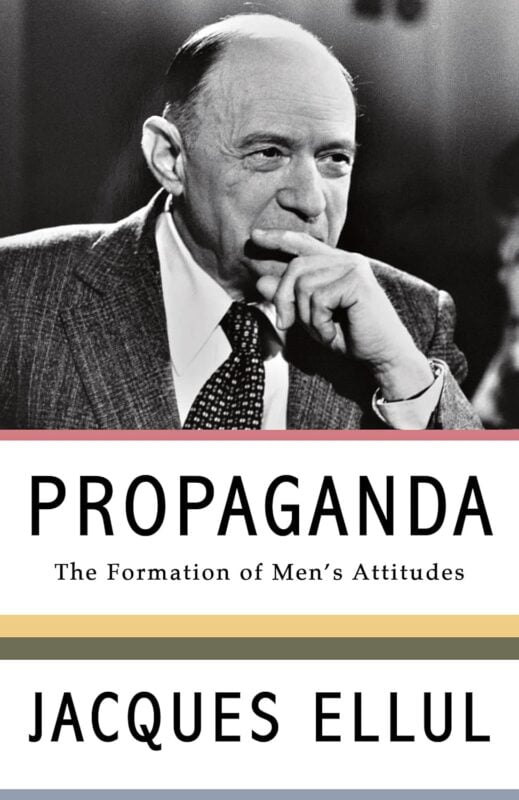
Propaganda: The Formation of Men's Attitudes by Jacques Ellul reveals the structure, function, and inevitability of propaganda in modern technological societies. Ellul defines propaganda as a necessary expression of technological society rather than an accessory of specific regimes or ideologies. He positions it as an integrated, scientific, and inescapable force that conditions individuals and shapes societies from within.
Propaganda as a Sociological System
Propaganda operates as an ecosystem, not as isolated incidents of media manipulation. Ellul rejects the view of propaganda as a deliberate and cynical series of lies told by powerful institutions. Instead, he frames it as a complex, systemic process embedded in technological society’s mechanisms. The primary engine of propaganda is not ideology, but the structure of mass communication, mass education, and the psychological environment that technology generates. Propaganda arises from the confluence of information saturation, mass society, and the psychological vulnerability of individuals who, in losing traditional social anchors, seek orientation and meaning.
The Conditions of Propaganda’s Emergence
Propaganda emerges from specific conditions: the existence of mass communication media, a mass audience, and a context in which political or ideological uniformity becomes functionally advantageous. It gains power through repetition, saturation, and integration. Technological advances enable the continuous, real-time delivery of coordinated messages that reinforce narratives and shape collective memory. In such societies, individuals do not form opinions—they absorb them. Opinion becomes a product of exposure and emotional resonance, not critical reflection.
Integration and Agitation Propaganda
Ellul distinguishes between integration and agitation propaganda. Integration propaganda stabilizes societies by normalizing dominant ideologies and incorporating individuals into existing structures. It sustains institutions, rituals, and behaviors that technological society requires. Agitation propaganda, by contrast, destabilizes. It mobilizes discontent, sharpens resentments, and incites disruption. Both forms depend on mass media, and both work through the systematic stimulation of emotional responses over time. Integration creates conformity; agitation channels dissatisfaction into organized movements.
Education as Pre-Propaganda
Education, Ellul argues, does not inoculate individuals against propaganda. It prepares them for it. Modern education floods students with fragmented facts, frameworks, and slogans. It teaches them to rely on mediated knowledge. It installs the habit of consuming pre-formed opinions. The result is not skepticism, but heightened vulnerability to systems of messaging that resemble education in structure. Propaganda exploits this vulnerability by offering seemingly coherent explanations and simple conclusions to the complexity education exposes without resolving.
The Role of the Individual in Mass Society
The individual in mass society becomes structurally dependent on propaganda. Disconnected from local traditions and organic community life, the individual seeks belonging in ideological identification. Propaganda offers psychological anchoring through participation, mobilization, and shared myths. It provides identity and direction. Individuals collaborate with propaganda not because they are coerced, but because they experience it as relief from isolation. This dynamic—demand for integration and the satisfaction of that demand through messaging—renders propaganda self-perpetuating.
Totality and Continuity of Propaganda
Effective propaganda does not function intermittently. It requires totality and continuity. Totality means that propaganda saturates all areas of life—media, education, art, entertainment, symbols, laws. Continuity means that it operates daily, without respite. Each message builds on the last, reinforcing narratives, displacing contradictions, and preempting alternative interpretations. Gaps allow reflection; continuity eliminates it. Repetition does not merely inform—it conditions. Through relentless consistency, propaganda restructures consciousness. It dissolves cognitive resistance by exhausting attention and replacing thought with reflex.
Psychological Crystallization and Alienation
Propaganda exploits psychological mechanisms to crystallize attitudes. By reducing complex phenomena to binary oppositions, it offers cognitive shortcuts. It promotes identification with images, slogans, and group affiliations. This process produces alienation by replacing lived experience with mediated interpretation. Propaganda alienates individuals from their own perceptions and inserts ideological filters through which all reality is processed. It breaks the link between personal judgment and external events, substituting orchestrated opinion for autonomous evaluation.
Propaganda’s Role in Shaping Public Opinion
Public opinion under propaganda does not emerge through open dialogue. It is constructed through strategic communication. Ellul details how propaganda modifies the constituents of opinion—beliefs, perceptions, emotions—by orchestrating the environment in which individuals encounter information. Media synchronize perspectives by controlling not just what is said but how it is framed, repeated, and contextualized. Over time, opinion ceases to reflect debate and becomes a reflection of exposure. The illusion of consensus emerges, not from agreement, but from uniform messaging.
Propaganda in Democracies and Technological States
Democracy does not exempt societies from propaganda. In fact, technological democracies require it. The complexity of modern governance, the scale of participation, and the volatility of mass opinion make propaganda essential for cohesion. It does not merely persuade; it manages expectations, modulates perception, and coordinates civic behavior. Ellul warns that democratic propaganda differs in method, not in purpose or effect. It uses techniques of transparency, participation, and rational appeal, yet these too serve the consolidation of power and the reduction of dissent.
The Irreversibility of the Propaganda Process
Propaganda, once launched at scale, cannot be undone through mere exposure or rebuttal. Its effects are cumulative and structural. It reorganizes habits of thought, reshapes memory, and conditions emotional response. Even if the message changes, the medium remains. Even if the content is revealed as false, the framework of interpretation persists. Ellul emphasizes the deep transformation individuals undergo through prolonged exposure. The propagandized subject is not simply misinformed—they become a different kind of subject altogether, responsive to a different logic.
Conclusion: Awareness as the First Defense
Ellul concludes by resisting both fatalism and optimism. Propaganda is a permanent feature of technological civilization. Its power lies not only in manipulation but in its structural congruence with mass society. To resist it, individuals must recognize its scope, mechanics, and functions. They must refuse the illusions of spontaneous opinion and confront the sources of their beliefs. True awareness begins not in opposing propaganda's content but in grasping its form. Only by understanding the necessity that drives propaganda can one regain the capacity for freedom within it.

About the Book