Ron The War Hero: The True Story of L Ron Hubbard’s Calamitous Military Career
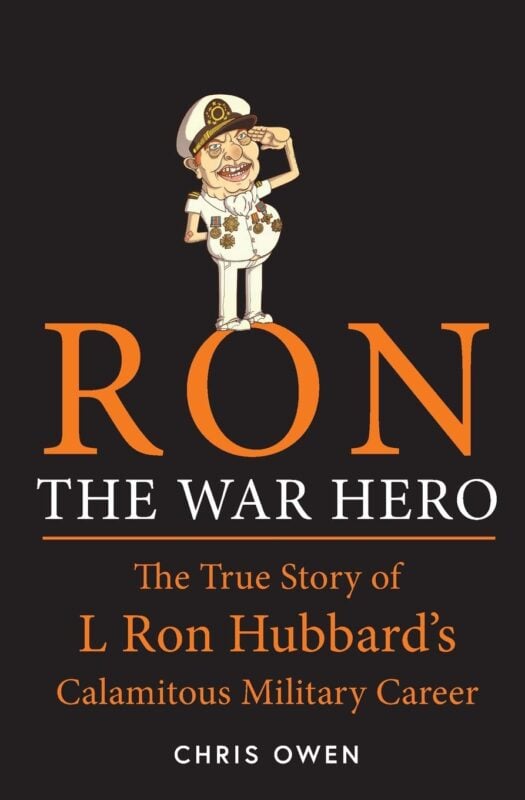
Ron the War Hero: The True Story of L. Ron Hubbard’s Calamitous Military Career by Chris Owen dismantles the heroic narrative surrounding L. Ron Hubbard’s wartime service, reconstructing his military history through naval records, government documents, and eyewitness accounts. Owen exposes a sequence of embellishments, misrepresentations, and self-generated myths that formed the foundation of Hubbard’s post-war persona and, by extension, the ideological structure of Scientology.
The Origins of a Myth
Before World War II, Hubbard pursued multiple paths to military involvement. He enrolled in the Montana Army National Guard underage and secured a promotion to First Sergeant in the Marine Corps Reserve without fulfilling standard requirements. These early episodes established a pattern. Hubbard exaggerated limited involvement into declarations of extensive experience. When he joined the Navy in 1941, his application included letters—some ghostwritten by himself—claiming fictitious achievements and credentials.
The U.S. Navy commissioned Hubbard as a Lieutenant (junior grade) in July 1941, assigning him mostly to shore-based intelligence and administrative duties. His initial postings involved tasks such as reviewing sailing directions and annotating charts. He compiled photos from a personal expedition and submitted corrections to navigation manuals, which the Navy acknowledged but considered minor.
Fabricated Feats and Inflated Roles
Hubbard’s postwar claims extended far beyond his actual assignments. He described leading combat operations, surviving dramatic encounters with Japanese forces, and healing wartime injuries through mental techniques that later became Dianetics. His accounts placed him at the center of nearly every major Pacific Theater campaign, as either a strategist, combat leader, or wounded survivor.
The narrative expanded to include imagined leadership roles in Australia, submarine battles off the Oregon coast, and navigation breakthroughs credited with laying the foundation for LORAN. He claimed 21 to 29 medals for valor and combat—none of which the Navy confirmed. Official records show he received four routine campaign medals and spent most of his active duty far from combat zones.
Two Failed Commands
Hubbard held command of two vessels: the USS YP-422 and the USS PC-815. He was removed from both commands. On the YP-422, issues emerged concerning discipline and leadership. On the PC-815, he initiated an unauthorized attack off the Oregon coast, claiming to engage and sink enemy submarines. Navy records confirmed the absence of enemy activity and reprimanded Hubbard for impulsive, unsupported actions. These events established a record of poor judgment, disobedience, and inability to manage command responsibilities.
Postwar Transformation and Institutional Mythmaking
Following the war, Hubbard repackaged his military career into a foundational myth. He claimed to have been crippled and blinded by combat injuries and subsequently healed himself through discoveries he would formalize as Dianetics. This narrative served as both personal origin story and institutional justification for Scientology. The Church’s biographical material, drawn from Hubbard’s lectures and unverified publications, presented dozens of contradictory timelines and achievements.
The Church of Scientology, relying on Hubbard’s words as doctrine, reinforced and institutionalized these myths. It published conflicting accounts with no attempt at internal consistency. Hubbard’s followers, prohibited from questioning the source, inherited a narrative that could not withstand scrutiny but was never meant to be tested.
Documentary Evidence and Legal Unraveling
The Freedom of Information Act and ensuing lawsuits unlocked extensive documentation from the U.S. Navy and Veterans Administration. These materials invalidated Hubbard’s claims. Logs, orders, correspondence, and performance evaluations outlined a career marked by shore duty, medical treatment for ulcers and arthritis, and removal from two commands due to incompetence. Court cases, most notably the Armstrong trial, exposed the Church’s efforts to suppress or misrepresent these records.
The trial featured damning cross-examination of Church witnesses and corroborated the findings of independent researchers. The Navy’s position remained consistent: Hubbard had not seen combat, had received no wounds, and was awarded only standard service medals. The Church lost the case, and public access to Hubbard’s records increased. No document supported his claims of valor or injury.
The Consequences of Deception
Hubbard’s military embellishments were not mere personal fabrications. They formed the rhetorical and psychological framework of Scientology. His alleged recovery from war injuries became the first demonstration of Dianetics. His supposed command experience justified the naval hierarchy adopted by the Sea Org. His claimed intelligence background inspired the structure of Scientology’s internal security operations.
These institutional forms drew authority from a narrative that Chris Owen’s research reveals as invented. Each claim of heroism or brilliance evaporates under scrutiny. The real Hubbard emerges not as a mystic or war hero but as a struggling officer whose performance fell short and whose ambitions demanded myth rather than memory.
Public Image and Historical Reckoning
Hubbard shaped his legacy through uncorroborated stories, often told in lectures or disseminated in Church publications. The lack of an official autobiography left followers and critics alike to interpret fragmented, often contradictory anecdotes. The Church, faced with the impossibility of reconciling multiple stories, chose to affirm them all. Every version was treated as accurate, even when mutually exclusive.
Chris Owen reconstructs a timeline grounded in primary documents. He identifies specific dates, postings, and actions that directly contradict published accounts. The resulting portrait is not only one of personal fabrication but of organizational complicity. The Church did not inherit a myth; it engineered and protected it, long after the facts had been exposed.
What drives a man to generate such an elaborate fiction? What systems enable the preservation of that fiction for decades? These are not rhetorical questions. They structure the historical problem that Owen resolves through detailed analysis. His findings reframe the origin of Scientology from a postwar revelation to a postwar reinvention.
Conclusion of Claims
Ron the War Hero challenges institutional narratives by presenting documented evidence that dismantles Hubbard’s self-portrayal. The book does not speculate. It provides records, transcripts, and historical context that demand reassessment of how foundational myths function inside belief systems. Hubbard’s wartime service, stripped of ornament and invention, reveals the mechanisms by which a man of ordinary service recast himself as a prophetic figure. The truth does not degrade the man; it defines him. What remains is a record of imagination deployed in service of power, not understanding. Chris Owen’s investigation ensures that record remains public, detailed, and impossible to ignore.

About the Book