Surprise, Kill, Vanish: The Secret History of CIA Paramilitary Armies, Operators, and Assassins
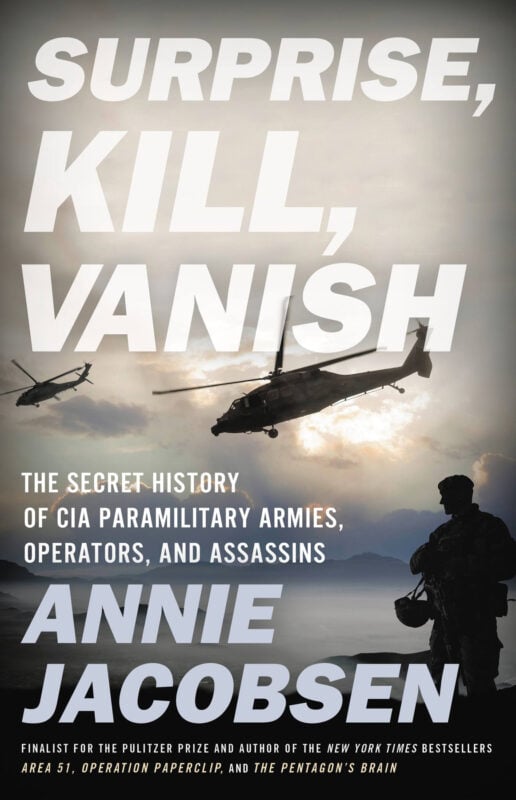
Surprise, Kill, Vanish by Annie Jacobsen tracks the evolution of American covert action from its World War II origins to the modern era of targeted killing, threading a continuous line through history’s most secretive operations. Jacobsen draws on firsthand interviews, declassified files, and field research to map the transformation of the United States’ clandestine forces into one of the world’s most formidable shadow armies. The book dissects the inner workings of covert missions, the psychology of operatives, and the shifting legal and moral ground beneath these operations.
The Genesis of Ungentlemanly Warfare
The story begins in wartime Europe, where the British Special Operations Executive (SOE) and its American counterpart, the Office of Strategic Services (OSS), designed a new kind of war. Sabotage, subversion, and assassination formed the core of their mission. This clandestine tradition set the precedent for the United States, inspiring the creation of a paramilitary ethos that prioritized disruption over convention. When the OSS Jedburgh teams parachuted into Nazi-occupied France, they acted as the vanguard of an approach that would shape American covert warfare for generations.
Tertia Optio: The President’s Hidden Hand
Jacobsen reveals how American leadership institutionalized covert action as the “third option”—termed tertia optio—after diplomacy and open war. The 1947 National Security Act birthed the Central Intelligence Agency and invested the president with sweeping authority to order covert operations under Title 50 of the U.S. Code. In this framework, covert action gained legal sanction through Presidential Findings and Memoranda of Notification, cementing plausible deniability as both a shield and a strategic asset. Administrations leveraged this power to reshape global events in silence.
From OSS to CIA: Organizational Transformation
The OSS dissolved after World War II, but its tactics and philosophy seeded the ground for the CIA. Jacobsen tracks this transition with precision, showing how William J. Donovan’s vision outlasted Truman’s reluctance and became central to the Cold War playbook. Recruitment, training, and operational doctrine from the OSS era reemerged in the CIA’s paramilitary Special Activities Division, notably the Ground Branch, which inherited the Jedburghs’ legacy of surprise attack and rapid disappearance.
Profiles in Shadow
Surprise, Kill, Vanish animates its narrative through detailed profiles of operatives whose careers span decades. William Waugh, for example, begins as a WWII paratrooper and later becomes a senior CIA paramilitary officer. Jacobsen interweaves his personal journey with the broader institutional evolution, demonstrating how individual experience, resilience, and improvisational skill underpin the success or failure of secret missions. The book explores the training, mindset, and psychological toll of a life spent on the edge of legality and morality.
Assassination and Legal Authority
Assassination occupies a central place in the story, reframed as “executive action” and authorized through legal instruments designed to maintain plausible deniability. The terminology evolves across administrations—health alteration, neutralization, targeted killing—while the core activity persists. Jacobsen details the mechanics of how U.S. leaders select targets, create kill lists, and authorize lethal force in environments ranging from Cold War Berlin to post-9/11 Afghanistan. The book unpacks the legalistic foundations that render these actions permissible, tracing how lawyers and policymakers create frameworks that justify and enable premeditated killing abroad.
Missions and Outcomes: The Global Battlefield
Jacobsen moves chronologically and geographically through the CIA’s operational history, tracing missions from Korea and Guatemala to Libya, Iraq, and Afghanistan. The account of Operation Anthropoid—the plot to assassinate Reinhard Heydrich—serves as an origin point, illustrating both the tactical complexity and the cascading consequences of targeted killing. Later, the book covers the attempted eliminations of Fidel Castro, Colonel Qaddafi, and Carlos the Jackal, revealing the intricate planning, technological innovation, and realpolitik calculus behind such efforts.
Technological Innovation and Adaptation
Surprise, Kill, Vanish highlights the persistent drive to adapt technology to the needs of covert action. From the Fairbairn-Sykes stiletto and homemade explosives of WWII, the narrative advances to modern sniper rifles, compact arms, and ultimately drone warfare. The ability to kill from a distance, to strike with precision, and to vanish without trace defines the cutting edge of contemporary operations. Jacobsen details how technological breakthroughs multiply the reach and lethality of U.S. operatives, even as the ethical boundaries blur.
Institutional Oversight and the Era of Denial
The Church Committee hearings of the 1970s introduced congressional oversight, compelling the CIA and the White House to formalize reporting and approval processes. Yet, Jacobsen shows how the logic of plausible deniability persists, enabling U.S. presidents to maintain distance from controversial actions. Executive accountability, she observes, exists in tension with operational secrecy, as classified findings and covert mechanisms ensure that the details remain hidden even as policies change.
The Rise of Targeted Killing
Jacobsen gives special attention to the post-9/11 expansion of targeted killing, focusing on the development of high-technology drone strikes and the proliferation of kill or capture lists. Under George W. Bush and Barack Obama, the machinery of lethal direct action accelerated, blurring distinctions between wartime combat and peacetime assassination. The narrative details the bureaucratic evolution of kill lists, interagency vetting, and the normalization of drone strikes in Yemen, Afghanistan, and Pakistan.
The Secret War’s Psychological and Moral Costs
Beyond tactics and technology, the book interrogates the human cost of covert action. Jacobsen conducts interviews with operators, policymakers, and legal experts who grapple with the weight of secret-keeping, the pressures of moral ambiguity, and the long-term consequences of their decisions. The story of Lewis Merletti, former director of the U.S. Secret Service, underscores the inverse side of the covert coin: the intense effort to deter assassination attempts against American leaders, revealing the dual logic of kill and protect that defines the covert world.
Narrative Momentum and Investigative Depth
Jacobsen drives the narrative through a blend of high-stakes missions and quiet moments of reflection. She recounts clandestine meetings, field training, operational failures, and the personal anecdotes that illuminate the hidden world of paramilitary action. Her research combines official documents, interviews, and on-the-ground reporting to reconstruct events with clarity and urgency. The cumulative effect draws the reader into a world where the stakes are existential, and decisions carry irrevocable consequences.
Defining Legitimacy in the Shadow War
The book poses fundamental questions about legitimacy and authority. Who decides when a covert killing advances national interest? What boundaries, if any, should restrict the application of lethal force in secret? Jacobsen contends that the legal and moral architecture supporting covert action forms a dynamic battlefield, shaped by changing presidents, lawyers, and operatives. The narrative invites readers to weigh the consequences—intended and unforeseen—of government power wielded in darkness.
Convergence and the Future of Covert Action
Surprise, Kill, Vanish closes with a meditation on the convergence of law, technology, and executive will. The apparatus built across decades now stands as a permanent feature of American statecraft. As new threats emerge and technologies evolve, the infrastructure of covert action adapts, multiplies, and grows more sophisticated. Jacobsen urges a reckoning with the costs, achievements, and risks embedded within this system.
Surprise, Kill, Vanish by Annie Jacobsen establishes the throughline from World War II’s clandestine beginnings to the globalized, technologically advanced shadow war of the twenty-first century. The book asserts that covert action—once a matter of improvisation and necessity—has become a pillar of U.S. policy, shaping outcomes in visible and invisible ways. The consequences of this evolution, both operational and moral, reverberate through the present and into the future, challenging citizens and leaders to confront the hidden machinery of power.