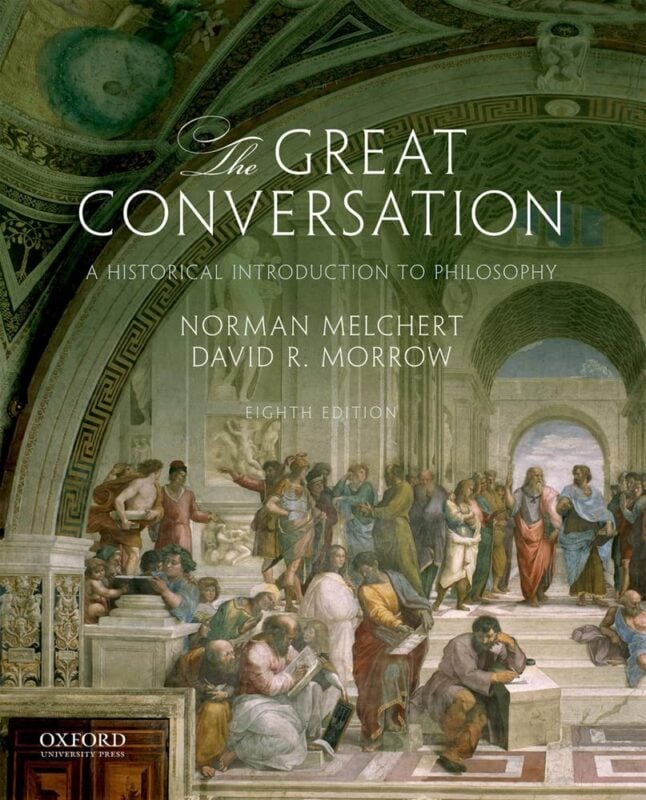
The Great Conversation: A Historical Introduction to Philosophy
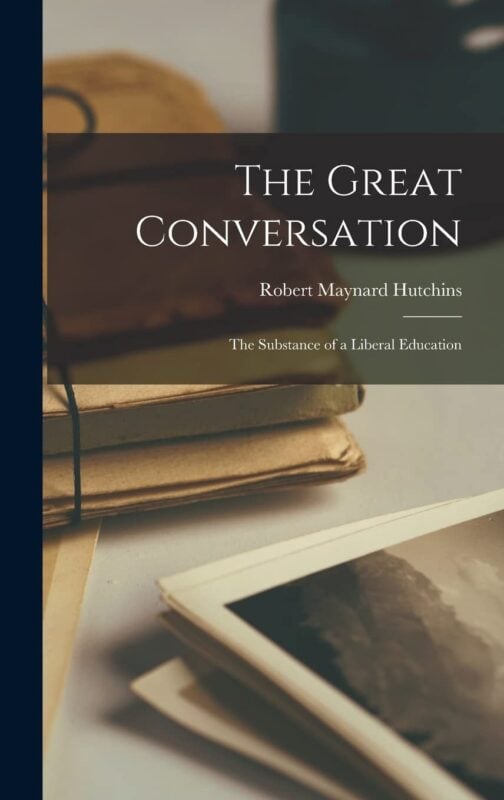
The Great Conversation by Robert M. Hutchins frames Western civilization as a centuries-long dialogue among thinkers seeking truth through rigorous exchange. This book launches the Great Books of the Western World series by asserting that civilization advances through engagement with ideas rather than accumulation of facts. Hutchins delivers a sharp critique of modern education, diagnosing its retreat from intellectual depth and its abandonment of liberal learning. He proposes a recovery through the great books that shaped the West, each selected for its contribution to an evolving inquiry into fundamental human problems.
The Purpose of a Liberal Education
Liberal education cultivates human excellence by teaching individuals to think clearly, reason critically, and reflect on values. Hutchins describes education as the process by which one becomes a person, not merely a functionary. Liberal education aims at developing the whole person, prioritizing judgment over training, and insight over information. It prepares citizens to engage in self-governance, equipping them with the ability to examine arguments, assess evidence, and participate meaningfully in public life.
This form of education does not begin or end with institutional schooling. It assumes a lifelong process grounded in fundamental texts. By participating in the same conversation that animated Socrates, Augustine, Aquinas, and Newton, individuals enter a community of inquiry that spans generations. This community is formed not through membership but through shared contemplation of perennial ideas.
The Structure of the Western Tradition
The Western tradition, as Hutchins defines it, exists in the interplay of texts responding to one another across time. This tradition speaks in many voices, each refining, challenging, or amplifying the others. It unfolds as an argument in motion, a sequence of engagements where later writers read, reinterpret, and revise their predecessors. A tradition formed in conversation does not require uniformity; it requires continuity through relevance.
Hutchins traces this lineage through a curated selection of texts chosen for their capacity to deepen this dialogue. These works pose questions rather than merely provide conclusions. They explore themes such as justice, freedom, truth, beauty, and the nature of the good life. Within this framework, the books become instruments for self-reflection and cultural understanding.
Criteria for Inclusion
Hutchins outlines three principles guiding the selection of texts. First, each work must have contributed significantly to the Great Conversation. Second, it must retain the capacity to engage readers directly, without intermediaries. Third, it must be intelligible to the general reader willing to make a sustained effort. These criteria reject both faddishness and specialization.
The result is a collection that privileges original thought and enduring relevance over historical representation or national balance. Works are included not to affirm cultural pride but to sustain inquiry. The selection spans disciplines: philosophy, science, theology, politics, literature, and mathematics each contribute to the shared project of understanding.
Why Science Belongs
Hutchins devotes special attention to defending the inclusion of scientific texts. Science participates in the Great Conversation by offering methods of inquiry and models of reasoning. Great scientific works reveal not just discoveries but the conceptual revolutions that reshape human understanding. They propose new structures of thought and engage philosophical issues about evidence, explanation, and reality.
The presence of Euclid, Newton, Darwin, and Freud in the series reflects a vision of science as a humanistic enterprise. These figures ask how we know, what counts as proof, and what implications follow from discovery. They challenge older worldviews and generate new philosophical problems. Scientific thought, no less than moral or political reasoning, forms the architecture of modernity.
The Threat of Propaganda
Hutchins warns of a culture dominated by propaganda and distraction. When media saturate public consciousness with slogans and imagery, citizens lose the ability to form independent judgments. The erosion of deliberation invites manipulation. Without habits of critical thought, democracy degenerates into spectacle.
Great books resist this trend by modeling reasoned argument and demanding intellectual engagement. They train the mind to identify assumptions, evaluate claims, and trace implications. They foster independence not by affirming opinion but by challenging it. The antidote to propaganda lies in exposure to complexity and in the cultivation of judgment through repeated encounters with serious thought.
Adult Education as a Cultural Imperative
Hutchins argues that liberal education cannot remain confined to youth or to elite institutions. In an industrial society, adults possess the time and capacity for reflection. He envisions a model where education extends throughout life, invigorating civic life and personal development. Adult learners bring experience, motivation, and context to their study. They understand that learning is not preparation for life but participation in it.
The structure of the Great Books project aligns with this vision. The books are accessible, their topics universal, their problems enduring. The set is designed not for academic mastery but for thoughtful engagement. It enables adults to become participants in the conversation that defines their civilization.
Temporal Scope and Canonical Limits
The series includes works up to the early 20th century, ending around 1900. Hutchins explains this limit not as a dismissal of contemporary thought but as an acknowledgment of perspective. Time reveals which ideas endure. The works included have passed through a filter of historical judgment. Their significance has withstood the fluctuations of taste and novelty.
Twentieth-century contributions remain open for future inclusion. Hutchins points to the Syntopicon's bibliography for readers seeking more recent voices. He affirms the need for continuity, not closure. The Great Conversation remains open-ended. Future generations will decide which contemporary works deserve a place within it.
The Syntopicon as a Guide
To support the reader, Mortimer Adler and his team created the Syntopicon, a thematic index that organizes the major ideas across the set. It presents 102 core topics, from justice and liberty to art and logic. Each entry traces the idea's development, noting agreements, conflicts, and transformations across time.
The Syntopicon enables readers to approach the series through questions. It provides an intellectual map that transcends chronological reading. This tool exemplifies the Great Books project’s purpose: to foster inquiry and to make the tradition accessible without diluting its rigor.
Civic Function of the Tradition
Hutchins connects the Great Conversation to democratic life. He claims that free institutions require free minds. When citizens understand the philosophical foundations of law, morality, and governance, they resist tyranny and demagoguery. The tradition equips them to discern policy from propaganda, argument from assertion.
This civic dimension defines the Great Books project as a political act. It proposes a model of citizenship grounded in reflection, dialogue, and mutual respect. It envisions a republic of letters where the authority of ideas supersedes the authority of force.
Integration of the Whole Person
By reading widely and deeply, individuals integrate emotional, ethical, and intellectual dimensions of their lives. Literature expands empathy. Philosophy sharpens clarity. History teaches humility. Science cultivates precision. Theology inspires reverence. Mathematics fosters discipline. The integration of these modes of thought enables individuals to navigate complexity and to pursue coherent lives.
The conversation among these disciplines forms the basis of human flourishing. It does not seek uniform answers. It invites participation in a process whose value lies in its continuation. To live in this tradition is to affirm that growth occurs through engagement, that insight follows persistence, and that freedom depends on understanding.
Enduring Relevance
The tradition of the West unfolds in the texts that shape its memory and direct its hopes. These books embody questions that remain urgent. What is justice? What is a good life? What obligations do we owe one another? How shall we govern ourselves? What can we know? What should we revere?
Hutchins asserts that to engage these questions through the works that first formulated them is to take responsibility for one’s intellectual heritage. The Great Conversation defines what it means to be educated. It locates wisdom not in answers, but in sustained, honest inquiry. Through these books, civilization does not preserve itself. It renews itself.