The Last Will And Testament Of Cecil John Rhodes
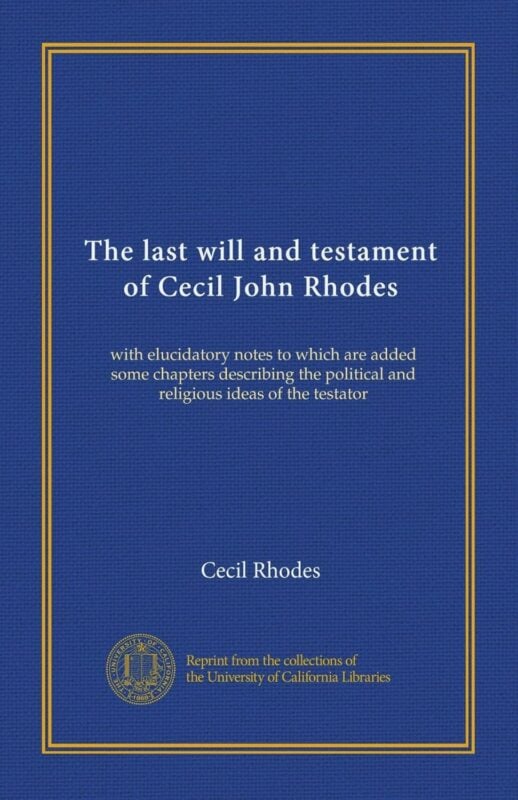
The Last Will and Testament of Cecil John Rhodes, edited by W. T. Stead, establishes a testamentary blueprint for imperial ambition, global leadership, and cultural engineering. Rhodes names his beneficiaries, defines the conditions of inheritance, and frames education as the lever of empire. The testament exerts gravitational pull on the political, educational, and economic history of the twentieth century. Its impact radiates from Oxford to Africa and across the Atlantic, orchestrating a convergence of personal ambition, social vision, and global reach.
Cecil Rhodes shapes the future from the grave. By directing the terms of his burial, he enshrines personal myth and public legacy on the summit of the Matoppos in Rhodesia, commanding a landscape he once dominated. Rhodes instructs that his grave, marked with a plain brass plate, remain perpetually maintained as a site of both solitude and statecraft. His will creates enduring obligations—Rhodes links memory with place, requiring the Matoppos and Bulawayo Fund to conserve the burial site and support the monument to the men who fell in the first Matabele War. He transforms landscape into political narrative, using geography to structure remembrance and authority.
Land as Living Legacy
Rhodes engineers the utility of land as both resource and school. His estates in Matabeleland near Bulawayo and in Mashonaland at Inyanga transfer into trust, designated for public agricultural experimentation and education. Rhodes binds these assets to the perpetual instruction of Rhodesians, integrating land management, scientific farming, and the creation of parks for communal benefit. He mandates the completion of infrastructural projects, including the Westacre dam and a railway extension, anchoring progress in material interventions. The trustees receive explicit authority to adapt their approach, investing income to yield results and applying profits to improve local conditions. By assigning the Inyanga property for irrigation, forestry, market gardening, and the establishment of an agricultural college, Rhodes constructs a framework where stewardship and innovation entwine.
Residence, Power, and Public Space
Groote Schuur, Rhodes’s Cape Town estate, embodies his fusion of private wealth with public power. He transfers the residence, its grounds, and associated properties under strict covenants, prohibiting sale, subdivision, or private suburban development. Rhodes designates Groote Schuur as the future official home for the Prime Minister of a federated South African government, encoding the estate into the architecture of statehood. Until such a federation materializes, he opens the estate as a public park. He appropriates funds to maintain gardens, staff, and amenities for state use, stipulating both the protection of the Hofmeyr family grave and the maintenance of ceremonial dignity. This act transforms Groote Schuur from a private retreat into a node of political legitimacy, framing leadership within natural grandeur and historical continuity.
Oriel College: Endowment and Instruction
Rhodes allocates £100,000 to Oriel College, Oxford, apportioning the sum for structural expansion, compensation for lost revenue, fellowships, and the comfort of the resident scholars. He establishes separate funds for building, income supplementation, and ongoing repairs, advising the college authorities to consult his trustees for prudent investment decisions. Rhodes regards the collegiate, residential university as the crucible for future leaders and expresses skepticism toward non-residential models. He articulates a direct link between the scope of the college’s physical infrastructure and its capacity to attract and nurture talent. This endowment becomes a mechanism to elevate the college’s status, support its traditions, and reinforce the values of academic community and public service.
The Rhodes Scholarships: Engine of Imperial Unity
The testament’s defining innovation arises in the creation of the Rhodes Scholarships. Rhodes asserts the power of education to shape imperial unity, international understanding, and the leadership class of the coming century. The will mandates scholarships at Oxford for male students from the British colonies, the United States, and Germany. He specifies a three-year tenure and an annual stipend of £300, ensuring scholars enjoy financial means sufficient for full participation in university life.
Rhodes engineers selection criteria that privilege not only academic excellence but also athleticism, leadership, public duty, and moral force. He instructs that scholars demonstrate achievement in outdoor sports, devotion to the protection of the weak, capacity for fellowship, and moral initiative during their school years. He prescribes an evaluation matrix: academic results, peer ballots for physical and leadership qualities, and headmaster assessments for character. This rubric institutionalizes a model where merit, public spirit, and embodied excellence align to advance the interests of the empire.
International Reach and Cross-Atlantic Vision
Rhodes appropriates two scholarships per year to every present state and territory in the United States, linking the American republic to his educational experiment. He expands the program to German students, with candidates nominated by the German Emperor, motivated by a belief in the strategic value of Anglo-German understanding. This global scope marks Rhodes’s intention to forge an elite bound by shared education, English language, and attachment to the ideals of public leadership. The scholarships become conduits for international exchange and political alliance, assembling a network of alumni with formative connections to Oxford and to each other.
Governance, Flexibility, and Trustee Authority
The will vests broad discretion in the trustees, empowering them to determine the implementation and adaptation of Rhodes’s directives. They retain control over investment, property management, and scholarship allocation, with authority to suspend or remove scholars as needed. Rhodes recommends annual dinners for scholars and alumni, envisioning a living network of former recipients who gather to share experiences and strengthen ties. The trustees operate as both stewards of the endowment and architects of its evolving legacy, ensuring the sustainability of Rhodes’s vision while retaining the power to interpret its application.
Dalham Hall: Succession and the Ethics of Landed Power
Rhodes’s English estate, Dalham Hall, enters the will under strict entail. He limits inheritance to male heirs on the condition of ten years of professional or business engagement, barring encumbrance or subdivision. Failure to comply triggers forfeiture of the estate to the next in line. Rhodes defines land ownership as a duty of maintenance and local stewardship, identifying the “country landlord” as a stabilizing force in English society. He forbids the fragmentation of the estate, seeking to preserve both its dignity and the practical leadership of its holder. The will embodies his conviction that active management and social obligation drive the strength of the landed class.
Political and Religious Philosophy in Action
The appended chapters extend the testament into a broader manifesto. Rhodes interprets imperialism as a racial and linguistic project, seeking the unity of English-speaking peoples and the harmonization of British, American, and German interests. He regards education as the primary means of advancing these aims, positioning Oxford as the spiritual and intellectual center of this imagined community. Through his bequests and educational initiatives, Rhodes envisions the rise of a cosmopolitan elite equipped to govern, mediate, and advance the collective interests of the English-speaking world.
The will’s religious references remain understated but present. Rhodes invokes concepts of duty, character, and public spirit as forms of secular piety, elevating the responsibilities of leadership to the level of vocation. His directives emphasize service, sacrifice, and the obligation to protect the weak. He refrains from imposing religious tests for scholarship eligibility, signaling a commitment to broad inclusion within the imperial and international framework.
Material Infrastructure and the Design of Influence
Rhodes ties the success of his philanthropic and political designs to the material realities of land, property, and investment. The estate funds projects in irrigation, agricultural research, park creation, and architectural expansion. The will’s structure assumes that the physical and institutional environment of learning and leadership shapes character and achievement. Rhodes’s precise allocations of funds for gardens, animals, and ceremonial traditions reflect his belief that grandeur, beauty, and ritual sustain social order and inspire those who inhabit positions of power.
Narrative as Structure
The testament unfolds as a narrative of construction and inheritance. Rhodes engineers systems to outlast his life, weaving together property, ritual, and instruction. He recognizes the limitations of the present but acts to structure the future, guiding the allocation of resources, the cultivation of talent, and the formation of memory. As the will moves from burial and monument to educational empire, it aligns personal destiny with collective transformation. Each section reinforces the imperative to act, build, and remember.
Convergence of Agency and Structure
The agency of the testator animates the structure of the will. Rhodes’s directives exert force, compelling trustees, heirs, and scholars to act within prescribed parameters. The flexibility afforded to trustees reflects an understanding of the unpredictability of the future, yet Rhodes secures the legacy’s foundations through specificity and discipline. The interplay of vision, directive, and interpretation sustains the legacy’s relevance and influence.
Enduring Influence and Legacy
The will establishes a template for philanthropic strategy, political engineering, and educational innovation. The Rhodes Scholarships catalyze the emergence of a global elite. The maintenance of public parks and agricultural experiments shapes regional development. Groote Schuur and Oriel College, bound by covenant and investment, become institutional symbols of authority and continuity. The Dalham Hall estate perpetuates the traditions of the English landed class. Through these instruments, Rhodes projects power and purpose into generations he will never meet.
A reader seeking to understand the architecture of legacy, the mechanics of educational influence, or the choreography of imperial ambition finds in this document a definitive text. Rhodes binds personal myth, public directive, and global aspiration into a single testament. The world that emerges from this structure reflects the force of a singular will, transmitted through the disciplines of land, learning, and law. What comes of a world shaped by such design? One finds answers in the lives shaped, the institutions transformed, and the conversations—public and private—that trace their origins to the last testament of Cecil John Rhodes.