The Gehlen Memoirs
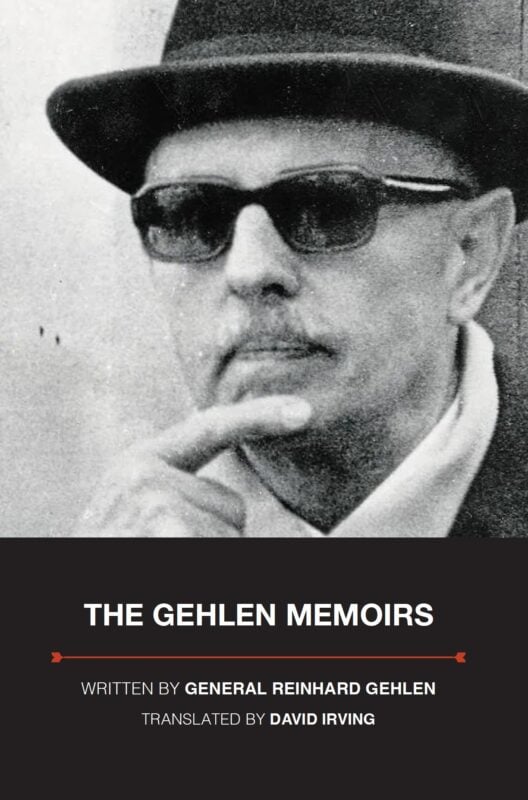
The Service – The Memoirs of General Reinhard Gehlen by Reinhard Gehlen, translated by David Irving, charts the trajectory of a man who shaped twentieth-century intelligence work from the inside of Hitler’s military staff to the leadership of the Federal Republic of Germany’s intelligence apparatus. His account blends battlefield analysis, postwar maneuvering, and the architecture of modern espionage, turning his personal career into a mirror of global strategic realignment.
From Hitler’s Bunker to Washington
Gehlen situates his story in the ruins of 1945, when he surrendered to American forces after burying files and planning for the survival of his intelligence team. He recalls being flown across the Atlantic in General Bedell Smith’s aircraft, disguised in civilian clothes, and housed under guard in Fort Hunt, Virginia. Within this liminal setting he negotiated with U.S. officers who saw in his Foreign Armies East archives a unique resource on the Soviet Union. He builds narrative tension around his exchanges with Captain John Boker, who shielded him from American indifference and Soviet claims, enabling him to preserve both documents and personnel.
The Making of Foreign Armies East
The memoir traces back to 1942 when Gehlen was appointed to head Fremde Heere Ost. He details the reorganization of German intelligence on the Eastern Front, the calculation of Soviet reserves, and the techniques of order-of-battle analysis. He describes how his staff compiled reports from deserters, prisoners, and aerial reconnaissance, assembling a mosaic of Soviet capacity. His warnings about the scale of Russian preparations before Stalingrad and Kursk framed him as a Cassandra figure whose assessments were ignored by Hitler, even as evidence mounted. He emphasizes the methodological rigor of his branch, contrasting statistical evaluation with the improvisation of battlefield command.
Stalingrad, Citadel, and Strategic Blindness
The collapse at Stalingrad emerges as the hinge of German fortunes. Gehlen recounts the despair of watching his forecasts dismissed and the destruction of entire armies that might have been spared through strategic restraint. The planning of Operation Citadel at Kursk becomes another emblem of fatal obstinacy. His unit estimated the Red Army’s strength with precision, yet Hitler clung to the offensive. Gehlen’s bitterness surfaces when he recalls suspicion that Martin Bormann might have leaked information to Moscow. He frames the catastrophe as the result of a regime deaf to intelligence, where ideology overpowered operational analysis.
Political Warfare and Missed Opportunities
Gehlen underscores the absence of a coherent German policy toward occupied Russians. He recounts how troops were welcomed as liberators in 1941, how local volunteers filled auxiliary units, and how the capture of General Vlasov opened the door to a broad anti-Soviet movement. He argues that Clausewitzian insight called for political as well as military engagement. Instead, Hitler sabotaged these opportunities, folding them belatedly under Himmler’s control in 1944, when it was too late to matter. The memoir thus frames intelligence as inseparable from the wider field of political warfare.
Defeat, Collapse, and Survival Strategy
In the final months of the war Gehlen describes a deteriorating Eastern Front, the destruction of Army Group Center, and the January 1945 Soviet drive into Silesia. His own family fled west as he conceived desperate measures, including setting forest fires to slow Soviet advances. When the Reich fell, he shifted to planning the survival of his service. He and his officers buried files in Bavaria, hid in the mountains, and then offered themselves to American forces as a functioning unit ready for redeployment. This foresight, he insists, set the stage for his later influence.
The Gehlen Organization and Pullach Headquarters
With American sponsorship, Gehlen rebuilt his network at Pullach near Munich. He recalls the delicate negotiations with General Sibert and the CIA, the establishment of funding channels, and the recruitment of reliable staff. He situates his organization as both a continuation of wartime expertise and a new instrument of Cold War strategy. Adenauer’s government entered the picture as the Americans sought to integrate intelligence into West German statehood. The memoir explains how tensions with the nascent Bundesamt für Verfassungsschutz shaped his vision of security, and how he resisted figures he considered untrustworthy.
Setbacks and Counterattacks
The organization faced exposure in the press, countermeasures from East Germany under Ernst Wollweber, and cases of infiltration that tested security. Gehlen recounts the kidnapping of agents, the betrayal of Wolfgang Hoher, and the propaganda assault of the Soviet “white book.” He portrays these episodes as the trials of a service under constant siege, balancing clandestine work with the pressures of legitimacy. He emphasizes the need for rigorous internal discipline, surveillance, and vetting, while documenting successes such as the defection of Eastern officials and penetration of Soviet structures.
Integration into the Federal Republic
By 1956 the Gehlen Organization transformed into the Bundesnachrichtendienst (BND). Gehlen reflects on his dealings with Adenauer, his impressions of Allen Dulles, and the institutional transfer of authority. He stresses the principle that intelligence must remain free from direct political manipulation, offering independent assessments rather than policy directives. He portrays the transition from American control to German sovereignty as a complex balancing act, one that required careful negotiation of trust and autonomy.
Crisis Zones and Global Reach
The memoir surveys the Hungarian uprising of 1956, the Suez Crisis, and Khrushchev’s secret speech. Gehlen describes the Berlin crises, the construction of the Wall, and the tremors of the Cuban missile standoff. He situates the BND as a service with European scope but global entanglements, monitoring insurgencies in Indonesia, Soviet penetration of the Middle East, and the balance of power in Vietnam. He frames intelligence as a forward radar system, one that revealed Soviet aid patterns after the 1967 Arab–Israeli war and guided Western responses.
Heinz Felfe and the Scars of Treachery
One of the most dramatic episodes centers on Heinz Felfe, the KGB agent within the BND whose exposure shook the service. Gehlen details the damage caused, the internal investigations, and the reliance on lie detector tests that followed. He connects this betrayal to earlier German traditions where loyalty and treue were paramount yet repeatedly violated. He argues that intelligence requires absolute trust, and that betrayal carries catastrophic consequences, both operationally and psychologically.
Final Years and Retirement
Gehlen recounts his disputes with civil servants, the suicide of his deputy, and his own forced retirement in 1968. He assesses the changing landscape of the Cold War, Khrushchev’s fall, the rise of China, and Ulbricht’s role in East Germany. He predicts that future threats would come from the Soviet–Chinese rapprochement and from Communist penetration of the Third World. His narrative closes with reflections on the institutionalization of German intelligence and his conviction that vigilance would decide the fate of the West.
Soviet Ideology and Disinformation
The final chapters extend beyond memoir into strategic treatise. Gehlen defines Soviet foreign policy as an ideological mission cloaked in semantic manipulation. He describes “disinformation” as a structured weapon, employed through diplomatic missions, front organizations, and cultural exchanges. He catalogues Communist efforts to infiltrate unions, student groups, and peace movements. He insists that democratic societies underestimate the precision with which Moscow choreographs influence campaigns, and he frames intelligence services as the critical tool for exposing and countering these operations.
Twenty-Five Years of Soviet Power Politics
Gehlen concludes with a panoramic review of Soviet strategy from 1945 to 1970. He traces patterns of expansion, the establishment of satellite governments, and the instrumental use of treaties. He interprets the 1970 Soviet–German treaty as an extension of traditional tactics. He predicts the succession of Shelepin as a potential dictator and anticipates a consolidation of Soviet and Chinese power. His forecast presents a world in which Western security depends on foresight, organizational discipline, and the unflinching analysis of adversary intentions.
Conclusion
The memoir establishes a continuum from the Wehrmacht’s intelligence bureau to the BND, anchored by Gehlen’s personal leadership. It illuminates how files buried in the Alps became the seed of a Cold War institution that shaped NATO strategy and West German sovereignty. By framing intelligence as both science and art, and by linking operational details with global ideology, Gehlen’s account situates espionage as a decisive force in twentieth-century history. The narrative advances through precise recollections of battles, secret negotiations, betrayals, and strategic assessments, all carried by the voice of a man who placed himself at the fulcrum of shifting world orders.