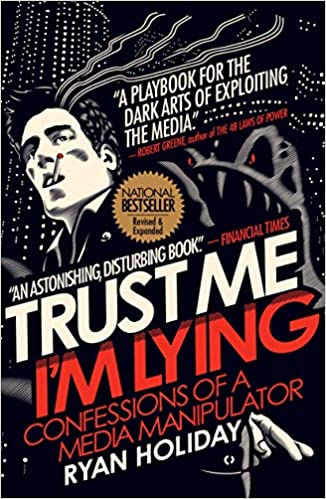
Trust Me, I’m Lying: Confessions of a Media Manipulator
Unveiling the Machinery of Media Deception
In Trust Me, I’m Lying: Confessions of a Media Manipulator, author Ryan Holiday pulls back the digital curtain to expose the manipulative tactics he wielded while orchestrating some of the most viral online narratives of the last decade. The book does not simply recount past campaigns—it maps the architectural fault lines of modern journalism and the blogosphere. From small-time blogs to national news outlets, Holiday lays out, with methodical precision, how content is gamed, how outrage is manufactured, and how public perception can be hijacked.
How Blogs Became the Primary Engine of Media Corruption
Holiday begins by establishing the foundational mechanism by which blogs influence the media ecosystem. Blogs, he writes, are impoverished and pressure-driven, reliant on pageviews to survive. They incentivize sensationalism because attention equals revenue. This economic dependence creates a media hierarchy where false or misleading stories, once published on a minor site, can “trade up the chain” to more prominent outlets. At each level, the story becomes more legitimate not by the strength of evidence, but by the credibility conferred through repetition.
The Viral Playbook: Manipulation as Strategy
Holiday dissects a series of tactics used to manipulate this ecosystem. He identifies specific methods: pay bloggers with gifts or ad revenue, craft headlines to mislead and provoke, and supply them with what spreads rather than what’s true. His campaigns created fake protests, planted false identities, and orchestrated pseudo-events—deliberate acts designed not to inform, but to be reported. With startling clarity, Holiday outlines how to engineer stories for virality, leveraging controversy and outrage to force media attention.
The "Link Economy" and Delegation of Trust
The concept of the “link economy” serves as a central critique. Holiday explains that blogs and online news outlets trade links to drive traffic without verifying content. This interlinking masquerades as sourcing, and it is built on a now-corrupt tradition called the “delegation of trust”—the assumption that if one reputable outlet reported something, others can repeat it. This system, he argues, is not just flawed but actively dangerous, allowing hoaxes and misinformation to metastasize within hours.
Fake News Is Not the Problem—Unreality Is
Holiday redefines the threat. The danger is not fake news per se, but “unreality.” Media consumers, immersed in a constant stream of curated, distorted information, begin to accept it as truth. The book presents pseudo-events as central to this unreality—press releases, red carpet events, and even protests staged only for coverage. These events are designed to simulate relevance, feeding a public increasingly dependent on narratives rather than facts.
Case Studies: Media Manipulation in Action
The narrative includes direct case studies—manipulations orchestrated by Holiday himself. He recounts defacing billboards for a film he was promoting, then anonymously tipping off blogs to the “outrage.” He fabricated email exchanges, faked identities, and tricked influential economists and publications into citing ideas that originated from him under aliases. In one instance, he got the Los Angeles Times to pick up a story seeded with a fake name, ultimately helping build his own reputation.
Bloggers Aren’t Investigators—They’re Traders
Throughout the book, bloggers are portrayed as traders, not journalists. They aren’t interested in verifying stories; they seek clicks. The structure of blogging discourages long-term credibility in favor of short-term virality. RSS died, and with it the concept of loyal readership. Instead, blogs target viral traffic—users who arrive through Google or Facebook, read one story, and disappear. This drive for virality creates a fertile field for manipulation.
Blogging Culture Isn’t Broken—It Was Built This Way
Holiday argues the system isn't failing—it's succeeding exactly as designed. The blog economy thrives on fast, low-cost content. The incentives are structured to reward those who exploit it best. He lays bare how headlines are engineered, stories are optimized for emotional response, and media watchdogs become complicit through neglect. Blogs are built to be gamed. Every click validates the system. Every retweet fuels it.
What the Reader Can Do: Read Differently, Consume Less
The solution isn’t to fix blogs; it's to change how readers interact with them. Holiday calls on readers to slow down, demand sourcing, and recognize manipulation. He suggests reading physical newspapers, subscribing to trusted outlets, and resisting clickbait. By consuming less and questioning more, audiences can regain some control over the narratives they absorb. Opting out of the click economy, he insists, is not a personal favor but a cultural necessity.
The Cost of Influence: Holiday’s Final Reckoning
Holiday concludes with a moral reckoning. The very tactics that made him powerful eventually became threats to his integrity and wellbeing. He writes this book as a controlled burn—to destroy the tools he once used, and to warn others who might follow his path. He understands the appeal. The tactics work. But the fallout—on public trust, on truth, and on personal ethics—carries consequences far beyond individual campaigns. His final confession echoes the book’s title, merging irony with accountability: "Trust me, I’m lying."


About the Book