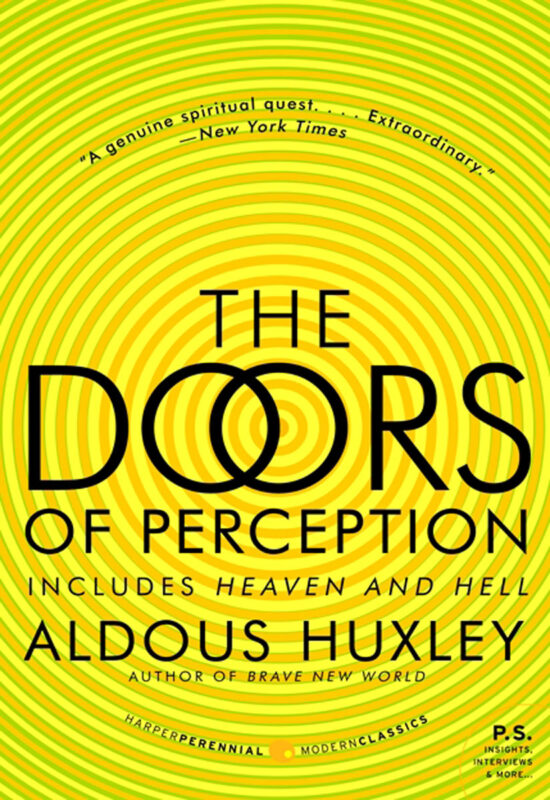
The Doors of Perception and Heaven and Hell by Aldous Huxley confronts the nature of consciousness by examining a single, transformative experience under the influence of mescalin. Huxley, a keen observer and masterful prose stylist, swallows the alkaloid in the spring of 1953. He turns his attention not only to the phenomenology of his own perceptions, but also to the historical, philosophical, and artistic implications of opening new doors within the mind. As the experiment unfolds, Huxley’s perspective shifts, exposing what he describes as “Mind at Large”—a reality filtered under ordinary circumstances by the brain for practical survival, now revealed in full through the temporary collapse of the mind’s usual barriers. What emerges is a radical, luminous confrontation with the “is-ness” of things, the unmediated intensity of existence, and the aesthetic, ethical, and metaphysical questions that such a revelation provokes.
The Experiment: Immediate Perception and Its Impact
Mescalin induces an overwhelming clarity of vision. Huxley reports an extraordinary shift in the qualities of perception—flowers become radiant, books glow with gemlike color, and the folds of his own trousers reveal an endless complexity. He finds that the sense of time recedes and spatial relationships lose their ordinary significance. Experience collapses into an unbroken present, every object charged with significance, every sensation imbued with meaning. His descriptions illuminate a phenomenological encounter in which the subject becomes indistinct, the boundaries between self and environment blur, and the “given” reality of ordinary objects emerges as miraculous and wholly sufficient.
The Reducing Valve and the Architecture of Consciousness
Huxley grounds his observations in the “reducing valve” hypothesis: the human brain does not produce consciousness, but restricts it, filtering a vast field of potential awareness into a manageable stream. He locates the source of ordinary perception in evolutionary necessity, as the brain’s narrowing function protects the organism from being overwhelmed. Mescalin inhibits this function, letting “Mind at Large” seep through. Huxley links these insights to the writings of philosophers such as Bergson and the research of neurologists and psychologists who, by means of drugs, hypnosis, or meditation, attempt to alter the thresholds of the mind. This argument repositions the mind-body relationship, positing a model where perception is fundamentally selective, utilitarian, and incomplete, shaped by the limits of attention and language.
Visionary Art and the Revelation of “Is-ness”
A central theme emerges as Huxley observes the transformation of his own aesthetic perception. He recognizes in the folds of drapery, the sheen of a vase, and the color of flowers the very subject matter that captivates great artists. He explores how painters like Van Gogh, Vermeer, and Botticelli have rendered the heightened significance of simple objects, not as symbols or emblems, but as ends in themselves—manifestations of “Suchness.” Huxley reads art history as the record of those rare individuals congenitally equipped to see what the rest perceive only in moments of radical openness. The visionary, in Huxley’s view, differs not in kind but in degree from the artist or mystic, as both seek to express and evoke the “intrinsic significance of every existent.”
Contemplation and Action: The Tension of the Transfigured Mind
In the midst of his experience, Huxley asks what becomes of ordinary human life when perception is cleansed and consciousness is saturated with meaning. He notes a profound loss of interest in utilitarian tasks, the will to action, and even human relationships. The contemplative, enthralled by the revelation of pure being, finds the duties and obligations of daily life diminished in urgency. Huxley frames this dilemma as the age-old conflict between contemplation and action, the way of Mary and the way of Martha, the stillness of the quietist and the active compassion of the Bodhisattva. The visionary state grants access to an order of being where value inheres in what is, and where human striving, competition, and ambition fall away. Yet the world’s demands persist, and Huxley recognizes the challenge in reconciling the call to contemplation with the ethical imperatives of social existence.
Schizophrenia, Madness, and the Limits of the Mind
The altered state induced by mescalin suggests to Huxley a model for understanding certain forms of madness. He sees a structural analogy between the visionary’s experience and the “heaven” and “hell” of schizophrenia. The person afflicted with psychosis may find the ordinary safeguards of the mind absent, their consciousness inundated by a reality too intense, too chaotic to bear. Huxley describes how, under mescalin, fear or hostility could easily turn every perception into a proof of conspiracy or cosmic malice—a self-validating spiral of paranoia. He draws on Buddhist and Christian mystical literature, referencing The Tibetan Book of the Dead and the doctrines of Boehme and Law, to argue that the unregenerate or unprepared soul experiences the divine as a burning, purgatorial fire. In this schema, madness becomes an overload of the “given,” a catastrophic incapacity to filter or manage the weight of the real.
Art, Symbol, and the Language of Revelation
Huxley interrogates the limits of artistic representation. He contends that even the highest art can only gesture toward the reality revealed in visionary experience. The chair painted by Van Gogh, the skirts in Botticelli’s “Judith,” or the still lifes of Vermeer—these are expressive symbols, not manifestations of the “Suchness” itself. The visionary may delight in art as a preparatory device or as a relic of insight, but finds its power strictly limited when compared to the immediacy of direct perception. Huxley asserts that the language of religion, too, functions as a symbol-system: necessary for communication and cultural continuity, yet also the source of the great mistake—taking the concept for the datum, the word for the thing. The universe of “reduced awareness” is petrified by language, while the visionary glimpses something more.
Mysticism, Religion, and the History of Perception
The book traverses the landscape of religion and mysticism, drawing connections between Huxley’s experience and the spiritual traditions of East and West. He surveys the religious art of Taoism, Zen Buddhism, and Christianity, tracing the ways these cultures have represented or denied the world of the senses. He discusses the rise of landscape painting as a religious art in the Far East, the Christian struggle to reconcile the Incarnation with the doctrine of the Fall, and the tendency for mystics and artists to seek the divine both within the mind and in the “ten thousand things” of objective reality. Huxley suggests that the visionary perception—available through drugs, spiritual exercises, or spontaneous revelation—offers direct access to a sacred order underlying the mundane, a territory too often obscured by routine, habit, and cultural prejudice.
Ethics of the Visionary State: Negative Virtue and Positive Influence
The contemplative mode, Huxley argues, does not simply lead to inertia. The visionary, absorbed in the order of things, refrains from many forms of wrongdoing, experiencing a spontaneous withdrawal from “the dirty Devices of the world.” He references Pascal’s claim that “the sum of evil would be much diminished if men could only learn to sit quietly in their rooms.” The contemplative, by virtue of direct vision, acquires a negative virtue—avoiding harm by being satisfied with the revelation of existence. Huxley goes further: those who practice contemplation “in the height” can become conduits, transmitting beneficent influence into a world starving for meaning. This positive, if elusive, ethical dimension emerges as a possibility when vision aligns with action, when the experience of unity births compassion rather than withdrawal.
Music, Mood, and the Texture of the Experience
During the experiment, Huxley encounters music—Mozart, Gesualdo, Alban Berg—and examines its power to connect him with the human world. Vocal music, especially, bridges the visionary state and the realm of relationship. He perceives a pattern in disintegration: even as musical order collapses, the presence of a “Higher Order” asserts itself in fragments, demanding immediate perception rather than reliance on fabricated coherence. The experiment with sound accentuates Huxley’s theme—meaning inheres not in systems or categories, but in the experience of presence, the “here and now” that visionary perception unlocks.
Toward Integration: The Challenge of Return
As the effects of mescalin fade, Huxley reflects on the challenge of integrating visionary insight into the flow of ordinary life. The world resumes its familiar shapes, yet traces of transfiguration linger. He acknowledges the impossibility of sustaining the visionary state indefinitely, yet insists on the lasting value of the experience. The real test, he suggests, lies in returning to human relations, work, and obligation while retaining the knowledge of “how one ought to see.” He holds up the saint and the active contemplative as models, those rare figures who can bring the insight of unity into compassionate engagement. The book closes with a recognition of both the gift and the task—vision points beyond itself, demanding both gratitude and application.
Search Engine Optimized Description
The Doors of Perception and Heaven and Hell by Aldous Huxley offers a firsthand exploration of consciousness through the lens of psychedelic experience. Huxley’s narrative, grounded in his mescalin experiment, reveals the hidden potential of the human mind to access heightened states of awareness, illuminating the relationship between perception, art, mysticism, and mental health. The book presents a compelling inquiry into the nature of reality, the function of the brain as a filtering mechanism, and the capacity for visionary insight to transform daily life. With direct engagement in the philosophy of mind, the psychology of altered states, and the history of religious and artistic vision, Huxley’s work stands as a foundational text in the literature of psychedelic experience, consciousness studies, and spiritual seeking. Readers seeking insight into the limits and possibilities of perception, the role of art in revealing meaning, and the ethical dimensions of contemplative vision will find The Doors of Perception and Heaven and Hell an essential resource, rich in observation, analysis, and provocation.