The Road to Eleusis
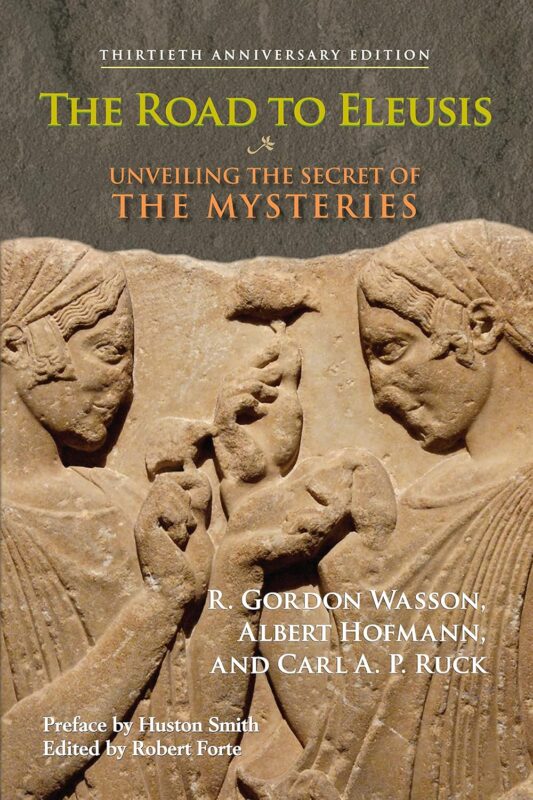
The Road to Eleusis by R. Gordon Wasson, Albert Hofmann, and Carl A. P. Ruck investigates the chemical, historical, and spiritual foundations of the ancient Greek Eleusinian Mysteries and asserts that their transformative visions arose from a psychedelic sacrament prepared from ergot, a parasitic fungus that grows on barley. The authors, drawn from ethnomycology, chemistry, and classical scholarship, merge their fields to reconstruct the most enduring secret of ancient religion—the visionary rite at Eleusis that shaped Greek consciousness for nearly two millennia. Their evidence unfolds through direct ethnographic observation, chemical demonstration, and textual exegesis, combining modern pharmacology with the mythic imagination of Greece.
The Rediscovery of a Forgotten Communion
R. Gordon Wasson opens the investigation through his own discipline of ethnomycology, which studies the cultural role of fungi in human history. He traces his insight to decades of fieldwork on the sacred mushroom cults of the Mazatec Indians in Oaxaca, Mexico. The emotional, sensory, and metaphysical intensity he witnessed there led him to search for analogs in ancient civilizations. In Mexico, he saw participants ingest hallucinogenic mushrooms called teonanácatl, “the flesh of the gods,” and enter a state of luminous vision, auditory synesthesia, and transcendental awe. The experience revealed to him a structure of consciousness beyond ordinary perception. He recognized the same structure in classical descriptions of Eleusis, where initiates emerged from the sanctuary declaring that they had “seen the great light” and no longer feared death. The symmetry between Mesoamerican mushroom rites and the Greek Mysteries suggested a shared human pattern: divine revelation through entheogenic transformation.
From Mycophilia to the Mysteries
Wasson recounts how his own life led to this hypothesis. A domestic disagreement with his Russian-born wife, Valentina Pavlovna, over wild mushrooms in the Catskills evolved into a lifetime of research on cultural attitudes toward fungi. Their inquiry produced the terms “mycophilia” and “mycophobia,” defining the ancient split between people who revered mushrooms and those who despised them. In Russia, mushrooms symbolized fertility, renewal, and sacred nourishment. In Anglo-Saxon cultures, they connoted decay and poison. This divergence, Wasson argues, reflects deep prehistoric memories of a once-revered visionary fungus whose ritual use later fell under taboo. The emotional polarity toward mushrooms persisted long after the original cult disappeared. From this cultural archaeology, he infers that ancient Greeks may have inherited both the reverence and the fear associated with divine fungi, a memory fossilized in the very language of myth.
The Mushroom and the Vision
The Eleusinian initiates drank a potion called the kykeon before entering the telesterion, the great hall of initiation. For nearly two thousand years, the ingredients of this beverage remained a mystery. Wasson proposes that it contained an infusion of ergotized barley, the same cereal revered by the goddess Demeter. He observes that descriptions of Eleusis—visions of radiant light, loss of bodily boundaries, and unmediated knowledge of immortality—mirror the phenomenology of hallucinogenic mushroom experience. The initiates’ awe and subsequent silence align with the Mazatec conviction that the sacred mushroom reveals the divine directly and that its essence must never be spoken of profanely. Wasson sees in this parallel the re-emergence of a perennial technology of the sacred. The Greeks called mushrooms “food of the gods” and “nurslings of the gods.” Such language encodes an ancient memory of entheogenic communion transformed into religious myth.
The Chemical Proof
Albert Hofmann, the Swiss chemist who first synthesized LSD in 1943, answers Wasson’s question with laboratory precision. Could ancient Greek herbalists have prepared a psychoactive extract from ergot? Hofmann’s experiments demonstrate that they could. Ergot, scientifically known as Claviceps purpurea, infects barley and wheat, producing alkaloids that range from toxic vasoconstrictors to potent hallucinogens. Among these, ergonovine and lysergic acid amide—natural analogs of LSD—are water-soluble and stable enough to survive simple brewing. A kykeon made from ergot-infected barley would therefore contain these compounds and could reliably induce visionary states. Hofmann’s own self-experiment with 1.5 milligrams of ergonovine produced colored patterns, inner explosions of sensation, and a detachment from ordinary perception—symptoms consistent with ancient reports of the Mysteries. The experience lasted several hours and left him with a sense of profound interiority rather than intoxication.
The Ergot Lineage
Hofmann traces ergot’s complex biography across Europe. In medieval times, contaminated rye bread caused ergotism, a convulsive and gangrenous poisoning known as “St. Anthony’s fire.” By the seventeenth century, healers had learned to use ergot medicinally to induce childbirth or control bleeding. Modern chemistry revealed over thirty alkaloids in the fungus, among them lysergic acid, the nucleus from which LSD and psilocybin derive their potency. Hofmann links these discoveries to his earlier work on the Mexican sacred plants. The morning glory seeds known as ololiuhqui, used ritually by the Aztecs, contain the same lysergic acid amides found in ergot. This cross-cultural continuity suggests an ancient lineage of plant-based entheogens that bridges the Old and New Worlds. If Mexican shamans achieved divine vision through lysergic compounds, the priests of Eleusis may have done the same.
The Craft of the Kykeon
The practical feasibility of such a potion forms the central argument of Hofmann. Ancient Greek herbalists possessed the tools to separate water-soluble hallucinogens from insoluble toxic alkaloids by simple infusion. Barley infected with Claviceps purpurea or Claviceps paspali—species common in the Mediterranean—would yield an extract rich in psychoactive amides without the dangerous ergotamine compounds. Hofmann notes that the Rarian plain near Eleusis was famous for its barley cultivation and may have been selected precisely for the quality of its sacred grain. The preparation required no advanced technology, only empirical knowledge of plant behavior and ritual discipline. The kykeon, therefore, could have been both safe and reliably psychoactive. Its ingestion before the vision would explain the physical symptoms described by ancient sources: trembling, vertigo, cold sweat, and sudden illumination.
The Greek Grammar of Ecstasy
Carl A. P. Ruck, the classical scholar of the trio, decodes the symbolic language that surrounded this potion. His essay “Solving the Eleusinian Mystery” reconstructs the mythic logic of the rite. The story of Demeter and Persephone embodies the agricultural cycle of death and rebirth, but it also encodes the psychic descent and return experienced by the initiate. Persephone’s abduction by Hades represents the plunge into the underworld of the mind, while her return with her divine child signifies spiritual regeneration. The goddess Demeter, mourning her loss and establishing the Mysteries, becomes the archetype of the human search for divine union. Ruck interprets the Homeric Hymn to Demeter as a veiled manual of initiation. The “hundred-headed narkissos” that lures Persephone into the earth recalls narcotic plants; the sacred marriage between sky and earth evokes the fungal fruiting that follows lightning. The entire myth functions as an agricultural and psychospiritual allegory of the mushroom’s emergence from the soil following thunder and rain.
Dionysus and the Entheogenic Continuum
Ruck extends this framework to Dionysus, the god of wine and ecstatic possession. Dionysus, he argues, represents the vegetative spirit that animates all inebriants, from fermented grapes to hallucinogenic fungi. His thyrsos staff, a fennel stalk filled with ivy leaves, mirrors the mushroom’s stalk and cap. Dionysus’ birth from Semele, struck by lightning, parallels the spontaneous emergence of mushrooms after storms. The god’s dual identity as both infant and bull, tenderness and terror, reflects the ambivalent power of the visionary experience—creative, erotic, and destructive at once. In the Dionysian rites, women known as maenads carried the thyrsos as they entered ecstatic states, reenacting the primal marriage of earth and sky. Eleusis, by contrast, systematized this ecstasy into a controlled revelation accessible to initiates of all classes. The Mysteries transformed raw shamanic experiences into civic sacraments.
The Architecture of Revelation
The telesterion at Eleusis was designed for thousands of initiates yet contained no stage or apparatus for theatrical illusion. Ancient testimonies describe the moment of vision as a sudden blaze of light, accompanied by awe and trembling. What mechanism could produce such a collective revelation on schedule? Ruck argues that only a psychotropic catalyst could synchronize subjective vision with ritual form. The hierophant’s role was not to perform but to guide. When the lights flickered and the chant rose, the kykeon had already taken effect. The initiate’s perception dissolved the boundaries between earth and sky, life and death. The experience of unity—“the beginning and the end are one”—defined Greek mysticism for centuries. Philosophers such as Plato transposed this insight into metaphysics, describing the realm of eternal Forms as the ultimate reality that can be glimpsed through initiation.
The Continuum of Greek Consciousness
The Eleusinian Mysteries endured for nearly two thousand years, attracting poets, emperors, and philosophers. Their secrecy preserved the integrity of the experience and protected the initiates from misunderstanding. The Mysteries were extinguished in the fourth century CE under Christian rule, but their influence persisted in the Western imagination. The concept of ekstasis—the flight of the soul from the body—entered philosophical vocabulary and shaped subsequent mysticism. Ruck situates Eleusis at the intersection of agrarian fertility cults and philosophical religion, where chemical vision and intellectual illumination converged. The initiates emerged transformed, convinced of the immortality of the soul and the divinity of life.
The Legacy of Entheogenic Religion
The Road to Eleusis restores the psychochemical dimension of ancient spirituality to historical visibility. It argues that the foundation of Western religious experience lies in a ritual technology of consciousness rooted in nature’s own chemistry. Ergot, mushroom, and vine become agents of revelation, mediating between human and divine. The book positions the Eleusinian kykeon within a global continuum of sacred entheogens—from the Mazatec teonanácatl to the Vedic soma—each expressing the same impulse toward direct experience of transcendence. The authors’ interdisciplinary synthesis demonstrates how empirical science, classical philology, and ethnography can illuminate spiritual history. Their argument dissolves the boundary between chemistry and theology by showing that the molecules of ergot once opened the gates of the Greek underworld.
The Restoration of Awe
Wasson concludes with a meditation on ecstasy as the essence of religion. The Greek word ekstasis, he writes, meant the departure of the soul from the body. The bemushroomed state fulfills that definition with empirical precision. Through the kykeon, the initiates of Eleusis entered the divine presence without death. The morning after the rite, they returned to ordinary life unchanged in form but transformed in understanding. The experience carved itself into memory like a revelation of the ineffable. For two thousand years, those who drank from Demeter’s chalice carried that vision through Greek culture, shaping its poetry, philosophy, and art. The Road to Eleusis brings that lost sacrament back into view and restores the forgotten link between human chemistry and divine imagination.