The Tavistock Institute Of Human Relations – Shaping the Moral, Spiritual, Cultural, and Political and Economic Decline of the United States of America
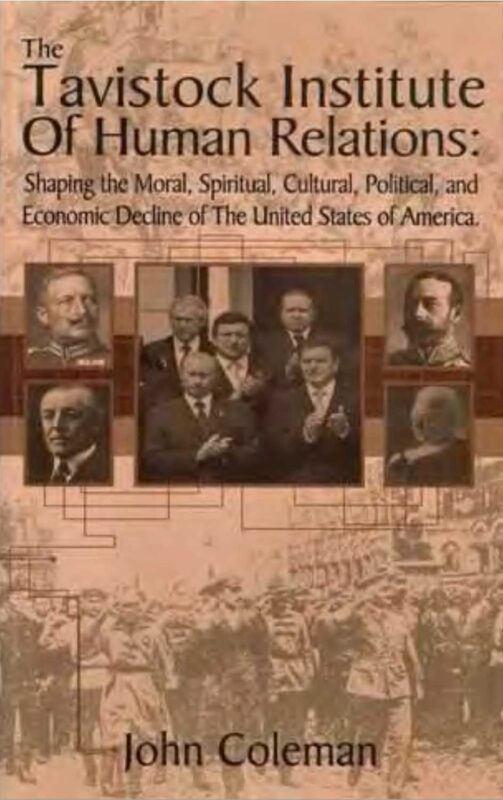
The Tavistock Institute of Human Relations: Shaping the Moral, Spiritual, Cultural, Political and Economic Decline of the United States by Coleman John maps the origins and global reach of a secretive think tank at the heart of twentieth-century psychological and social engineering. Coleman asserts that the Institute, originating from Wellington House in London in 1913, functions as the world’s premier center for brainwashing and mass manipulation. Funding from the British monarchy, the Rothschilds, and the Rockefellers empowered Tavistock’s early mission: direct the collective mindset of Britain and the United States toward the geopolitical aims of an elite ruling class. The author attributes the seismic cultural, political, and economic shifts of the past century to deliberate campaigns of psychological warfare and propaganda developed, perfected, and deployed by Tavistock’s network of social scientists.
The Birth of Modern Brainwashing
Coleman traces the modern science of mass manipulation to the offices of Wellington House, where a cadre of social engineers, including Arnold Toynbee, Walter Lippmann, and Edward Bernays, orchestrated Britain’s transition from anti-war sentiment to enthusiastic participation in World War I. The methods developed there did not arise from wartime necessity alone; the project received clear directives from the British royal family and their financial patrons to mold public opinion on a grand scale. The architects of this project recognized that shifting the collective perspective required more than appeals to patriotism or reason; they developed techniques of opinion-making through polling and psychological manipulation, laying the groundwork for the sophisticated propaganda machines that would later dominate Western societies.
Edward Bernays, the nephew of Sigmund Freud, emerges as a pivotal figure in this history. He pioneered strategies for manipulating group consciousness and popularizing the illusion that manufactured beliefs and desires originated within the individual. His technique of “engineering consent” involved using trusted third-party authorities to legitimize the opinions Tavistock sought to implant. When leaders accepted these implanted beliefs, their followers conformed in turn, ensuring wide-scale behavioral compliance. Bernays, along with Lippmann, brought this apparatus to the United States, where they guided President Woodrow Wilson’s administration in rallying support for American entry into World War I against significant public opposition.
Orchestrating War and Revolution
The book connects the Institute’s work to watershed events that transformed the world order. According to Coleman, Tavistock’s propaganda strategies extended beyond the realm of public persuasion and entered the theater of war and revolution. The Bolshevik Revolution, the destruction of the old European monarchies, and the rapid spread of socialist ideologies throughout the West stemmed from calculated campaigns that destabilized traditional structures. The collaboration of intelligence agencies, financiers, and social scientists facilitated the movement of key figures, such as Lenin, across borders and into positions of revolutionary leadership, with financial backing and logistical support carefully managed by a transnational elite.
Tavistock’s influence shaped the psychological climate that enabled catastrophic wars. The First and Second World Wars, Korea, Vietnam, and both Gulf Wars followed patterns of manufactured crises, “contrived situations,” and orchestrated consent. Propaganda techniques adapted to new technologies—radio, television, and eventually digital media—brought mass manipulation to an unprecedented scale, allowing the Institute and its affiliates to reshape collective perception, override rational dissent, and accelerate the pace of social and political transformation.
Social Engineering as an Instrument of Control
The narrative unfolds a deliberate program to degrade and transform Western moral, spiritual, and social norms. The Institute, drawing on the theoretical work of Oswald Spengler and other early social scientists, set out to “democratize” the West by undermining the racial, religious, and gender foundations upon which classical and Christian civilization rested. The systematic attack on womanhood, family, and religious faith aimed to destabilize established hierarchies and create populations more susceptible to control. The author describes this as the “decline of Western civilization,” executed through engineered cultural upheavals, psychological operations, and the persistent assault on traditional values.
Tavistock’s approach to social engineering extended to education, media, and entertainment. Coleman highlights the Institute’s role in crafting public opinion through polling, shaping mass media narratives, and introducing psychological triggers into art, literature, and popular culture. The rise of mass polling, the creation of a polling industry, and the manipulation of focus groups and surveys enabled opinion-makers to steer social attitudes without detection. Changes in fashion, the normalization of behaviors once considered taboo, and the elevation of celebrities and “non-entity stars” functioned as tools for reprogramming societal norms and reinforcing engineered beliefs.
Invisible Government and Crisis Management
The structure and reach of Tavistock’s network reflect a deliberate strategy to entrench control over government and policy-making. Coleman describes the emergence of an “invisible government,” a parallel structure of advisors, think tanks, and social scientists who direct national and international policy from behind the scenes. Presidents and prime ministers, guided by unelected counselors schooled in Tavistock’s methods, enact decisions that align with the broader agenda of the Institute’s patrons. Public policy, foreign relations, and even domestic laws reflect the priorities of those who master the arts of mass persuasion and psychological operations.
The Institute’s signature contribution lies in its theory and practice of crisis management. By creating, sustaining, and resolving public crises—economic, military, cultural, or psychological—Tavistock induces a population to accept otherwise unthinkable changes. These “contrived situations” produce stress, confusion, and ultimately compliance. Coleman draws on the research of Dr. Kurt Lewin and Dr. Fred Emery, who analyzed the predictable responses of population groups to induced turbulence: initial superficial adaptation, fragmentation into isolated groups, and eventual retreat into self-absorption and introspection. Throughout, the true cause of the crisis remains obscured, preventing any effective resistance or reversal.
Cultural Subversion and the Paradigm Shift
The book explores how Tavistock and its affiliates engineer cultural transformation. By infiltrating the media, educational systems, and entertainment industries, the Institute injects values and narratives designed to erode traditional loyalties and beliefs. Coleman details the assault on art, music, and literature, characterizing the spread of “decadent” forms as a deliberate strategy to weaken cultural resistance. The proliferation of themes celebrating sexual liberation, drug use, and rebellion against authority advances the project of social fragmentation. Celebrities and public figures become vehicles for promoting engineered behaviors, while advertising, news, and film reinforce the programmed worldview.
The author connects the rise of “non-entities”—manufactured stars in media, music, and politics—to Tavistock’s formula for creating compliant, easily manipulated public figures. Through relentless exposure and psychological conditioning, individuals with little intrinsic merit ascend to influence, embodying and propagating the values selected by opinion-makers. These changes manifest as shifts in fashion, language, attitudes toward family and gender, and new models of social behavior, all designed to facilitate the transition toward a society more amenable to centralized direction.
Monopoly of Mind and the Agenda for Global Control
Coleman extends his argument to claim that Tavistock’s ultimate objective centers on consolidating power within a New World Order, governed by a small elite employing the tools of psychological warfare and social engineering. The Institute and its sponsors seek to dissolve national sovereignty, local traditions, and democratic accountability, replacing them with a managed global system in which populations accept their roles through manufactured consent. The ongoing process of globalization, the expansion of supranational institutions, and the growing influence of think tanks and private advisors reflect this structural shift.
Tavistock’s network, including institutions such as the Stanford Research Center, the Wharton School of Economics, and the National Institute of Mental Health, represents the infrastructure of a coordinated program for behavioral control. Financial contributions from government and industry sustain a system that monitors, profiles, and analyzes the psychological characteristics of entire populations. Data-driven insights into human motivation and group dynamics empower decision-makers to shape attitudes, manage crises, and enforce compliance on a vast scale.
Patterns of Influence and Paths to Resistance
The convergence of psychological warfare, media control, and political engineering generates a pattern of influence that runs through the twentieth and twenty-first centuries. Wars, economic collapses, and cultural revolutions bear the signature of Tavistock’s methodology: crisis induction, managed response, and long-range transformation. The manipulation of polling, focus groups, and public relations campaigns subverts the foundations of democratic decision-making, replacing open debate with manufactured consensus.
The book closes with a warning and a challenge. Coleman argues that the capacity for resistance depends on recognizing and naming the true source of the crisis—a program of deliberate social engineering orchestrated by the Tavistock Institute and its network. Understanding the mechanisms of opinion control and mass manipulation offers the first step toward reclaiming agency and autonomy. Where populations fail to identify the enemy and the nature of the campaign waged against them, they drift further into the managed, compliant state envisioned by the architects of the New World Order.
Conclusion: Unmasking the Architects of Change
The Tavistock Institute of Human Relations stands at the intersection of psychological science, political power, and cultural transformation. Through a combination of financial patronage, strategic vision, and relentless experimentation, its founders and directors shaped the conditions for unprecedented change across the Western world. Coleman John’s analysis exposes a pattern of deliberate intervention, aimed at dissolving established loyalties and facilitating the emergence of a managed society. The enduring legacy of the Institute, according to the author, resides in the technologies of mind control and social engineering that continue to shape public consciousness, define cultural norms, and direct the political destinies of nations. What possibilities arise for genuine self-governance and social renewal when the architecture of manipulation stands revealed? The pursuit of that answer defines the structural core of Coleman’s inquiry.

About the Book