Food of the Gods: The Search for the Original Tree of Knowledge : A Radical History of Plants, Drugs, and Human Evolution
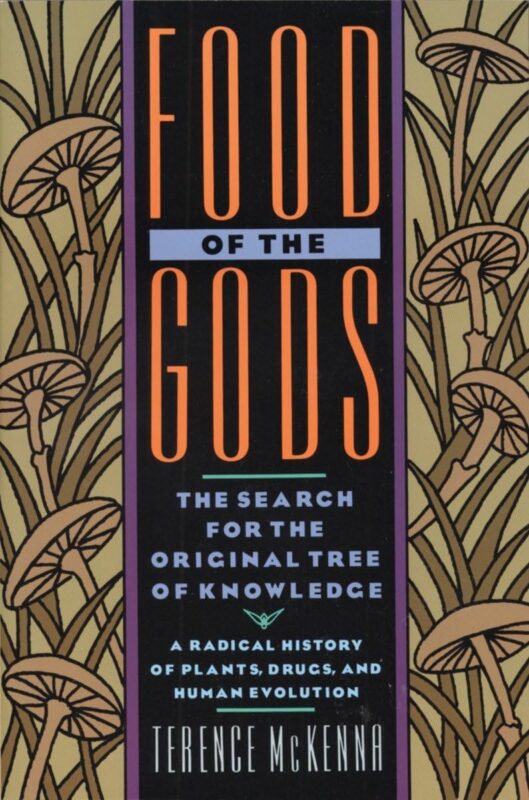
Food of the Gods by Terence McKenna advances a compelling argument that psychoactive plants played a central role in shaping human evolution, cultural development, and spiritual practice. McKenna positions the ingestion of substances like psilocybin mushrooms as catalysts for consciousness expansion, linguistic innovation, and the formation of early religious experiences.
Psychoactive Symbiosis and the Origins of Human Consciousness
Hominids on the African savannah encountered psilocybin mushrooms growing in the dung of ungulates. These encounters introduced biochemical influences that altered perception, cognition, and behavior. Psilocybin heightened visual acuity, enhanced synesthetic association, and stimulated the neurological capacity for symbolic thought. These effects fed back into social rituals, sexual behavior, and linguistic complexity. As mushroom use persisted across generations, the compound effects of these altered states generated a self-reinforcing loop that advanced neurological evolution. Consciousness, in this framework, emerged from a chemical coevolution with the vegetable mind.
The Mushroom and the Shamanic Archetype
Within this hallucinogenically enhanced environment, the figure of the shaman appeared as a stabilizing social agent. The shaman did not merely consume entheogens for personal insight. He or she journeyed into liminal realms, gathered information from visionary encounters, and returned to inform group survival strategies. The shaman communicated directly with entities perceived as distinct from the self—beings that instructed, healed, warned, and revealed. McKenna defines this relationship not as symbolic or metaphorical, but as structurally real within the altered cognitive domains activated by psychedelics.
Language as Entheogenic Feedback
Language crystallized in the wake of these entheogenic experiences. The structures of grammar, metaphor, and narrative emerged from attempts to encode and share the ineffable dimensions encountered during altered states. Words became tools for mapping psychic topologies. As linguistic complexity increased, it enabled recursive self-awareness. This convergence of verbal precision and visionary insight marked the transition from animal instinct to cultural intentionality.
The Fall into Agricultural Domination
The rise of agriculture replaced nomadic mushroom-collecting cultures with grain-based, city-centered societies. This shift brought about fundamental transformations. Hierarchies emerged. Monotheism displaced polyphonic animism. The feminine symbols that once governed nature-based societies gave way to paternal gods. Domestication of plants and animals initiated a cognitive domestication. Ritualistic trance states yielded to rule-based dogma. The fluid relationship with the vegetable mind ossified into priestly mediation.
Psychoactive Memory in Ancient Religions
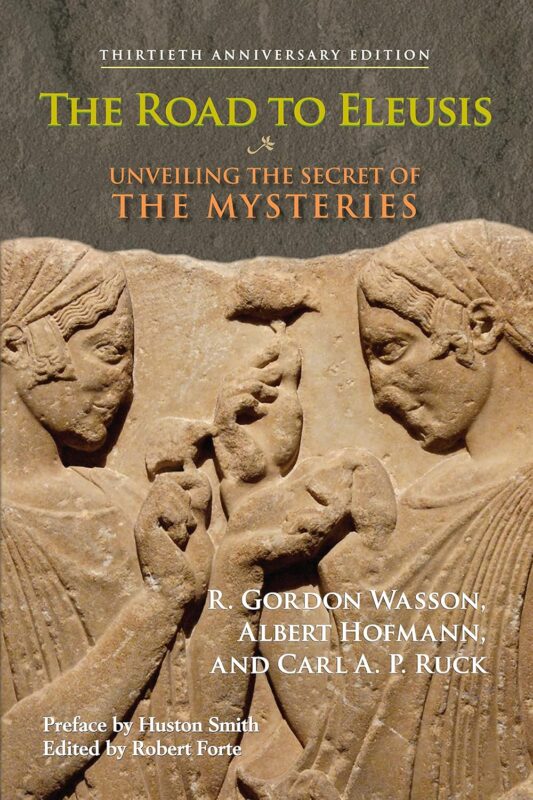
Despite suppression, remnants of the sacred plant relationship remained embedded in ancient religious systems. McKenna investigates the Vedic soma, the Eleusinian Mysteries, and Minoan iconography for signs of entheogenic practice. He identifies recurring motifs—serpents, mushrooms, solar-phallic hybrids—that signal encoded knowledge of psychedelic states. These religions used myth and ritual to simulate visionary ecstasy, yet concealed the botanical source.
The Synthetic Age and Cultural Amnesia
In modernity, synthetic analogs displaced natural entheogens. Narcotics, stimulants, and depressants redefined human-drug relationships around addiction, escapism, and control. Media, particularly television, functioned as a chemical analog—numbing awareness, broadcasting consensus, and flattening perceptual variance. McKenna categorizes these developments as structural regressions, where the potential of mind-altering substances was severed from ecological and spiritual feedback loops.
Reviving the Archaic Future
Reintegration of natural psychedelics offers a path to restore cognitive balance. These substances, when used in ritualized, intentional settings, reconnect the psyche to biological rhythms and planetary intelligence. McKenna frames this revival as essential for species survival. Only by recovering the evolutionary dialogue with the plant world can humanity recalibrate its cultural trajectory.
Entheogens and the Ethics of Perception
The question emerges: what responsibility accompanies access to expanded consciousness? McKenna demands an ethics grounded in ecological empathy, artistic creation, and spiritual authenticity. The psychedelic experience dissolves egoic boundaries, reveals interconnectedness, and amplifies emotional intelligence. This shift mandates a social response that values sustainability, cooperation, and pluralism.
Structural Implications for Global Culture
Psychedelics destabilize authoritarian models. Their capacity to induce direct spiritual insight undermines institutional intermediaries. Governments that criminalize these substances enforce perceptual orthodoxy. McKenna exposes this prohibition as a political act—one aimed at preserving economic, religious, and ideological hierarchies. Entheogenic use becomes a civil liberties issue. Access to one’s own mind, unmediated and uninhibited, constitutes a foundational human right.
The Reemergence of Psychedelic Science
Scientific interest in psychedelics has reawakened. Studies on psilocybin, LSD, ayahuasca, and DMT demonstrate efficacy in treating depression, addiction, PTSD, and existential distress. These findings validate ancestral insights. The shamanic model, once dismissed as superstition, now informs neurochemical and psychotherapeutic innovation. As clinical models catch up to ethnobotanical traditions, a new synthesis becomes possible.
The Role of the Artist-Shaman
McKenna emphasizes the cultural function of the psychedelic artist. This figure transmits visionary content into forms accessible to society. Through painting, music, literature, and architecture, the artist reveals structures glimpsed in altered states. These outputs guide others toward inner exploration. They shape aesthetic norms and extend the perceptual envelope. The psychedelic artist reclaims the mantle of the shaman.
Reinhabiting the Mythic Landscape
Entheogenic experience transforms myth from abstraction into sensory encounter. Archetypes animate. Symbols radiate agency. The user does not interpret myth but enters it. This shift reorients consciousness toward pattern recognition. Meaning arises from relational intelligence. McKenna argues that this sensibility prepares the mind for planetary citizenship—rooted in compassion, humility, and reverence.
The Psychedelic as a Cognitive Tool
Psychedelics offer not escape, but revelation. They expose blind spots, recalibrate priorities, and spark creative insight. They function as heuristics for self-understanding. In the hands of disciplined explorers, these tools accelerate learning, problem-solving, and systems thinking. Used wisely, they enhance clarity, focus, and integrative capacity.
Conclusion: Toward a Psychedelic Epistemology
McKenna insists on epistemic diversity. He challenges the hegemony of materialist science. Psychedelic states, though subjective, generate reproducible phenomena. They yield consistent motifs, cross-cultural symmetries, and transformative outcomes. These results demand serious inquiry. The integration of psychedelics into education, medicine, and public policy requires a philosophical framework that honors their uniqueness. Such a framework would redefine knowledge itself as a multi-modal spectrum of relational, affective, and intuitive dimensions.
The core insight animating Food of the Gods is the recognition that plants communicate. Their messages, encoded in molecular languages, shaped our minds, structured our societies, and seeded our mythologies. Listening again—through intentional ingestion, respectful ritual, and open inquiry—restores a lost alliance. This alliance holds the key to reimagining what it means to be human.

https://www.youtube.com/watch?v=_uG27YAKeUo