The Politics of Heroin: CIA Complicity in the Global Drug Trade
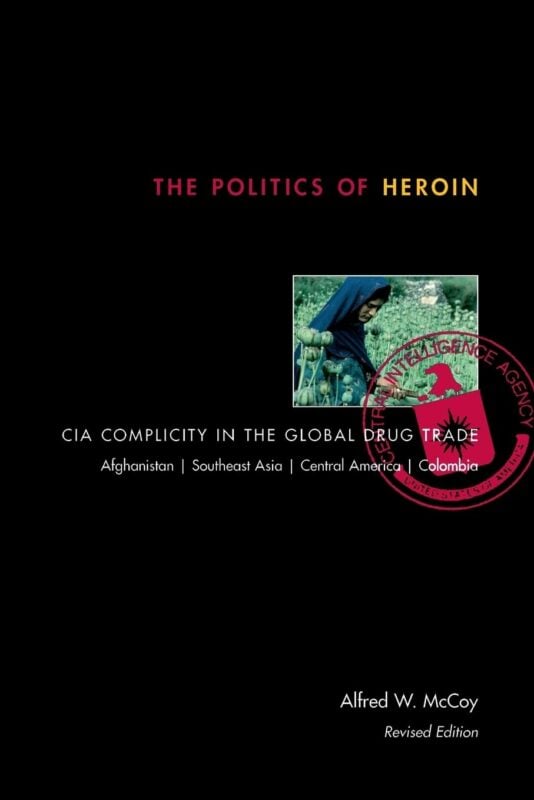
Alfred W. McCoy’s book The Politics of Heroin: CIA Complicity in the Global Drug Trade exposes the intersection of American foreign policy, covert intelligence operations, and the international narcotics industry.
A Global Epidemic Rooted in Policy
In the early 1970s, heroin addiction spread across the United States with sudden force. Factories, military bases, schools, and middle-class neighborhoods became consumption zones. The estimated number of addicts jumped from 57,000 in 1965 to 560,000 in 1971. Crime rates surged. Law enforcement attributed 75 percent of urban crimes to addicts sustaining their habits. President Nixon responded with a declaration of war on drugs. Despite new funding and legislation, heroin shipments into the country increased.
Why did supply intensify in direct proportion to interdiction? McCoy locates the cause not in the margins but in the decisions of central institutions. Intelligence alliances, strategic imperatives, and anticommunist campaigns shaped the logistics of heroin movement across continents.
Strategic Alliances That Enabled Smuggling
During World War II, the Office of Strategic Services (OSS), the precursor to the CIA, partnered with the Sicilian Mafia to facilitate the Allied invasion of Italy. Don Calogero Vizzini, a local mafia leader, provided logistical support and received political rewards. After the war, Lucky Luciano, a convicted heroin trafficker, was released from prison due to his wartime assistance. Deported to Italy, he rebuilt a transnational heroin network that linked Middle Eastern morphine suppliers to European refining labs and American distribution routes.
Luciano’s syndicate operated with operational precision and legal insulation. The U.S. deported over 100 additional mafiosi to Italy, reinforcing a structure of narcotics logistics that expanded in lockstep with Cold War strategy.
Marseille as the Nexus of Conversion
In postwar France, the Mediterranean port of Marseille emerged as the heroin capital of Europe. The CIA backed Corsican syndicates to undermine Communist influence in the city’s unions and docks. These Corsican allies controlled heroin laboratories. Their protection from arrest and prosecution derived from their political utility. They processed morphine base into heroin for export to the United States. The product—No. 4 heroin—was water-soluble, potent, and lucrative. A kilo sold wholesale for $27,000 and retailed on the streets for over $225,000.
The CIA’s operations in Marseille prioritized containment of Soviet influence. Within that hierarchy of objectives, heroin production remained a tactical tradeoff.
Southeast Asia’s Golden Triangle
By the 1960s, the center of illicit opium production shifted east. The highlands of Burma, Laos, and Thailand—collectively known as the Golden Triangle—produced 70 percent of the world’s illicit opium. Peasant farmers harvested thousands of tons annually. These regions lacked government oversight and relied economically on poppy cultivation. Insurgents, warlords, and military factions derived revenue from the trade.
The CIA formed alliances with these groups to counter Communist forces. In Burma, it armed Kuomintang remnants. In Laos, it organized Meo hill tribe armies under generals who simultaneously operated heroin refineries. Air America, a CIA airline, transported arms and supplies into these regions and returned with opium shipments. These operations occurred in parallel, not in opposition. Military imperatives governed logistical flows.
From Morphine to Heroin: Industrial Process
Heroin production involves chemical transformation. In jungle labs, morphine was extracted from opium using lime, ammonia, and flannel filters. That morphine base traveled to regional labs where master chemists used acetic anhydride and heat to synthesize diacetylmorphine. Five stages produced a white powder, 80 to 99 percent pure. The compound moved through multiple smuggling layers—diplomats, sex workers, cargo shipments, and couriers—before reaching Mafia distributors in the U.S. Each level diluted the product, increasing volume and reducing purity. Street-level heroin averaged 3 to 5 percent.
The global logistics of heroin mirrored industrial design. Raw material, production, packaging, and retail followed a coordinated hierarchy. Strategic cover enabled continuity.
The Vietnam War’s Domestic Fallout
As the U.S. military escalated operations in Vietnam, a heroin epidemic spread among troops. Army doctors estimated 10 to 15 percent of soldiers used heroin. Southeast Asian heroin—cheap, potent, and abundant—circulated in bases and barracks. The CIA’s mercenary allies in Laos and Vietnam, tasked with combatting Communism, produced the very heroin consumed by American soldiers.
Political alliances determined the flow of goods. Military necessity superseded narcotics control. Corruption extended to South Vietnam’s government. Generals, naval units, and high-ranking officials facilitated heroin transport via air and sea. Heroin became a revenue stream embedded within official channels.
Domestic Crime and Urban Collapse
As heroin flooded back into the United States, urban centers collapsed under the weight of addiction-driven crime. Police departments reported unprecedented levels of theft, assault, and armed robbery. Hospitals treated overdoses in record numbers. Lawmakers responded with punitive laws, but enforcement never reached the upper tiers of the trafficking hierarchy. Arrests focused on users and low-level dealers. Syndicates continued to operate through legal insulation and intelligence protection.
The narcotics economy embedded itself within the structure of urban decay. Policy responses addressed symptoms without confronting the enabling architecture.
Official Cover and Complicity
The book identifies three forms of U.S. complicity. First, the CIA formed alliances with drug-producing factions to serve geopolitical goals. Second, it shielded known traffickers from prosecution to preserve intelligence channels. Third, it participated directly in the transport of opium and heroin under the cover of military logistics. These actions were not accidental deviations. They were structural features of Cold War policy.
The CIA’s support for narcotics-linked allies did not stem from rogue agents or isolated corruption. Institutional doctrine defined objectives. Anticommunist outcomes justified operational alliances. Heroin became a collateral consequence.
Suppression of Inquiry
Investigations into the drug trade often met institutional resistance. Congressional hearings faced redacted documents and noncooperative witnesses. Journalists risked reprisal. Government officials denied knowledge or minimized involvement. The public narrative framed heroin as a criminal issue, disconnected from foreign policy. Media reinforced the separation between domestic crime and international strategy.
But McCoy documents a convergence. Strategic alliances, covert operations, and economic structures produced the conditions for heroin’s proliferation. The American addict became the final node in a supply chain designed through geopolitical calculation.
Systemic Entrenchment
By the early 1970s, heroin addiction had become a systemic feature of American life. Its supply chain ran through mountain villages, military bases, intelligence bureaus, and corporate docks. The politics of heroin were embedded within the politics of containment, intervention, and empire. Heroin traffickers gained political cover through their usefulness to American objectives. The epidemic reflected structural priorities.
The intelligence community operated under a doctrine of plausible deniability. The heroin trade remained below the threshold of policy discourse. But the outcomes—millions of addicts, billions in revenue, destabilized communities—demanded accountability.
What governs the hierarchy of American foreign policy choices? Who defines the acceptable cost of containment? McCoy’s research answers through evidence rather than theory. The heroin trade expanded where it intersected with strategic necessity. Those intersections produced complicity. That complicity reshaped global markets and domestic lives.