Hess: The Missing Years 1941–1945
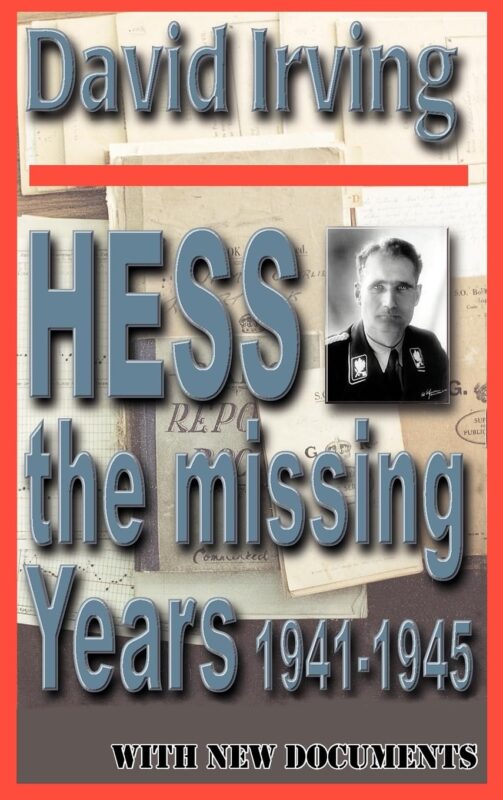
Hess: The Missing Years 1941–1945 by David Irving reconstructs the extraordinary journey of Rudolf Hess, his flight to Scotland, his imprisonment in Britain, and his eventual role at the Nuremberg trials. Irving grounds his narrative in diaries, interrogation records, and contemporary testimony to reveal the peculiar blend of conviction, naiveté, and endurance that defined Hess during these decisive years.
The Flight to Scotland
On the evening of May 10, 1941, Rudolf Hess climbed into a Messerschmitt Bf 110 and set course for Scotland. He carried maps, survival gear, and a handwritten plan to parachute into Britain as an emissary for peace. His flight path across the North Sea brought him into the skies over northern England, where his aircraft ran out of fuel. Hess bailed out and landed near Floors Castle in Scotland. Farmers discovered him wandering the fields, disoriented yet determined to announce his mission. He requested an audience with the Duke of Hamilton, whom he believed sympathetic to peace. The British government detained him instead, classifying him as a prisoner of war rather than a negotiator.
Intentions and Motives
Hess acted under a belief that Britain could be persuaded to withdraw from the war if approached directly. He carried no official documents, relying instead on personal conviction and vague assurances. His ambition rested on securing an audience with influential aristocrats who might pressure Winston Churchill to accept terms. Hess sought an end to the bombing campaign and envisioned Germany turning its full attention toward the Soviet Union. His motives puzzled observers then and continue to fuel debate. Did he receive tacit encouragement from Hitler, or did he act entirely on his own? Irving argues that Hess believed in his mission with absolute sincerity, regardless of Hitler’s awareness.
Capture and Initial Imprisonment
British authorities transported Hess to the Tower of London. Guards monitored him closely, wary of suicide or escape attempts. From the outset, he endured isolation and scrutiny, treated less as a soldier and more as a potential intelligence source. His captors recorded his conversations, studied his handwriting, and subjected him to psychiatric evaluation. He reported stomach pains, dizziness, and insomnia. Doctors debated whether his symptoms reflected genuine illness or a strategy to influence his captors. MI5 considered the possibility of using him for propaganda but feared unintended consequences.
Transfer to Secret Facilities
After several months, Hess was moved from the Tower to a series of secret detention centers, including the fortified Camp Z near Aldershot. Camp Z, under the command of Colonel Robin Stephens, specialized in extracting intelligence through prolonged questioning. Hess met interrogators who pressed him for details of German war aims, military capacity, and internal politics. He spoke freely at times, offering reflections on Hitler’s leadership and the Nazi hierarchy, but withheld strategic secrets. His conversations revealed a man driven by ideological faith, yet increasingly detached from reality.
Psychological Strain and Memory Loss
Reports of memory lapses emerged during his confinement. Hess claimed he could not recall basic facts, including his mission. He accused British officials of poisoning him. His writings alternated between lucidity and paranoia. Medical officers noted sudden shifts in mood, extended silences, and bouts of depression. At one stage he attempted suicide by throwing himself down a staircase. The event intensified British concerns about his stability. Was Hess fabricating his condition to avoid interrogation, or had prolonged isolation fractured his mind? Irving presents testimony suggesting that Hess oscillated between genuine breakdowns and deliberate theatrics, blurring the line between illness and strategy.
Conversations in Custody
Hess engaged in long dialogues with psychiatrists, military officers, and occasional visitors from government circles. He spoke of cosmic destiny, the unity of the German people, and his vision of Anglo-German cooperation against Bolshevism. He dismissed charges of aggression, framing Germany’s actions as a defensive struggle for survival. His fixation on spiritual and racial themes reinforced impressions of detachment from reality. Yet, within these conversations, he disclosed valuable observations on Hitler’s temperament, the power of propaganda, and the ideological discipline of the Nazi Party.
The Road to Nuremberg
By 1945, Hess was transferred back to Germany to stand trial before the International Military Tribunal at Nuremberg. The Allies sought to present a unified case against major war criminals, and Hess ranked high on the list as Deputy Führer. His defense strategy revolved around claims of memory loss. He insisted he could not follow the proceedings or remember his actions. For weeks he sat in silence, staring ahead, seemingly unaware of his surroundings. Then, in a dramatic moment, he announced that his amnesia had been feigned. He explained that he wanted to confuse the prosecution and draw attention to the injustice of the tribunal. The revelation astonished observers and cast doubt on all medical assessments made during his imprisonment in Britain.
Performance at the Trial
Hess’s courtroom behavior oscillated between defiance and apathy. At times he laughed uncontrollably, at others he appeared disengaged. He rejected responsibility for aggression, claiming loyalty to Hitler as his guiding principle. He delivered no elaborate defense but instead allowed his erratic performance to speak for itself. The tribunal judged him guilty of crimes against peace and conspiracy. Unlike other defendants, he faced no death sentence. The court imposed life imprisonment, consigning him to Spandau Prison in Berlin.
Life in Spandau
Spandau housed seven prisoners under joint Allied administration. Guards from Britain, France, the United States, and the Soviet Union rotated duty monthly. Hess endured the strictest conditions. His letters were censored, his diary confiscated daily, and his visits restricted. As fellow inmates completed their sentences or died, Hess remained. By the 1960s he became the sole occupant of the vast facility. His daily routine involved tending a small garden, reading, and occasional walks under guard. He suffered from stomach ulcers, arthritis, and failing eyesight. Requests for release on humanitarian grounds surfaced repeatedly, but the Soviet Union vetoed them. Hess grew into a living symbol of the unresolved wartime legacy.
The Longevity of Confinement
Why did the Allies insist on keeping an aging, infirm prisoner locked in solitary confinement for decades? The answer lay in symbolism. To release Hess risked transforming him into a rallying point for extremists. To keep him imprisoned affirmed Allied unity long after the war ended. The prison itself became a ritual, maintained by the rotation of guards and the bureaucracy of the Four Powers. Hess’s endurance within these walls underscored the peculiar fusion of personal tragedy and political theater.
The Final Years
By the 1980s, Hess was frail, semi-blind, and barely mobile. His family petitioned for his release so he could live out his last years at home. Western governments expressed readiness, but Soviet authorities remained firm in opposition. On August 17, 1987, Hess was found dead in the prison garden, a cord around his neck. The official verdict declared suicide. His son and supporters disputed the finding, claiming murder. Conspiracy theories multiplied, fueled by the secrecy surrounding his death and the immediate demolition of Spandau Prison. Authorities destroyed the building to prevent it from becoming a site of pilgrimage.
Legacy and Historical Meaning
Hess occupies a unique position in the history of the Third Reich. He was neither architect of military campaigns nor commander of vast forces. He was a deputy whose loyalty bound him to Hitler and whose quixotic flight to Britain sealed his fate. His years of imprisonment turned him into a figure of enigma. Was he a deluded fanatic who imagined he could broker peace? Was he a visionary who sought to spare Europe further destruction? Irving’s account emphasizes the texture of Hess’s daily life, his writings, and the testimony of those who encountered him, allowing the reader to grasp the human dimensions behind the myth.
The Pattern of a Life Defined by Solitude
From his cell in Britain to his decades in Spandau, Hess experienced prolonged solitude. That solitude shaped his mental state, his writings, and his reputation. His story illustrates the consequences of conviction pursued without realism, the cost of political loyalty sustained beyond reason, and the persistence of unresolved questions that outlast wars. The image of an old man tending a prison garden while guards from four nations rotate duty each month captures the unresolved shadow of the Second World War.
The Weight of Historical Memory
The memory of Hess endures as an unresolved case within the larger narrative of the war. His mission failed, his imprisonment stretched beyond normal bounds, and his death left lingering suspicion. The demolition of Spandau erased the physical site, but the questions remain. How should history regard a man who sought peace through reckless action yet served as a loyal deputy to a regime of conquest and genocide? Irving’s study presents the evidence and leaves the reader to confront the paradox. Hess lived long after the Reich fell, and in that longevity he embodied the unfinished business of a century shaped by war.

About the Book