The Rape of Justice: America’s Tribunals Exposed
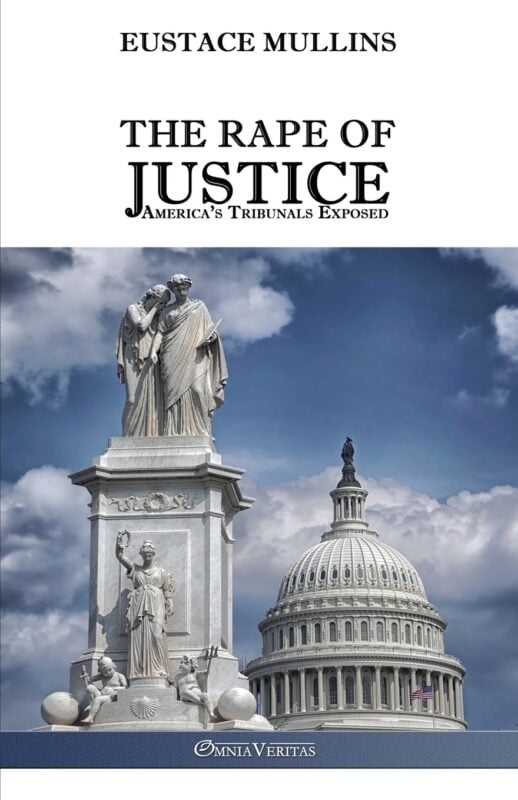
The Rape of Justice America’s Tribunals Exposed by Eustace Mullins delivers a comprehensive indictment of the American legal order, portraying a system governed by commercial interests and political leverage rather than constitutional guarantees. Mullins constructs his argument through historical excavation, case studies, and philosophical claims about law’s origin and function. He positions tribunals as mechanisms of coercion that substitute procedure for principle, elevating manipulation over fairness. His study advances a stark claim: the American legal system operates under the law merchant, a regime of commerce, which supplanted constitutional protections after the Civil War and now drives judicial practice at every level.
The architecture of legal anarchy
Mullins opens with a vivid tableau of disorder in domestic tribunals. He recounts cases in which mothers lose custody to abusive or unfit fathers, juries deliver verdicts that violate physical evidence, and judges impose fines that bankrupt municipalities. These stories build an atmosphere of systemic inversion, where legal authority targets the law-abiding rather than the criminal. He argues that litigation rarely resolves disputes on the merits of evidence because attorneys deploy tactics of exclusion, intimidation, and procedural sabotage. The courtroom becomes an arena where outcomes reflect alliances of wealth, status, and influence.
Law merchant as hidden code
The central thesis defines American law as subordinate to the principles of commerce rather than the Constitution. Mullins names this framework “law merchant,” tracing it to Roman and medieval traditions where merchants codified rules of exchange that transcended national boundaries. He asserts that judges and lawyers operate within this system while concealing it from litigants who invoke constitutional protections. In his analysis, when citizens appeal to the Bill of Rights, courts rebuke them because tribunals prioritize contracts, obligations, and financial equities over rights. He demonstrates this dynamic through examples such as Internal Revenue Service trials, which exclude juries because law merchant recognizes no trial by peers, only enforcement of contract terms.
Historical roots of authority
Mullins situates the genealogy of law within ancient civilizations. He links the word “law” to Aryan and Teutonic roots meaning fixed order and recalls Egyptian hymns to Ra as lord of law. He emphasizes the biblical mandate of justice in Isaiah and Micah, presenting divine authority as the original foundation. From this perspective, English common law emerges as an extension of the covenantal contract between God and His people. He cites Alfred the Great’s Dooms, Blackstone’s Commentaries, and Sir Edward Coke’s Institutes as codifications of this sacred and rational order. In contrast, equity and parliamentary enactments dilute this foundation by introducing flexibility and commercial pragmatism.
Judges as political actors
The book casts judges as figures who wield authority not as impartial arbiters but as members of a guild that protects its own. Mullins describes them turning off hearing aids, drinking heavily, or ignoring testimony while decisions align with predetermined interests. He claims that most cases are settled before evidence is heard because outcomes depend on political or financial alliances. The judge functions less as a guardian of justice than as a coordinator of procedure who ensures the appearance of fairness while facilitating the victory of entrenched power.
The Supreme Court as an instrument
Mullins devotes significant attention to the Supreme Court, portraying it as an arena reserved for special interests. He argues that individuals cannot reach it unless their case aligns with the strategies of powerful lobbies. Decisions, he maintains, advance consolidation of federal authority and expansion of commercial law at the expense of states’ rights and individual protections. He cites Jefferson’s warning that the judiciary would operate like gravity, extending jurisdiction silently until it absorbed all state sovereignty. The Court becomes, in his telling, an engine of centralization.
Department of Justice and coercive machinery
The Department of Justice appears in his study as a bureaucratic fortress that enforces the will of law merchant. He describes its prosecutors as career operatives who suppress exculpatory evidence, manipulate witnesses, and construct charges to entrap. He frames their operations as less concerned with protecting public safety than with securing convictions that reinforce institutional authority. This structure produces what he calls “durance vile,” the captivity of citizens within procedures that drain resources and foreclose liberty without genuine adjudication.
Case studies of distortion
Mullins builds his indictment through narratives of individual cases that illustrate systemic tendencies. He recounts the “schizophrenic driver” forced into legal limbo, the “senile millionaire” manipulated through guardianship proceedings, and citizens prosecuted for tax disputes that result in asset seizure far beyond the alleged liability. These stories highlight the convergence of judicial discretion, psychiatric testimony, and financial interests. Each episode, presented with names and circumstances, underlines his claim that tribunals serve predators who exploit legal mechanisms for profit and control.
Taxation as weapon
A substantial section examines taxation as the clearest example of law merchant’s triumph. Mullins traces the Internal Revenue Service’s practices to Lenin’s program “The Threatening Catastrophe,” which established confiscation of concealed income as revolutionary doctrine. He argues that IRS procedures—demanding production of private records, imposing penalties that consume entire estates, and excluding juries—translate this doctrine into American law. The process operates through contracts of commerce: citizens become “merchants” by engaging in transactions and are thus subject to compulsory disclosure. In this system, taxation functions not as lawful contribution but as enforced forfeiture.
Equity as perversion
In his chapter on equity, Mullins contends that the equitable tradition, presented historically as a corrective to rigid law, in practice undermines fixed rights. He portrays equity courts as institutions that expanded discretion for judges, enabling them to privilege commerce and compromise constitutional protections. Equity merges with law merchant to elevate procedure over principle, producing outcomes that reflect bargaining power rather than rights derived from natural or divine authority.
A vision of legal future
Mullins closes with predictions of continued consolidation of power within tribunals unless citizens reclaim constitutional law. He asserts that survival depends on exposing the hidden code of law merchant and demanding identification of every procedure as constitutional or commercial. He advocates for public insistence that trials recognize the guarantees of the Bill of Rights. He frames this as a struggle not for reform but for survival of a people whose liberties face extinction through judicial absorption.
Convergence of themes
The book integrates historical etymology, biblical covenant, Roman jurisprudence, English common law, and American case studies into a unified critique. Mullins constructs a narrative where law once expressed divine order, then degenerated into commercial procedure. He treats the shift from common law to equity to law merchant as a historical progression toward coercion. His stories of contemporary trials serve as evidence that this progression has reached its apex. He concludes that justice in America has been raped because tribunals administer contracts, not rights, and their allegiance belongs to guilds of power rather than to the people.
Persistent question
What then is the role of citizens confronted with a tribunal that enforces commercial procedure while suppressing constitutional protection? Mullins offers a practical directive: demand identification of each legal act, expose the dominance of law merchant, and resist with knowledge of constitutional guarantees. He presents this confrontation as the decisive contest between survival under law and extinction under procedure.
Through historical scholarship and polemical narrative, Mullins defines a system where justice functions as ritualized commerce. The book stands as both an account of legal evolution and a manifesto for those who would challenge the power of tribunals in America.