Wall Street and FDR: The True Story of How Franklin D. Roosevelt Colluded with Corporate America
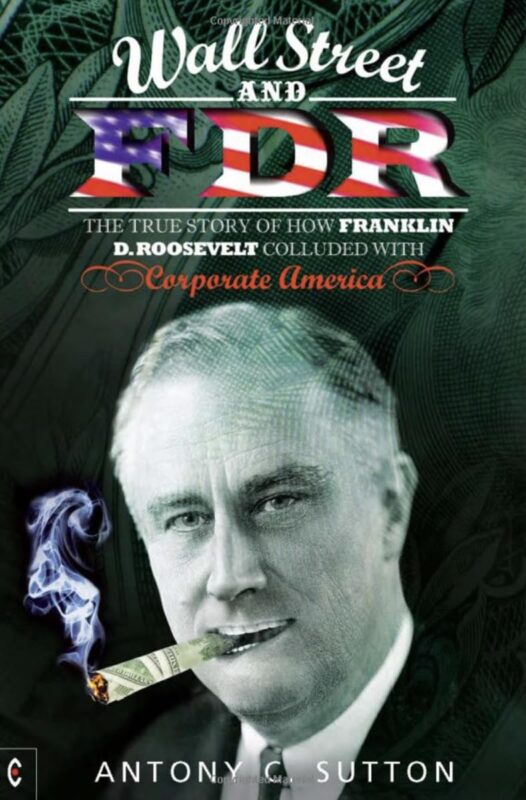
Wall Street and FDR by Antony C. Sutton reveals the deep financial entanglement between Franklin Delano Roosevelt and the banking elite headquartered at 120 Broadway. Drawing from Roosevelt's own correspondence and official archives, Sutton reconstructs a picture of FDR as a political operative enmeshed in the economic machinery of Wall Street before and during his presidency. The narrative dismantles the constructed image of Roosevelt as a solitary reformer and replaces it with a portrait of a financier-politician whose ascent depended on networks of capital, patronage, and ideological alignment with corporate planners.
The Roosevelt-Delano Banking Legacy
Franklin D. Roosevelt descended from two families embedded in the financial infrastructure of New York. The Roosevelts founded and directed Roosevelt & Son, an investment banking firm tracing its roots to the late 18th century. The Delano side boasted ties to railroad expansion, maritime finance, and central banking. Frederic A. Delano, FDR’s uncle, sat on the Federal Reserve Board and chaired the National Resources Planning Board, guiding economic policy alongside key figures like Beardsley Ruml and Leon Henderson. These family connections shaped FDR’s early exposure to economic planning and monetary policy, embedding him within the ideological architecture of regulated capitalism.
FDR at 120 Broadway
In the 1920s, Roosevelt held multiple directorships and partnerships tied to influential financial institutions. As vice president of the Fidelity & Deposit Company of Maryland, FDR oversaw bonding contracts awarded through political patronage. At this office on 120 Broadway, he cultivated a network of contacts in state and municipal government to direct insurance business toward his firm. Roosevelt's letters show him leveraging political relationships, particularly with trade union leaders and Democratic machine operatives, to secure commercial deals. These activities mirrored the power structure that would later define the New Deal coalition.
Speculative Ventures During German Hyperinflation
Roosevelt organized and presided over United European Investors, Ltd., a financial company aimed at acquiring distressed German assets during the hyperinflation of 1922-23. By pooling marks deposited in U.S. accounts and reinvesting them in German property, Roosevelt and his associates sought to capitalize on the collapse of the Weimar currency. This operation unfolded alongside the reparations negotiations led by American financiers Owen D. Young and J.P. Morgan. These dual tracks—political negotiation and speculative acquisition—positioned Roosevelt at the intersection of diplomacy, capital flows, and monetary crisis.
Formation of Corporate Socialism
The economic collapse of the 1930s and the legislative framework of the New Deal reflected a design consistent with the aspirations of corporate socialists. Sutton defines corporate socialism as the strategic alignment of big business and federal authority to rationalize industry, reduce competition, and centralize planning. The Swope Plan, authored by Gerard Swope of General Electric, exemplified this model by proposing compulsory industry-wide codes and government-sanctioned monopolies. Roosevelt adopted the plan as the National Industrial Recovery Act. Sutton traces its intellectual lineage to Clinton Roosevelt, who in 1841 outlined a similar agenda of centralized economic control and labor regimentation.
Wall Street Elects Roosevelt
Roosevelt’s presidential campaign in 1932 received substantial financial backing from the very banking houses he publicly denounced. Bernard Baruch, John J. Raskob of Du Pont and General Motors, and the Rockefellers contributed heavily. These financiers shifted their support from Herbert Hoover after he rejected the Swope Plan and resisted permanent industrial regimentation. Roosevelt, by contrast, accepted the blueprint and delivered a legislative framework that matched Wall Street’s consolidation interests. The financial elite viewed Roosevelt not as a threat but as an implementer of their vision, enabling controlled recovery and managed competition.
The Butler Affair and Suppressed Allegiances
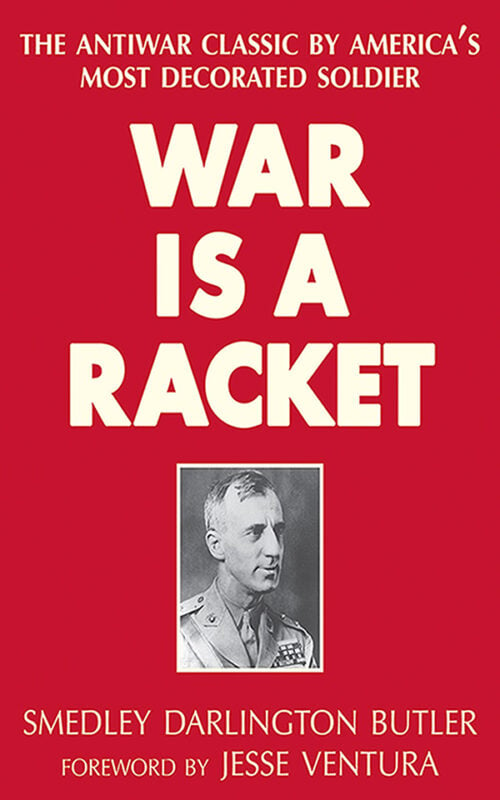
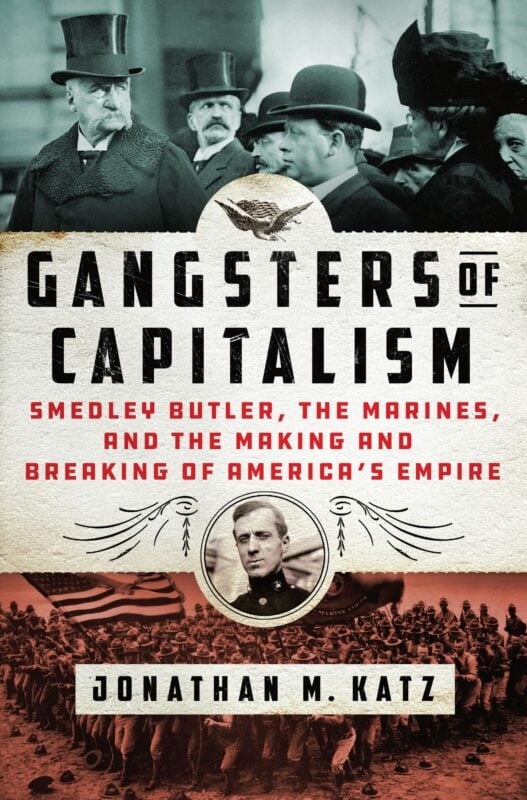
Major General Smedley Butler testified before Congress that Wall Street operatives approached him with a plot to lead a coup against Roosevelt, intending to install a compliant figurehead and steer the administration from behind the scenes. Although the press dismissed the allegations, Sutton notes the involvement of Grayson M.P. Murphy and others with deep financial ties. The House committee confirmed some of Butler’s testimony, but the Roosevelt administration declined to pursue prosecution. This episode, known as the Butler Affair, revealed the volatility within the corporate establishment and their demand for control over political outcomes.
120 Broadway as Strategic Headquarters
Multiple entities tied to international finance operated out of 120 Broadway: American International Corporation, Guaranty Trust, the Federal Reserve Bank of New York, and law firms managing corporate reorganizations. This address served as the logistical base for efforts ranging from Bolshevik funding during the Russian Revolution to Roosevelt’s pre-presidency financial ventures. Sutton characterizes 120 Broadway as the central node in the network of managed capitalism—a place where public policy and private capital merged to form an economic elite capable of shaping national and global destinies.
The Trade Associations as Proto-NRA
In the 1920s, Roosevelt and Hoover both promoted trade associations designed to stabilize industry and prevent price competition. These groups, such as the American Construction Council, advocated voluntary codes and eventually laid the groundwork for mandatory coordination under the New Deal. The strategy, endorsed by figures like Baruch and Warburg, emphasized the replacement of market dynamics with hierarchical planning under public-private consensus. Sutton asserts that this system functioned as a precursor to full-scale corporate socialism and institutionalized the priorities of capital over entrepreneurial risk.
The Role of Economic Planning Boards
Frederic Delano’s National Resources Planning Board, staffed with social engineers and technocrats, defined economic development strategies that privileged regional integration, resource allocation, and population management. These efforts coalesced with Roosevelt's broader goal of centralizing administrative power and standardizing industrial practices. The board’s advisors, drawn from elite universities and corporate research centers, proposed frameworks that coordinated investment with national priorities, effectively removing decision-making from the hands of dispersed capital and placing it within bureaucratic command.
Ideological Synthesis of Finance and Administration
Roosevelt’s ascent to the presidency aligned with a structural transformation in American capitalism. His financial backers sought regulatory regimes that favored consolidation and planning. Sutton demonstrates that Roosevelt did not merely respond to crises; he operationalized an ideology of controlled capitalism developed over decades by figures in his familial, financial, and intellectual orbit. These reforms were not reactions to Depression-era instability but long-term objectives actualized through political will and institutional engineering.
Conclusion
Wall Street and FDR asserts that the Roosevelt presidency executed a corporate agenda under the guise of social reform. The New Deal institutionalized mechanisms of central planning, cartelization, and economic regimentation crafted in concert with financial elites. Roosevelt’s personal history—his directorships, speculative investments, and ideological alignment with planning advocates—substantiates Sutton’s thesis that the architecture of modern American capitalism was built not through resistance to Wall Street, but through its direct influence and strategic patronage. The book urges a reevaluation of the foundations of federal economic policy and its origins in the coordinated interests of finance and state power.


About the Book