Brutal Kangaroo: WikiLeaks Verdict Against Josh Schulte, and Other Whistleblowers
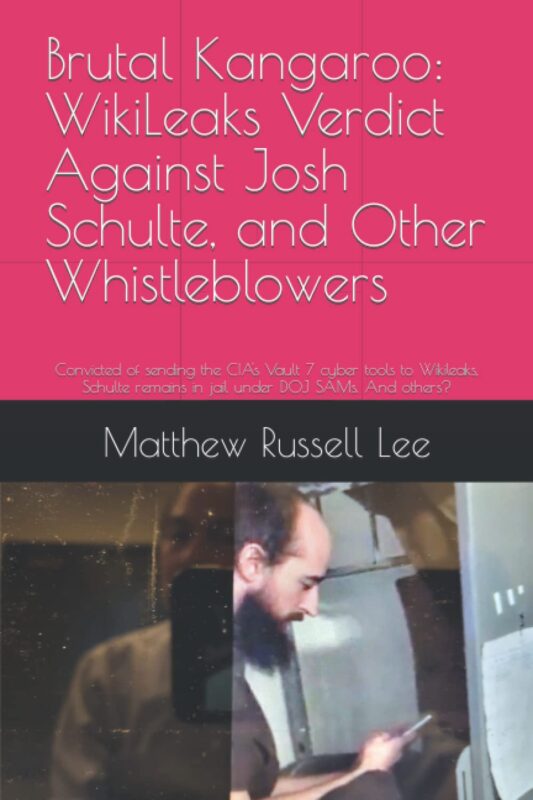
Brutal Kangaroo: WikiLeaks, Josh Schulte and Other Whistleblowers by Matthew Russell Lee opens inside a courtroom sealed from public view, where secrets held more sway than verdicts and the stakes of information control played out in stark confrontation. Lee chronicles the federal retrial of Joshua Schulte, a former CIA developer accused of orchestrating the largest intelligence leak in agency history by transmitting the Vault 7 cyber toolset to WikiLeaks. As the government marshaled every instrument of classification and secrecy, Schulte stood alone, facing espionage and hacking charges while representing himself in court.
Vault 7 and the architecture of exposure
The CIA had built a digital arsenal capable of penetrating systems across the globe. Vault 7, a suite of cyber espionage tools, included programs like Brutal Kangaroo and Drifting Deadline—software designed to jump air gaps, infiltrate secure networks, and manipulate data undetected. These tools embodied the agency's offensive cyber capacity. When WikiLeaks published them in 2017, the consequences reverberated through intelligence communities worldwide. Operations ceased. Allies hesitated. Trust fractured. The FBI labeled the exposure catastrophic.
Administrative access and digital fingerprints
Schulte worked in the CIA’s Center for Cyber Intelligence with administrative access to development servers. Prosecutors alleged he used his elevated privileges to back up and exfiltrate data before security protocols changed. Evidence showed he reverted servers, deleted logs, and searched for data-wiping techniques. They traced his activity through forensic markers, positioning him as the architect of the breach. Schulte countered with claims that DEVLAN, the internal system, was so insecure that anyone could have accessed the files. He argued that the government's evidence lacked definitive links.
Courtroom as theater and battleground
Acting as his own attorney, Schulte transformed the courtroom into a site of personal reckoning and public challenge. He cross-examined witnesses with precision and irritation, demanding answers about oversight, access, and CIA policy inconsistencies. His performance oscillated between defiance and procedural missteps. Judge Jesse Furman managed the proceedings with firm control, limiting what Schulte could argue and how he framed his questions. CIA witnesses testified under sealed conditions. Even jurors were temporarily excused when the most sensitive information surfaced.
CIA witnesses and workplace rupture
Anthony Leonis, Schulte’s former supervisor, testified that Schulte displayed confrontational behavior, bypassed managerial decisions, and resisted attempts to limit his access. He described how Schulte reversed security configurations and contested reassignments. Leonis portrayed an employee bent on retaliation, committed to undermining internal controls. Schulte, during cross-examination, pointed to procedural irregularities, unverified claims, and a lack of formal conflict resolution mechanisms. He argued that his demotion and surveillance reflected internal vendettas rather than a legitimate security breach response.
Special Administrative Measures and silencing
After his arrest, Schulte was placed under DOJ-imposed Special Administrative Measures (SAMs), restricting his communication with the outside world. He filed civil actions challenging the conditions of his confinement, describing them as inhumane and obstructive to his legal defense. Inner City Press, represented by the author, successfully petitioned for the unsealing of related court documents, revealing government measures to silence Schulte’s interactions with the media. The documents illustrated the intersection of surveillance, punitive detention, and information suppression.
Narrative entanglement and media dynamics
Kurt Wheelock, the journalist persona of Lee, navigated this legal and bureaucratic maze as a rare pool reporter. His reportage blended observation with resistance, challenging courtroom closures and advocating for transparency. Wheelock drew parallels between Schulte’s isolation and his own expulsion from the United Nations, where he had documented internal corruption and censorship. These personal experiences converged with courtroom narratives, forming a dual thread of exclusion and exposure. Wheelock's work insisted on the public's right to witness state mechanisms.
Cultural memory and the shape of whistleblowing
Public perception of whistleblowers varies with narrative framing and institutional response. Edward Snowden and Chelsea Manning received global attention, symbolic protection, and cultural mythologization. Schulte, by contrast, remains sidelined, his case shrouded in secrecy and procedural complexity. Wheelock interrogates this divergence, questioning why some leaks receive validation and others condemnation. The book tracks how narrative control and institutional framing shape legacy, influence public discourse, and determine who receives protection versus punishment.
Structural vulnerabilities and bureaucratic inertia
The trial revealed systemic weaknesses within the CIA’s internal systems. DEVLAN, described in court as chaotic and poorly governed, allowed developers broad access with minimal oversight. Schulte's exploitation of this architecture—whether malicious or misunderstood—reflected deeper institutional failings. Testimony indicated that passwords were shared, backups poorly managed, and software auditing inconsistently applied. The agency's reaction, from rushed reassignments to aggressive prosecution, underscored a reactive posture rather than preventive control.
Judicial process and procedural choreography
Judge Furman’s courtroom became a tightly managed environment where classified evidence, jury dynamics, and media presence intersected. He approved limited access for press and imposed strict guidelines on witness description and evidence handling. Schulte’s dual role as defendant and counsel complicated the trial’s pace and rhythm. His questioning often bordered on testimonial, prompting frequent objections and judicial corrections. The tension between procedural rigor and narrative emergence shaped the trial’s progression and public understanding.
Patterns of suppression and institutional closure
The book’s final chapters trace institutional patterns: how organizations suppress dissent, marginalize internal critics, and reframe exposure as betrayal. From the CIA’s revocation of Schulte’s access to the UN’s ejection of Wheelock, the mechanisms of exclusion operate through similar logic—control access, discredit opposition, and monopolize narrative authority. These cases suggest that whistleblowing threatens structural coherence by exposing contradictions. Institutions respond by isolating the dissenter, reducing their claims to noise, and fortifying procedural opacity.
Investigative convergence and geopolitical implications
The retrial’s setting intersected with broader geopolitical concerns. Testimony alluded to foreign intelligence vulnerabilities, international reactions, and digital espionage escalations. Wheelock’s investigative leads pointed toward UN complicity with member state intelligence operations. He uncovered connections suggesting shared interests among the Security Council’s permanent members in managing global information flows. As the trial unfolded, it became a microcosm of international power dynamics shaped by secrecy, surveillance, and strategic leakage.
Journalistic persistence and structural confrontation
Lee’s account, through Wheelock’s persistent coverage, asserts that journalism functions not merely as observation but as structural intervention. By contesting court closures, filing motions, and publishing detailed narratives, the reporter enters the legal process as an actor. The book argues that the press, when committed to exposure, disrupts institutional inertia and compels accountability. Schulte’s case, mediated through such reporting, reaches beyond individual guilt to address how states manage truth, punishment, and control.
Human cost and existential weight
Beneath the legal frameworks and cyber intrigue lies a portrait of personal unraveling. Schulte’s five years in detention, often in solitary, reflect the psychological and existential costs of national security litigation. His handwritten notes, defiant statements, and courtroom performance suggest both resilience and fragility. Wheelock’s empathy, grounded in his own institutional exile, anchors the narrative in lived experience. The trial’s stakes extended beyond verdicts to the terrain of identity, resistance, and visibility.
Reckoning with secrecy and democratic tension
Brutal Kangaroo closes with an unresolved but urgent call to interrogate the balance between secrecy and transparency. The courtroom’s drawn curtains, the redacted exhibits, and the restricted press access all symbolize a state apparatus increasingly insulated from public scrutiny. Lee positions this tension at the heart of democratic integrity. The structures that demand secrecy also define the limits of accountability. This case compels readers to ask: who controls the archive of power, and what happens when someone breaks the seal?