Palisades Oil: A Community Battles Over Oil Drilling
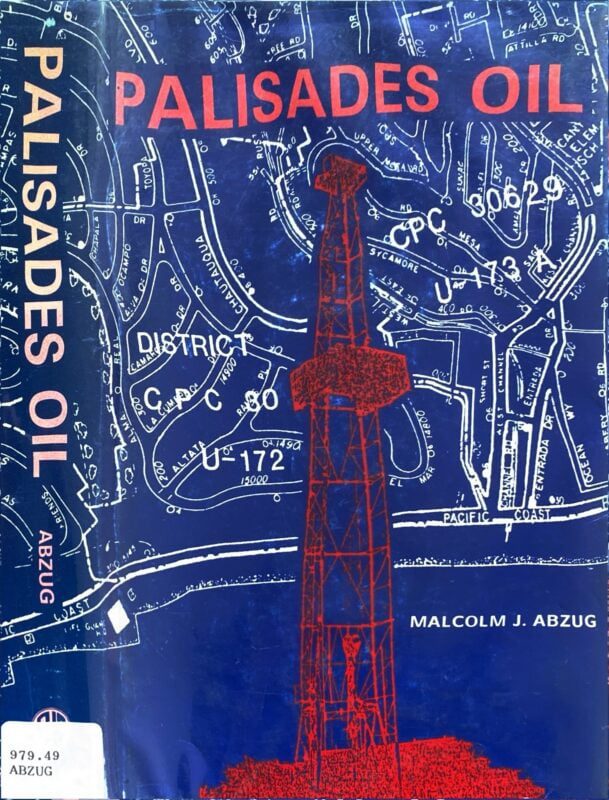
Palisades Oil by Malcolm J. Abzug documents a 22-year conflict that redefined environmental activism and civic resistance in Southern California. From 1966 to 1988, residents of Pacific Palisades mobilized against oil drilling proposals by Occidental Petroleum and Chevron. This prolonged struggle unfolded across courtrooms, city council chambers, and beachfront rallies, uniting neighborhood volunteers, celebrities, and city officials in one of the longest-running environmental resistance campaigns in Los Angeles history.
A deal struck in secrecy
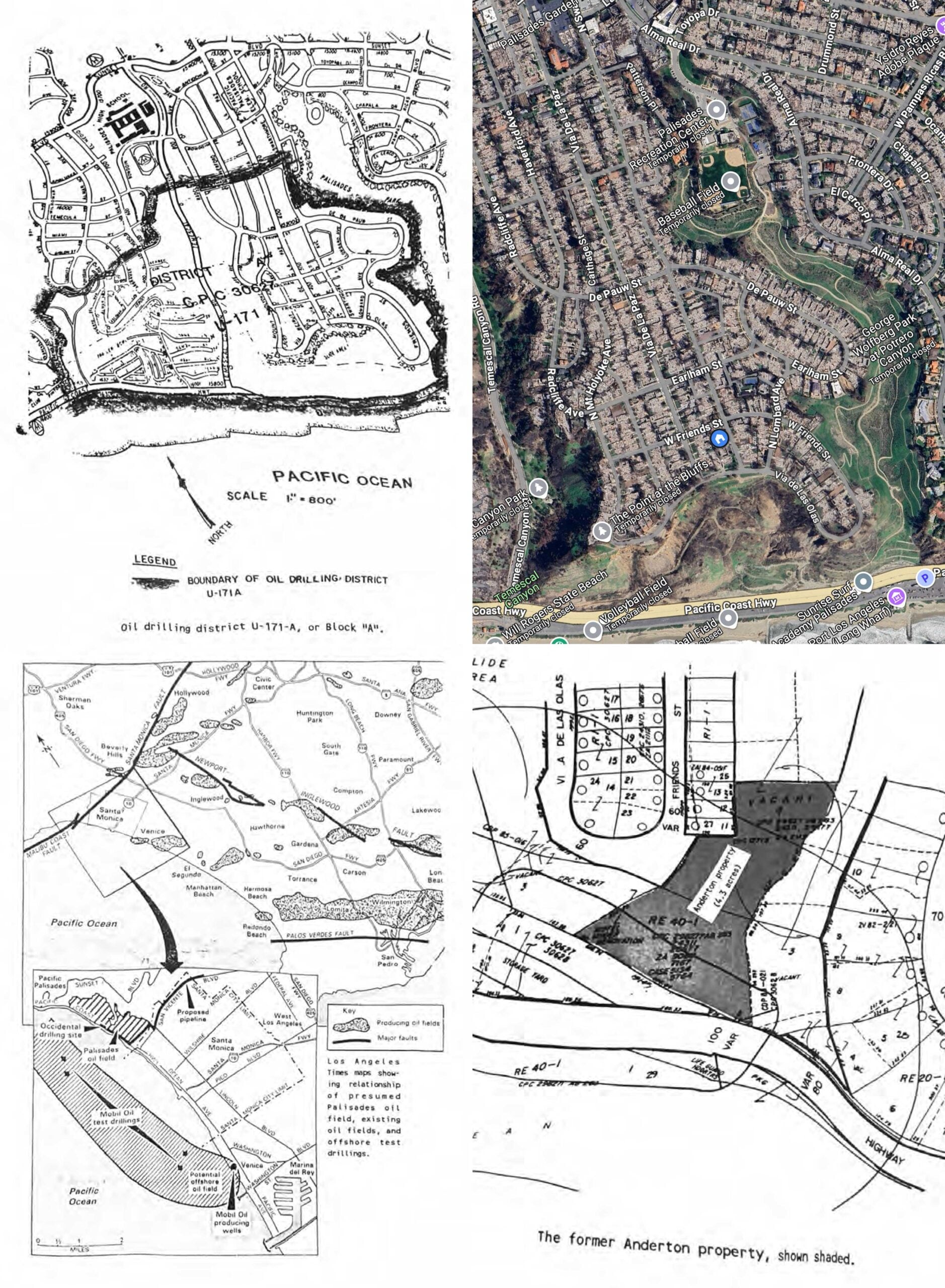
Occidental’s interest in drilling began with the acquisition of subsurface leases in 1965. Company representatives went door-to-door securing oil and gas rights from homeowners, offering cash incentives and minimal transparency. The real objective emerged in 1966 when OXY, through a front company, obtained an option on the Anderton property—a 4.3-acre parcel at the mouth of Potrero Canyon.
City records later revealed that OXY sought a land swap with the City of Los Angeles, trading its hillside Anderton site for a flat, two-acre parcel owned by the State but managed by the city’s Department of Recreation and Parks. This parcel, known as the “highway site,” had been part of the public trust since 1931, dedicated to park and recreation use. Yet by 1968, OXY secured a deed revision permitting oil drilling, under conditions the state’s own officials later claimed were misrepresented.
Who enabled the transfer? What commitments were implied? These questions drove the Los Angeles City Council’s Government Efficiency Committee to investigate. Their 1976 report identified possible conflicts of interest, including Mayor Sam Yorty's financial ties to Occidental. The committee exposed opaque dealings, unrecorded commitments, and planning maneuvers conducted outside the public eye. The swap, while legal, rested on a foundation of political pressure and selective disclosure.
Formation of the opposition
As the land transfer finalized in early 1969, opposition solidified. Local attorney Roger Diamond and concerned residents convened in March 1970, forming what became No Oil, Inc. Their first mass meeting drew hundreds to Palisades High School. The organization quickly gained traction, producing media campaigns, gathering signatures, and pressing for environmental review under the newly enacted California Environmental Quality Act (CEQA).
No Oil filed lawsuits, demanded Environmental Impact Reports (EIRs), and challenged every permit issued to Occidental. The group’s legal strategy complemented its public actions—yard signs, beach demonstrations, letter-writing campaigns. Their efforts forced OXY to submit multiple EIRs, each scrutinized for deficiencies. The state Supreme Court ruled in 1974 that the City had violated CEQA by approving drilling without environmental review, invalidating the ordinances that permitted drilling.
Environmental law in motion
The Palisades case became a proving ground for CEQA's power. Every phase—core sampling, dewatering, derrick construction—required separate permits, reviews, and often, litigation. The Coastal Commission’s jurisdiction over shoreline development added another layer. Opponents argued the project posed landslide risks and failed to address pipeline safety. In 1983, a major slide west of the proposed site disrupted traffic on Pacific Coast Highway, reinforcing these concerns.
The legal path zigzagged through appeals, reversals, and procedural battles. No Oil’s lawsuits challenged lease validity, permit compliance, and the adequacy of hazard mitigation. Courts intermittently sided with both factions, but the delays compounded Occidental’s costs and eroded lease coverage as property owners refused renewals. Each delay narrowed the company’s legal and practical maneuvering room.
Community organizing and cultural capital
The opposition drew strength from cultural capital. Pacific Palisades, home to prominent entertainment figures, supplied high-visibility support. Celebrities including Lloyd Bridges, Shirley MacLaine, and Robert Redford endorsed the cause. Fundraisers at local venues like Mort’s Delicatessen drew attention from citywide media. The campaign’s visuals—oil-soaked birds, pipeline warnings, human chains on the beach—embedded the issue into public consciousness.
Grassroots activism merged with institutional advocacy. Councilmembers like Marvin Braude and Zev Yaroslavsky championed No Oil’s position. City commissions found themselves divided, with some planning officials recusing over conflicts of interest, while others upheld pro-drilling stances. The contradictions within city governance mirrored the larger tension: who decides the future of coastal land use?
Three legislative rounds
Occidental’s application endured three full rounds of legislative review between 1970 and 1988. Each phase brought new ordinances, revised plans, and a cascade of hearings. The first round ended in 1974 with the state Supreme Court’s invalidation of drilling approvals. The second round climaxed in 1978 with a City Council vote in favor of drilling—later vetoed by Mayor Tom Bradley.
The third round began in 1980 with a new EIR and culminated in a dual ballot initiative campaign in 1988. Proposition O, backed by No Oil, sought to ban coastal oil drilling. Proposition P, funded by Occidental through a front committee, aimed to reinstate the 1985 drilling ordinances. Both appeared on the same ballot. Voters passed Proposition O with 52.3% support, rejecting P with only 34.3%.
Ballot box finale
The electoral contest required mass mobilization. No Oil operated phone banks, canvassed neighborhoods, and organized benefit events. Occidental invested heavily in advertising and slate mailers. Each side projected dueling visions—community preservation versus energy independence, environmental protection versus economic potential. In the end, voters sided with a precautionary principle: the risk of industrializing a landslide-prone coastal bluff outweighed the projected benefits.
After the election, Occidental pursued legal options but signaled retreat. The company’s 1989 asset sale announcement marked the beginning of its disengagement. In May 1991, Occidental’s CEO Ray Irani declared that the company would no longer pursue drilling in Pacific Palisades.
Strategic persistence
What sustained the opposition across two decades? A consistent structure. No Oil maintained records, coordinated legal counsel, cultivated political allies, and retained public attention. Each setback became a data point, each victory a precedent. The campaign demonstrated how community-based advocacy, grounded in detailed knowledge and procedural rigor, can counterbalance corporate scale.
Rather than a spontaneous protest, this was a methodical defense campaign. It used CEQA requirements as procedural levers. It aligned local concerns with legal thresholds. It translated emotion into organized resistance. The battle’s complexity—land deeds, zoning ordinances, pipeline hazards, seismic studies—demanded technical fluency. No Oil developed that fluency, meeting engineers and city planners on their own terms.
Lessons from a localized stand
Palisades Oil delivers more than a case history. It models how land-use disputes unfold through legal, political, and cultural domains. Malcolm J. Abzug, a participant-observer with extensive archival access, reconstructs each phase with precision. His narrative follows not just institutional decisions but human responses: how neighbors rallied, how officials chose sides, how activists sustained momentum across changing legal terrain.
This book sharpens understanding of how cities negotiate extractive industry proposals within urban settings. It shows how zoning law, environmental regulation, and public opinion intersect. It makes clear that once a community acquires procedural knowledge and strategic discipline, it can force recalibration—even from multibillion-dollar firms.
No Oil's victory came through attrition, public relations acuity, and timing. The campaign ended before drilling began, but only after years of legal entrenchment and ballot-driven affirmation. By documenting this in granular detail, Palisades Oil offers future activists a map of the terrain they may face, and a chronicle of one city's decision to protect its coastline from irreversible change.
The book is available at the Santa Monica Library.

About the Book