The First Professional Revolutionist: Filippo Michele Buonarroti, 1761–1837
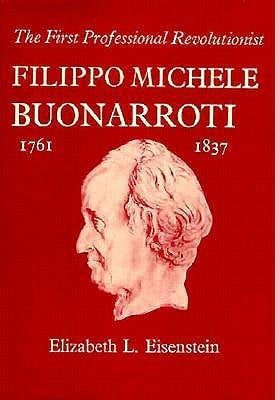
The First Professional Revolutionist by Elizabeth L. Eisenstein traces the long and intricate career of Filippo Michele Buonarroti, revealing how one man pioneered the role of revolution as a full-time occupation. Through archival analysis and interpretative narrative, Eisenstein establishes Buonarroti as a foundational figure in the development of the professional revolutionary, a vocation that redefined the architecture of modern political movements.
Revolution as a Career
Filippo Buonarroti was not a figure shaped by revolutionary circumstance. He fashioned revolution into a deliberate career. Born into a patrician family in Pisa in 1761, Buonarroti received an elite education and entered early adulthood poised for advancement within traditional institutions. He rejected that path. Inspired by Rousseau, he aligned his life with a vision of radical egalitarianism. By 1787, he edited anti-monarchical journals in Florence and risked expulsion for defending the Dutch Patriots against their ruling Stadtholder.
His relocation to Corsica in 1789 marked the beginning of active revolutionary engagement. Buonarroti implemented Republican reforms, dismantled clerical hierarchies, and tested the methods of political transformation. His administrative service for the French Republic in Corsica and later in Oneglia exposed him to governance under ideological pressure. He forced implementation of egalitarian decrees among unwilling populations, and he learned to synchronize revolutionary goals with institutional instruments.
The Institutionalization of Dissent
When the French Revolution turned against its own, Buonarroti refused to adapt. He maintained loyalty to Robespierre’s Republic of Virtue. The Thermidorian Reaction did not temper his convictions. His arrest and imprisonment at Plessis in 1795 placed him among other disillusioned Jacobins, including Gracchus Babeuf. Their shared incarceration catalyzed a new form of activism—clandestine, conspiratorial, and perpetual. The prison became an incubator for a permanent revolutionary cadre.
The result was the Conspiracy of Equals. Buonarroti emerged as one of its architects. With Babeuf and others, he sought to organize a coup against the Directory, envisioning a restoration of the Constitution of 1793 and the communal ideals of Rousseau and Mably. The plot failed. Babeuf was executed. Buonarroti was imprisoned again.
Ideological Continuity Through Subterranean Networks
After his release, Buonarroti resumed work in secrecy. He embedded revolutionary ideals into clandestine structures that transcended national boundaries. He helped develop proto-communist cells across Italy and France. He coordinated with Dutch Jacobins, corresponded with Spanish radicals, and mentored younger conspirators. He maintained a disciplined belief in revolutionary inevitability, even as political landscapes fractured.
He did not treat defeat as a rupture. Each failure deepened his commitment. Each betrayal refined his strategy. From exile, he distributed ideological tracts, formed secret societies modeled on Masonic structures, and elevated conspiracy into an operational principle. His life became an institutional scaffold for underground resistance.
Revolution as Sacred Discipline
Buonarroti regarded the revolutionary project as a moral and spiritual duty. He built its framework with liturgical precision. His vision emphasized sacrifice, anonymity, and submission to collective will. He rejected public acclaim. He celebrated civic virtue, censured indulgence, and promoted revolutionary asceticism. His personal life mirrored these values. He lived modestly, taught music to survive, and directed funds toward political work.
He never held office after the 1790s, but he shaped political generations. Through correspondence, mentorship, and clandestine doctrine, he influenced figures like Blanqui and Mazzini. He bridged the Jacobin legacy with emerging socialist frameworks, not by adaptation, but through rigid preservation. He fossilized the idea of a revolutionary elite—bound by oath, hidden from public view, committed to long-term transformation.
Print as Weapon
In 1828, he published History of Babeuf’s Conspiracy for Equality. It was a tactical move. The book preserved the ideological purity of the Babeuf plot while disguising its author’s continued activity. It read as historical testimony. It functioned as political manifesto. It circulated among radicals, was translated into multiple languages, and seeded conspiracies across Europe.
The book did not analyze events with detachment. It sanctified them. Buonarroti converted failure into doctrinal foundation. He portrayed Babeuf as martyr and the plot as the blueprint for future movements. He framed the conspirators as architects of a coming egalitarian order, whose failure was temporary, whose method was reproducible, whose cause was immortal.
Convergence in the 1830s
The July Revolution in France revived Buonarroti’s operational relevance. He returned to Paris. He joined secret societies, advised insurrectionists, and coalesced veteran conspirators around a new revolutionary network. He introduced young radicals to the traditions of 1793. He initiated them into the methods of secrecy, loyalty, and ideological clarity.
He cultivated three protégés—Charles Teste, Adrien d’Argenson, and François Gracchus Buonarroti (his assumed spiritual heir). Together, they developed the foundations of a revolutionary trinity: organizational hierarchy, ideological fidelity, and operational secrecy. They viewed the state as structurally unjust and revolution as the only path to social regeneration.
He did not need to lead uprisings. He planted their premises. During the insurrections of the 1830s, Buonarroti’s societies supported republican barricades in Lyon and Paris. They failed to seize power but succeeded in asserting the presence of an underground order that refused integration, disdained compromise, and awaited catalytic opportunity.
Death Without Retirement
Buonarroti died in 1837. He left no wealth, no office, no institutional title. He left blueprints, disciples, and a durable method. His funeral attracted veterans and neophytes, both silent and conspicuous. They carried forward his doctrines, replicated his organizational forms, and preserved his texts as sacred instructions.
He did not invent class struggle or utopian socialism. He constructed the role that turned ideology into occupation. He made permanent opposition a viable life path. He structured revolution as a vocation. He demanded from followers the surrender of personal ambition to collective purpose.
Legacy and Structural Inheritance
Buonarroti’s significance lies not in isolated acts but in systematized behavior. He forged the professional revolutionary as a functionary of long-term destabilization. He created habits, networks, and rituals that shaped radical practice into the late nineteenth century. His influence operated through repetition. He canonized failure as rehearsal. He institutionalized exile as continuity. He configured secrecy as permanence.
His organizational forms reappeared in the Société des Saisons, in Mazzinian networks, and in Blanquist conspiracies. His ideological matrix informed the vocabulary of early communism. His memoir of the Babeuf conspiracy served as political scripture. His conception of revolution defined action as obedience, identity as role, and life as doctrine.
Strategic Importance of Biographical Focus
Eisenstein focuses not on the events but on the man who lived through them with unbroken intensity. She constructs a biography that shows how individual continuity stabilizes ideological turbulence. She positions Buonarroti not as a historical footnote to Robespierre or Babeuf, but as the operator who maintained the integrity of revolutionary vision across decades of betrayal, defeat, and distraction.
This is a study in political resilience. Buonarroti aligned thought with action, scaled conspiracy to strategy, and extended rebellion beyond spontaneous explosion into durable form. Eisenstein captures the architecture of that extension.
Search Performance Optimization
The First Professional Revolutionist by Elizabeth L. Eisenstein ranks as an essential resource for understanding the origin of the professional revolutionary model in modern European politics. The book contextualizes Filippo Buonarroti’s influence on clandestine activism, his direct impact on movements from the 1790s through the 1830s, and his long-term legacy across radical networks. It appeals to researchers, students, and readers interested in revolutionary history, political organization, and the evolution of socialist thought. With clear narrative structure, rigorous sourcing, and analytical insight, this biography provides the definitive account of how one man transformed dissent into disciplined vocation.

About the Book