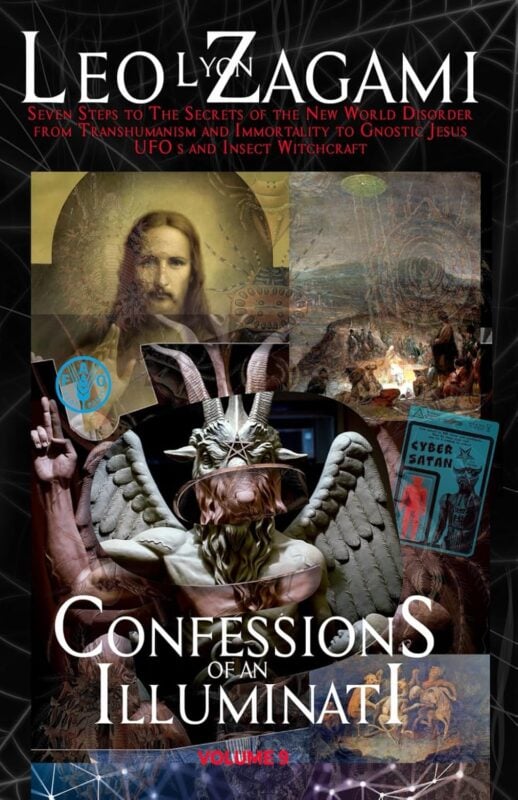
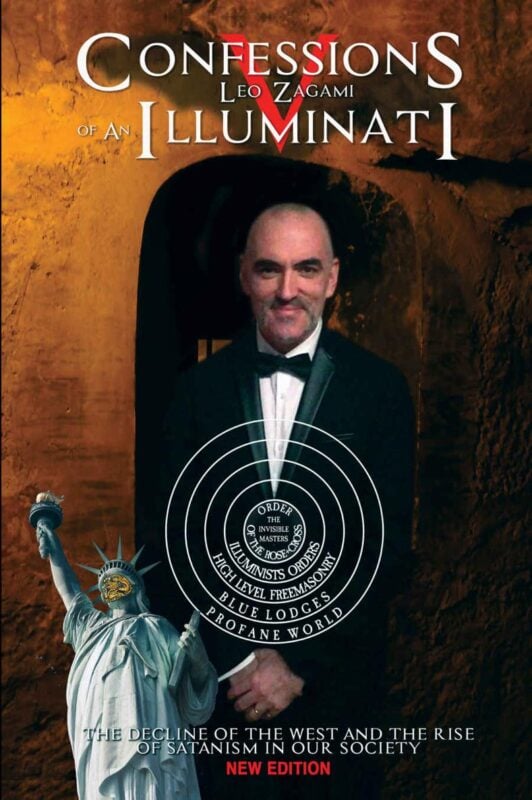
Confessions of an Illuminati Volume 8: From the Rise of the Antichrist To the Sound of the Devil and the Great Reset

Confessions of an Illuminati Volume 8: From the Rise of the Antichrist To the Sound of the Devil and The Great Reset by Leo Lyon Zagami contends that powerful occult forces shape culture and consciousness through Hollywood, music, and covert manipulation, forging the conditions for a profound spiritual and societal transformation. Zagami writes from direct experience within secret societies and the entertainment industry, presenting a unified narrative in which cultural history, esoteric knowledge, and modern technology converge to serve a coordinated elite agenda.
The Architecture of Hollywood’s Hidden Power
Hollywood forms a living monument to occult engineering. Zagami traces its history to the emergence of American cinema in the early twentieth century, grounding the industry’s rise in the strategic calculations of Masonic lodges and secret societies. The city’s symbolic geography, from the stars on its sidewalks to its legendary “Two-Hour Rule” devised for studio actors, reflects an intricate web of ritual, power, and compliance. The book connects the city’s golden era to figures such as D. W. Griffith, whose filmic innovations and affiliations intersected with occult experiments occurring simultaneously across the Atlantic, notably those of Aleister Crowley and his ritual work in Algeria and London.
Palm Springs emerges in the author’s narrative as a desert enclave for elites—both sanctuary and command post. Zagami details how actors, musicians, and powerful producers, lured by a proximity mandate, formed enclaves that functioned as both escape and strategic reserve. Within this ecosystem, rituals, relationships, and silent allegiances unfolded far from public scrutiny, shaping the social DNA of American entertainment.
Music, Frequency, and the Mechanics of Control
The book asserts that the standardization of music at 440 Hz, imposed internationally by the ISO and initially driven by the American and Nazi establishments, constitutes a deliberate mechanism of psychological manipulation. Zagami draws on musicology, history, and testimony from key figures to claim that the shift from the so-called “Verdi’s A” at 432 Hz to 440 Hz interrupts natural resonance, weakens human connection to higher spiritual order, and generates subtle agitation and social discord.
Pythagoras and Guido d’Arezzo enter the narrative as foundational figures who uncovered music’s esoteric structure. Their discoveries, appropriated and redirected by later elites, provide the conceptual scaffolding for a world in which music can either heal or control, depending on its tuning and context. The history of tuning forks, the transmission of musical notation, and the symbolic power of the number seven unfold as the groundwork for a system vulnerable to co-option.
Why did the Nazis, under Goebbels, insist on 440 Hz as standard? Zagami identifies a pattern in which powerful actors leverage technical and bureaucratic decisions to enact broad psychospiritual effects, bypassing public scrutiny. The alignment between wartime propaganda, Rockefeller Foundation initiatives, and the Vatican’s strategic interventions creates a causal chain that privileges manipulation over artistic authenticity.
Mind Control and Modern Technology
Zagami integrates the research of figures like Dr. Leonard Horowitz and cites real-world examples—such as the mind-control experiments at the Tavistock Institute and the MKUltra program—to assert the existence of a coordinated campaign for mass brainwashing. He discusses the rise of technologies that use sound waves and electromagnetic frequencies to modulate consciousness. The narrative cites declassified documents, such as the infamous FOIA releases describing “Psycho-Electronic Weapon Effects,” mapping how sonic, visual, and electronic interventions produce profound changes in brainwave activity.
Within this schema, the alpha and theta states induced by television and music function as gateways for subconscious reprogramming. The author explains the process: as the mind relaxes into these frequencies, critical resistance diminishes and suggestion penetrates deeply, fostering compliance, addiction, and a gradual alignment with imposed cultural narratives.
Satanism and the Culture of the Occult
The book contends that Satanism, far from an isolated phenomenon, saturates the entertainment industry. Through symbolic analysis and case studies, Zagami demonstrates how occult themes, rituals, and language pervade pop music, movies, and even children’s entertainment. Hollywood, as an extension of esoteric orders, channels these motifs to foster nihilism, hedonism, and spiritual confusion.
Aleister Crowley receives sustained attention as a seminal architect of the occult revolution in art and culture. Zagami dissects Crowley’s legacy, linking his rituals to the emergence of rock music’s “egregore” and the normalization of themes such as transgression and chaos. The Ordo Templi Orientis, for which Crowley composed the Gnostic Mass, is placed at the heart of this transformation, with Hollywood functioning as the Vatican of infernal propaganda.
Disney, Club 33, and the Machinery of Initiation
Zagami devotes significant attention to Walt Disney and his empire, identifying Disneyland’s Club 33 as a locus of secret networking and Masonic symbolism. He provides evidence of Disney’s collaboration with federal agencies and highlights the industry’s role in reinforcing ideological compliance. Club 33, its exclusivity, and its coded associations with the 33rd degree of Freemasonry illustrate the permeation of occult hierarchies into the fabric of family entertainment.
The text draws further connections to Nazi propaganda, noting that Disney invited Leni Riefenstahl, Hitler’s favorite filmmaker, to Hollywood at the outbreak of World War II. These convergences, for Zagami, signal an unbroken lineage of influence spanning secret societies, intelligence agencies, and corporate media.
The New World Order and Spiritual Warfare
At the core of Zagami’s thesis lies the assertion that a coordinated elite—comprising the Rockefeller Foundation, Jesuit orders, Sabbatian Frankists, and financial powerhouses—shapes culture to prepare the world for the advent of the Antichrist. The manipulation of sound, image, and symbol, when aligned with technological advances in neuromodulation, enables these elites to guide the development of society toward what Zagami describes as the “End Times.”
The Rockefeller Foundation, for example, receives sustained scrutiny for its funding of the Tavistock Institute and its influence on medical, pharmaceutical, and cultural policies. Through institutional power, this network enacts what Zagami describes as “flattening” and “framing” of cultural experience, creating a population more susceptible to external command.
From the normalization of violence and hypertransgression in entertainment to the diffusion of nihilistic philosophies espoused by figures like Aleister Crowley and Paulo Coelho, the author charts a steady progression toward a culture conditioned to accept materialism, moral relativism, and spiritual defeat.
Neuromodulation, Mind Control, and the Ethics of Power
The book scrutinizes recent developments in neuromodulation and the use of sound waves for direct brain control. Citing Oxford University professor Antoine Jérusalem, Zagami explores the dual-edged nature of technologies capable of both curing disease and controlling the mind. The author presents these advances as both opportunity and existential threat, arguing that in the hands of unaccountable elites, they provide the means for direct, literal control of perception and thought.
Zagami also references electromagnetic harassment cases, such as the “Havana Syndrome” experienced by American diplomats, as well as experiments documented during the Cold War, including the “Frey effect,” which allows microwaves to induce auditory hallucinations and even implant words in the mind.
Egregores, Ritual, and the Battle for the Soul
Central to Zagami’s framework is the concept of the “egregore”—a collective thought-form generated through ritual, repetition, and mass experience. The book explains how music, especially when tuned to 440 Hz, amplifies and broadcasts egregores aligned with control and dissolution. Television, film, and music function as rituals in their own right, entraining the public in states of suggestibility and compliance.
The rise of social media platforms such as TikTok, for the author, marks a new phase in this spiritual contest. The acceleration and ubiquity of influence bypass traditional safeguards, reaching children and young adults during the most malleable phases of development. The text asserts the necessity for early, conscious intervention to counteract this drift, positing parental and educational vigilance as the primary defense against spiritual and psychological colonization.
Cultural and Spiritual Consequences
Zagami describes the social and psychological fallout of this coordinated manipulation: the fragmentation of tradition, the erosion of stable identities, the glorification of crime and nihilism, and the commodification of body and soul. By weaving together case studies such as the mafia’s influence on the Godfather trilogy, the propagation of Italian gangster culture through series like Gomorra, and the normalization of violence in global entertainment, he builds a cumulative argument that contemporary culture has become a battlefield for the soul.
The closing argument demands recognition of the stakes. Awareness and knowledge, especially when grounded in esoteric and vibrational realities, form the only bulwark against manipulation. The cultivation of discernment, both spiritual and cultural, becomes essential for survival in an environment engineered to condition, divide, and ultimately dissolve resistance.
Convergence of Art, Power, and Esotericism
Throughout the book, Zagami interlaces biographical detail—his experiences as a record producer, DJ, and researcher—with historical and esoteric analysis. He shows how the entertainment industry operates at the intersection of artistry, propaganda, and spiritual warfare. By uncovering hidden affiliations, ritual structures, and the manipulation of frequency and symbol, he exposes a dynamic system of control that continually adapts to new technologies and social forms.
The synthesis of occult history, technological advancement, and institutional power defines the argument’s structure. Instead of seeking isolated villains or episodic conspiracies, Zagami posits a coherent logic in which the architecture of the entertainment industry, the evolution of media technology, and the spread of occult symbolism manifest as expressions of a deeper spiritual contest.
The Endgame and the Path to Liberation
The narrative culminates in a call to vigilance, education, and spiritual resistance. Zagami challenges readers to cultivate the knowledge necessary to discern manipulation, resist spiritual dissolution, and reclaim the autonomy of mind and soul. The text claims that through mastery of vibrational realities and esoteric traditions, individuals can resist the conditioning imposed by the occult machinery of entertainment.
What lies at the intersection of culture, technology, and spiritual warfare? Zagami answers: the opportunity for awakening. The recognition of patterns, symbols, and frequencies that shape consciousness becomes both a tool and a responsibility. The book stands as a manifesto for those who seek to understand and transform the hidden structures governing contemporary life.

About the Book