Pope Francis: The Last Pope?: Money, Masons and Occultism in the Decline of the Catholic Church
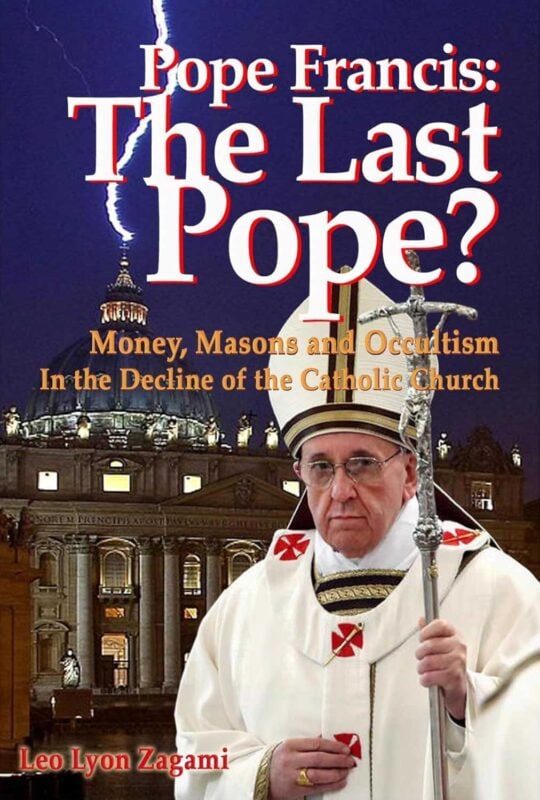
Pope Francis: The Last Pope? by Leo Lyon Zagami and Brad Olsen examines the rise of Jorge Mario Bergoglio amid one of the most tumultuous periods in the Vatican’s modern history. The authors follow the arc of Francis’s papacy from its origins in resignation and crisis to its deep entanglement with allegations of financial crimes, secret societies, and global prophecy. The book scrutinizes both the visible actions and the concealed motives of those steering the Catholic Church, raising urgent questions about the institution’s trajectory and the forces shaping its future.
Resignation, Crisis, and Papal Succession
On February 11, 2013, Pope Benedict XVI announced his resignation, sending shockwaves through the Catholic world. The event echoed the resignation of Celestine V in 1294 and set the stage for what the authors depict as a calculated intervention in Vatican history. The text asserts that power struggles within the Roman Curia, pressure from secretive cliques, and mounting scandals forced Benedict’s departure. The election of Bergoglio, a Jesuit from Buenos Aires, occurred in this context, and the authors chart the implications for the Church’s internal stability.
The narrative draws a parallel between Bergoglio’s rise and the elevation of a crisis manager—a figure brought in to restore institutional order amid widespread chaos. This analogy evokes the appointment of Vladimir Putin as the head of post-Soviet Russia, suggesting that Francis’s mandate centers on crisis management rather than spiritual renewal. The Vatican’s decision-makers, according to Zagami and Olsen, selected Francis to salvage the institution’s credibility and shield it from further damage.
Scandal and the Struggle for Credibility
The authors recount the emergence of explosive allegations of sexual abuse, financial corruption, and organized blackmail within the Vatican hierarchy. High-profile figures, including Cardinal Tarcisio Bertone and others connected to the Vatican Bank (IOR), appear as central actors in these scandals. Testimonies from whistleblowers, such as Francesco Zanardi and anonymous insiders, describe elaborate systems of abuse, prostitution rings, and systematic cover-ups involving clergy and external accomplices.
The text connects these revelations to a broader crisis of trust, in which the Church’s leadership prioritizes institutional image over justice for victims. The authors catalogue media investigations, police actions, and court filings that trace the persistence of abuse and the impunity granted to perpetrators. As the authors describe it, these scandals do not arise in isolation but converge through networks of influence, loyalty, and shared interests across clerical and lay elites.
Networks of Power: Freemasonry, Illuminati, and Financial Manipulation
The book devotes significant attention to the role of secret societies and clandestine alliances in Vatican affairs. Zagami, drawing on his background and sources, asserts that Masonic lodges, Illuminati groups, and the Knights of Malta exert substantial influence over the Church’s highest echelons. These groups use financial leverage, blackmail, and political strategy to shape outcomes within the Vatican, especially in times of crisis.
The Vatican Bank, or Istituto per le Opere di Religione (IOR), serves as a focal point for the intersection of financial crime and secret power. According to the authors, money laundering, illicit asset transfers, and manipulation of real estate deals have transformed the IOR into a hub for clandestine activity. Key appointments, such as those of Ernst von Freyberg and Jean-Baptiste de Franssu, illustrate the continuity of these networks and their ability to adapt under different pontificates.
Media, Manipulation, and the Battle for Narrative Control
Zagami and Olsen dissect the relationship between the Vatican and mainstream media, arguing that coverage of Church scandals often vacillates between sensational exposure and abrupt retraction. The authors provide instances where media outlets—after releasing damning reports—issue clarifications or withdrawals, often under pressure from Church authorities or their affiliates. The book contends that the Vatican’s communications apparatus leverages its global reach to suppress damaging stories and manage public perception.
The text tracks high-profile cases, such as the Vatileaks scandal and the prosecution of whistleblowers, to demonstrate how the institution preserves its authority. The authors highlight the risks faced by journalists, activists, and insiders who challenge the Church’s official narrative, citing incidents of intimidation, surveillance, and retaliation. In this environment, transparency becomes a contested terrain, and the stakes for truth-tellers intensify.
Prophecy, End Times, and the Symbolism of the Last Pope
Woven throughout the narrative are references to Catholic prophecy, particularly the “Prophecy of the Popes” attributed to Saint Malachy. This centuries-old text, popularized in apocalyptic discourse, lists a succession of popes culminating with “Peter the Roman,” who would preside during the destruction of Rome. The book situates Francis as the 112th pope in this sequence, drawing connections to broader eschatological themes and the anxieties of global Catholicism.
The authors argue that the convergence of institutional crisis, leadership transition, and mounting external threats lends urgency to these prophetic frameworks. By foregrounding these narratives, the book contends that the Vatican’s current predicament cannot be disentangled from questions of spiritual destiny and historical culmination. The framing of Francis as the “last pope” generates both fascination and foreboding, catalyzing debates about the future of the Church and its global mission.
Whistleblowers, Victims, and the Demand for Justice
The narrative foregrounds the voices of victims, activists, and those who risk personal safety to expose abuse within the Church. Individuals like Francesco Zanardi, who documents sexual violence through his association “network abuse,” emerge as key agents in challenging the Vatican’s culture of secrecy. The text describes the threats, intimidation, and violence directed at those who break silence, underscoring the institutional resources mobilized to stifle dissent.
Court filings, police investigations, and international advocacy by groups such as SNAP (Survivors Network of those Abused by Priests) enter the story as mechanisms for seeking justice beyond the Vatican’s control. The book chronicles efforts to bring Church leaders to account, including filings before the International Criminal Court and public campaigns targeting key officials. Despite these interventions, the authors observe entrenched resistance within the Vatican to systemic reform or meaningful accountability.
Reform, Resistance, and the Limits of Papal Authority
Pope Francis, according to the authors, faces immense obstacles in pursuing substantive reform. Public gestures, such as the arrest of Archbishop Jozef Wesolowski or apologies for past abuses, signal a willingness to address longstanding issues. Yet the book maintains that entrenched interests, internal lobbies, and the enduring culture of secrecy dilute the impact of these measures. The text catalogues moments where Church authorities prioritize reputation over substance, orchestrating public relations campaigns while resisting deep structural change.
Appointments of trusted Jesuit allies, efforts to revise Vatican financial statutes, and rhetorical commitments to transparency suggest incremental progress. However, the authors identify a pattern in which genuine accountability remains elusive, especially for powerful insiders. The Church’s survival strategies rely on adaptability and selective self-correction, rather than the root-and-branch transformation advocated by critics and victims’ advocates.
Convergence of Crisis: The Vatican’s Precarious Future
The cumulative effect of overlapping scandals, power struggles, prophetic anxieties, and external pressures creates a landscape of convergence within the Vatican. The book suggests that the Church’s future hinges on its capacity to respond decisively to these intersecting challenges. Questions arise: What compels the institution to defend itself at such cost? Who stands to benefit from the preservation of the status quo? Which actors possess the leverage to drive lasting reform?
As the narrative advances, evidence of interconnected networks—financial, spiritual, and conspiratorial—emerges with increasing clarity. The Church functions as both a global spiritual community and a locus of political intrigue, where the stakes of leadership selection and institutional continuity reverberate far beyond Rome. In this setting, the actions of Pope Francis acquire heightened significance, with each decision interpreted through layers of history, prophecy, and power.
Global Implications and the Role of Faith
The authors contend that the Vatican’s internal crises possess global implications, affecting not only Catholics but societies grappling with the legacy of clerical abuse, financial secrecy, and transnational influence. The Church, as steward of immense resources and spiritual authority, exerts pressure on political, economic, and cultural systems worldwide. The text points to recent initiatives—such as interfaith dialogues and outreach to marginalized communities—as efforts to reframe the Vatican’s role on the world stage.
The persistence of faith among ordinary Catholics, despite institutional failures, sustains the Church’s presence in diverse contexts. The narrative acknowledges the dedication of many within the Church who seek renewal and justice, even as leadership falters. The possibility of transformation rests on the convergence of internal courage, external pressure, and the willingness of authorities to confront the full scope of the institution’s challenges.
Final Reflections: The Burden of Secrecy and the Path Forward
Pope Francis: The Last Pope? frames the contemporary Vatican as an institution encumbered by secrecy, struggling to reconcile its spiritual mission with the demands of modern governance and accountability. The authors urge transparency, courage, and a reckoning with the full truth of the Church’s history. They argue that the risks undertaken by whistleblowers, journalists, and victims constitute acts of moral leadership, pressing the Church toward a more just and open future.
The narrative concludes by situating the papacy of Francis within a pivotal moment—a juncture marked by unresolved crisis and profound opportunity. The convergence of scandal, prophecy, and reform attempts generates a climate of uncertainty, yet also possibility. The book insists that the Vatican’s next steps will determine not only its survival as a religious institution but its capacity to embody the values it professes before a watching world.