Trial and Error : The Autobiography of Chaim Weizmann
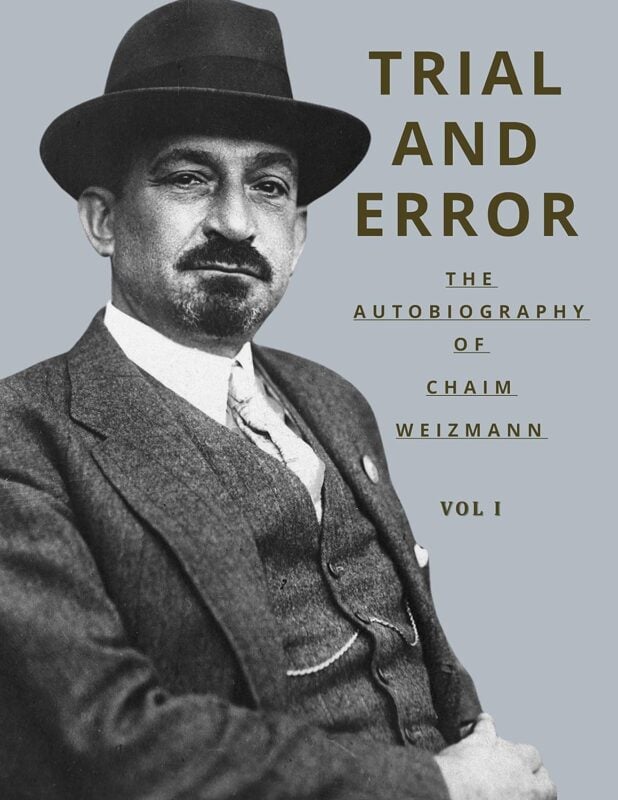
Trial and Error: The Autobiography of Chaim Weizmann recounts the life of the first President of Israel, tracing his journey from a small town in White Russia to international prominence as a scientist and Zionist leader. Weizmann frames his early identity through landscape and culture, describing Motol not merely as geography but as spiritual topography, a point of departure embedded with ritual, scarcity, and ambition.
Early Landscapes and Cultural Formation
Motol sits within the Pale of Settlement, a geographic restriction and ideological boundary imposed on Jews in czarist Russia. Life unfolds in wooden houses, muddy roads, and seasonal isolation. Yet Weizmann’s memories reveal a community suffused with resilience. Family structures hinge on oral history, religious ritual, and economic survival. His father, a timber transporter, commands not wealth but stature through learning and character. His mother bears fifteen children with elemental patience, embodying a form of maternal leadership rooted in continuity and protection.
Education begins in the cheder, a world of rote learning, harsh discipline, and spiritual aspiration. Weizmann endures the physical cold and emotional pressures of a system designed more to preserve than to awaken. Yet a second teacher ignites his intellectual desire through Hebrew scripture, threading prophecy into imagination. The introduction of a Hebrew textbook on natural science marks an inflection point—an opening toward modern inquiry veiled as tradition.
Pinsk and the Expansion of Consciousness
Leaving Motol for Pinsk at age eleven, Weizmann enters a larger Jewish world. The city pulses with Zionist beginnings, revolutionary whispers, and cultural awakenings. He joins the Real-Gymnasium, a Russian high school governed by official suspicion and cultural exclusion. The numerus clausus sharply limits Jewish enrollment. Access becomes a function of bribery or chance. Yet inside this limitation, Zionist fervor coalesces. The contradiction between formal repression and informal flourishing sharpens Weizmann’s political sensibility.
A chemistry teacher named Kornienko transforms his intellectual trajectory. Kornienko builds a laboratory within the constraints of an empire hostile to Jewish advancement. Through hands-on science, Weizmann discovers not only methodology but purpose. Science becomes a domain of certainty amid systemic fragility. It offers a form of power rooted in knowledge, verifiable through experiment, and applicable across borders.
Zionism and the Internal Revolution
While science shapes his analytical mind, Zionism forms his moral and strategic orientation. The pogroms of 1881 and the May Laws of 1882 mark a collective descent. Emigration becomes a form of despair. But within the intellectual households of Pinsk, Weizmann encounters an alternative: a proactive nationalism rooted in historical memory and political clarity.
He engages with the early Chibath Zion movement, attending readings, joining discussions, absorbing the fervor of Reb Dovidl Karliner and others who connect biblical yearning with tactical preparation. The dream of returning to Palestine shifts from eschatology to strategy. Youth groups meet in secret, blending study with vision. The Hebrew language becomes not only a subject but a tool of reconstruction.
Family, Identity, and Resistance
The Weizmann household operates as a microcosm of Jewish diversity. One brother embraces socialism, another pursues commerce, and the home itself welcomes revolutionaries, assimilationists, and traditionalists. Arguments unfold in Hebrew, Russian, and Yiddish. Bookshelves hold Maimonides, Tolstoy, Zionist periodicals, and science texts. Weizmann moves through these contradictions without fracture, learning to listen, defend, and synthesize.
His mother navigates the ideological storms with grace and resolve. She prays in Hebrew, hosts radicals, and preserves unity across philosophical divisions. Her kitchen feeds the debates. Her faith anchors the volatility. Through her, Weizmann sees that leadership requires endurance before authority.
Scientific Ascent and Political Strategy
Science draws him westward. He leaves Russia to study in Germany, where the methodological precision of chemical research sharpens his discipline. Unlike the coercive learning of the Pale, the laboratories of Western Europe operate through merit. He earns respect not by lineage but by experiment. This experience cements his belief in the compatibility of Jewish survival and scientific modernity.
His research in synthetic chemistry—particularly on fermentation and acetone—gains him prominence. But he never separates science from strategy. He envisions a Zionist future built not only on ancient dreams but modern infrastructures: agriculture, industry, education. In every discovery, he sees application to statehood.
War, Diplomacy, and the Balfour Declaration
World War I offers unexpected openings. The British war effort suffers from a shortage of acetone, a vital component in munitions. Weizmann provides a solution through a biochemical process. This contribution elevates him from academic to strategic asset.
Simultaneously, he advances Zionist goals. The British seek post-war allies. Weizmann leverages his scientific utility into political influence. Through calculated diplomacy, he builds relationships with figures like Arthur Balfour. His advocacy frames Zionism not as religious mysticism but as a viable policy. He presents the Jewish homeland as aligned with British imperial interest.
The Balfour Declaration of 1917 emerges from this convergence. Britain publicly supports the establishment of a Jewish national home in Palestine. Weizmann recognizes the fragility of declarations without infrastructure. He works to translate promise into presence.
Mandate Realities and Institutional Building
Postwar realities require implementation. Weizmann leads commissions to Palestine. The land, language, and logistics offer resistance. Arab opposition grows. British commitments waver. Zionist factions clash over priorities. Yet Weizmann persists. He advocates for science, education, and economic development as the foundation for sovereignty.
He helps establish the Hebrew University in Jerusalem. He supports the Jewish Agency as a quasi-governmental body. Each institution reflects his dual allegiance: to knowledge and to nationhood. Political setbacks—White Papers, riots, and diplomatic betrayals—punctuate his leadership. Still, he affirms that the return to Zion demands strategy, sacrifice, and stamina.
Statehood and Presidential Role
As World War II devastates European Jewry, Weizmann presses for rescue, migration, and state recognition. British resistance hardens. American support grows. In 1948, the State of Israel is declared. Weizmann, now in his seventies, becomes its first President.
His presidency is ceremonial, but his legacy is operational. He has laid the scientific, diplomatic, and ideological foundations of the state. He views statehood as both culmination and inception. The book ends not in triumph but in reflection—on the cost, the continuity, and the moral claims of Jewish sovereignty.
Legacy and Structural Impact
Trial and Error defines leadership as the convergence of insight, resilience, and adaptation. Weizmann does not offer nostalgia. He documents rupture, transformation, and iteration. He frames Zionism as both ancient will and modern response. His life argues that Jewish survival requires agency, that belief must manifest through institutions, and that history bends through initiative.
He anchors Jewish identity in action—building schools, laboratories, and diplomatic pathways. He shows that vision without execution recedes into longing. Across every stage, from cheder to chemistry lab to presidential office, he insists that history yields only to those who prepare its foundations.
How does a child from Motol become a statesman in Jerusalem? Through a life calibrated by structure, ignited by belief, and executed through persistent construction. This is not a journey of escape. It is an ascent rooted in deliberate architecture, each layer reinforcing the next.

About the Book